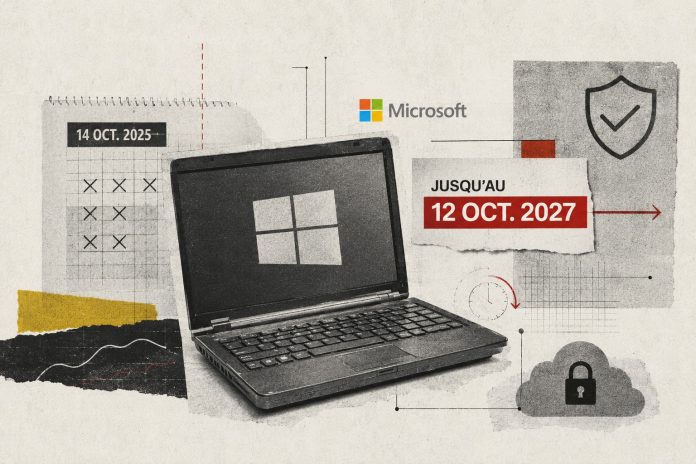
To avoid being accused of abandoning Windows 10 users after official support ends on October 14, 2025, Microsoft has announced an extension of access to its Extended Security Updates (ESU) program until October 12, 2027. Initially, the company offered free access to those willing to back up their data with Microsoft, while the alternative involved a fee of $30. However, in the European Economic Area, Microsoft was compelled to remove this condition following intervention from consumer organizations.
Microsoft had long announced the termination of Windows 10 support, stating that on October 14, 2025, the operating system would stop receiving security updates under standard support. For organizations not transitioning to Windows 11 due to hardware limitations or time constraints, the ESU program remains the only option. ESU provides critical and important security updates, validated by the Microsoft Security Response Center, for devices running Windows 10 version 22H2. It’s important to note that the ESU program is strictly focused on security; it does not offer new features, quality fixes, or technical support.
The public ESU webpage now outlines three avenues for coverage that will continue until October 12, 2027. The first option involves backing up PC settings to a Microsoft account, which is presented as free. The second alternative consists of redeeming 1,000 points from the Microsoft Rewards program. Lastly, the third option is a one-time purchase of $30, or its equivalent in local currency, which applies to up to ten devices linked to the same account. All three choices provide identical coverage and expiration dates.
A Support End That Encourages Hardware Renewal
For months, Microsoft portrayed the end of Windows 10 support as a compelling reason to upgrade to Windows 11 or opt for new Copilot+ PCs. The hardware requirements for Windows 11, especially the TPM 2.0 module, eliminate a significant portion of existing installations, effectively using the end of support as a stimulus for hardware renewal. Initially, the ESU program offered a $30 per device fee for those who refused to migrate or could not do so.
Consumer groups and observers criticized this approach. The only pathway offered without a fee required users to activate the backup of settings to a Microsoft account, which effectively enrolled them in the Microsoft ecosystem and utilized its online storage. As such, the free option was not without strings attached; it required the creation or connection of a Microsoft account and the transmission of data to its servers. For users who were accustomed to local accounts, the cost-free option necessitated a behavioral change that directly benefited the company.
European Pushback Amid Consumer Pressure
In the European Economic Area, Microsoft retreated under pressure from consumer advocacy groups. The organization Euroconsumers obtained and made public a letter confirming that access to ESU is free within the region without mandating users to back up settings, applications, or credentials, or to utilize reward points. As a result, the cloud backup requirement that applied elsewhere has been eliminated for European users. This adjustment came after consumer protection organizations flagged the initial conditions as coercive.
However, this concession has its limits. A Microsoft account remains obligatory for enrollment, even in the free version for European users. The company requires re-authentication linked to this account. If a device is not connected to the account for sixty days, it will stop receiving updates. Although the European version removes the storage requirement, it retains the anchor point of the account. This dependence on a U.S. provider shifts from cloud storage to identity verification, without entirely disappearing.
For IT Departments, a Brief Reprieve and a Need for Clarification
The public ESU program does not cater to professional use. Enrollment is not available for devices in kiosk mode, those joined to an Active Directory or Microsoft Entra domain, or machines managed under a mobile device management solution. A consumer device that is enrolled and then moved to one of these categories will have its enrollment suspended. Organizations are subject to a separate ESU arrangement, with its own pricing and activation mechanisms documented for IT administrators.
The reprieve lasts only until October 12, 2027, providing two additional years of security updates post support termination. For IT departments maintaining Windows 10 machines for peripheral functions, this timeframe should be used to finalize migrations, not to delay them indefinitely. The reliance on tools from a U.S. vendor becomes particularly pronounced during these transitional phases, where timelines and conditions are set by the provider. The European pushback illustrates that there is room for negotiation when organized advocates take action, yet it leaves the lingering issue of account dependency that each organization must address before the next support end date.