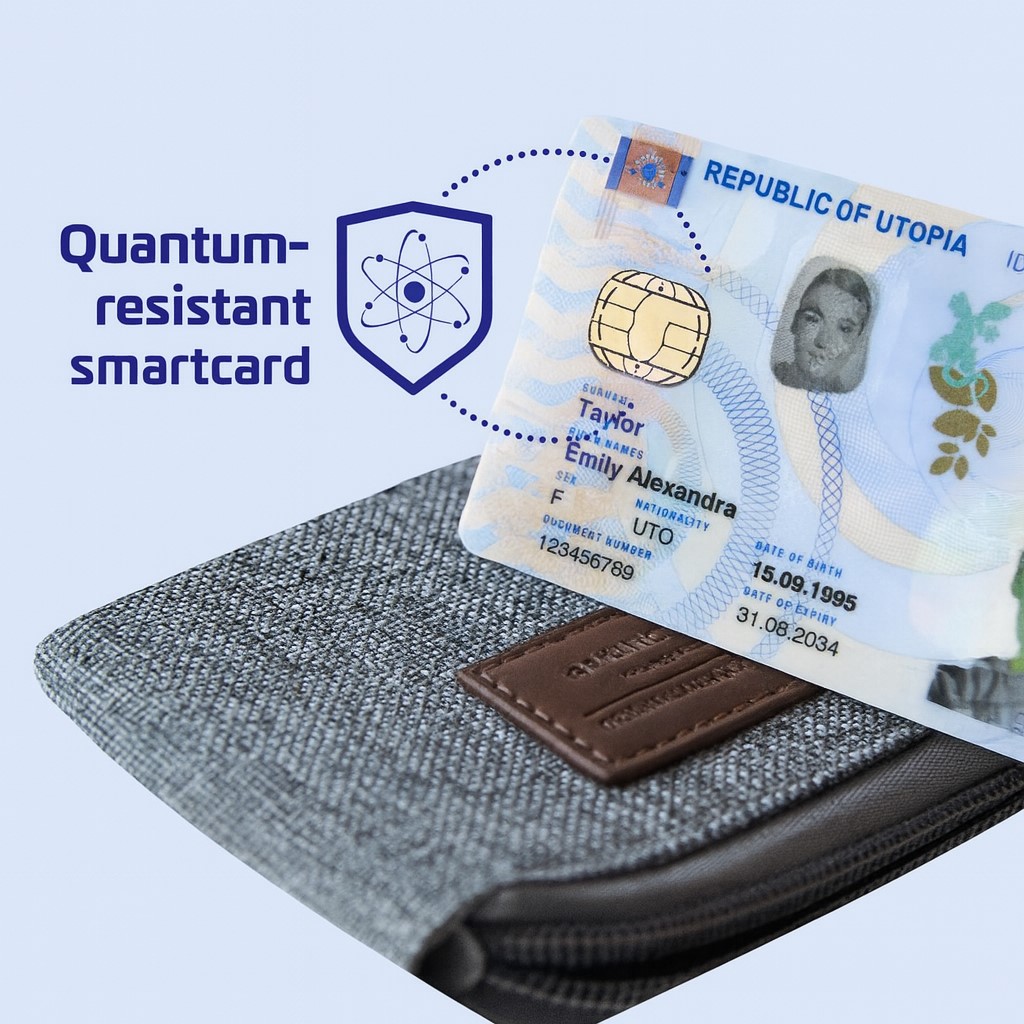
Thales has announced the launch of a cutting-edge chip card designed for the post-quantum era across Europe. This innovative solution combines quantum-resistant algorithms with high-level certification, aimed at enabling the universal adoption of secure digital identities. It reflects a strategic initiative to enhance the sovereign security of critical infrastructures by 2030.
The transition to operational quantum computing is no longer a hypothetical scenario; it is a credible reality on the horizon. This paradigm shift challenges the viability of current asymmetric cryptography systems deployed across identity infrastructures, telecommunications, banking networks, and the Internet of Things (IoT). In anticipation of this disruption, several governments, standardization bodies, and key industry players are initiating a transition to “post-quantum” systems capable of withstanding the computational power of quantum computers. In this context, Thales’s launch of the MultiApp 5.2 Premium PQC chip card marks a significant milestone. It incorporates NIST-standardized signature algorithms alongside an EAL 6+ certification, confirming its robustness against both physical and logical attacks.
The challenge goes beyond mere technical adaptation. It encompasses the need to ensure the continuity of digital identities over time, free from exploitable security vulnerabilities. Protecting state secrets, critical access points, and identity documents necessitates an immediate shift to solutions that can resist deferred attacks—where tomorrow’s decrypted data could be based on information intercepted today. By addressing this issue with a broadly marketable offering, Thales is positioning itself as a credible European leader in this field.
Thales has strategically chosen the chip card format, which is the preferred medium for various identity documents, healthcare cards, and electronic driver’s licenses. The standard format is established, the industrial supply chain is reliable, and the use cases are well-defined. By integrating post-quantum cryptography into this standardized medium, Thales enables public authorities to plan for a gradual renewal of identity documents without logistical disruptions or excessive complexity. According to Thales, the user experience remains seamless for citizens, even as the underlying security scales up significantly.
The Post-Quantum Market: A Race for Standards
This strategy of technological invisibility—where cryptographic innovations blend seamlessly into existing applications—acts as a lever for rapid adoption. As numerous governments update their national cybersecurity and digital sovereignty strategies, having an immediately available, certified solution aligned with international recommendations (especially those from NIST and ANSSI) becomes a decisive factor in tenders. Thales is capitalizing on its dual foundation: robust industrial capabilities for large-scale deployment and high-level cryptographic expertise integrated closely with hardware.
The introduction of Thales’s chip card is emblematic of a broader competition among technology providers vying to establish themselves as the de facto standard for post-quantum security. The integration of NIST-standardized algorithms, particularly Crystals-Dilithium for signatures, shows an eagerness to align with future international frameworks. However, the competition extends beyond cryptographic standards; it encompasses software-based approaches (encryption libraries, hybrid public key infrastructure) versus hardware-based strategies (HSM modules, chip cards, specialized circuits).
In this context, Thales advocates for a hardware-rooted vision of security, where technological sovereignty is achieved through mastery of critical components. In the face of American players like IBM, Google, and Microsoft, who are heavily investing in post-quantum software infrastructures, or Asian initiatives that combine microelectronics with cryptography, Thales’s card launch positions it as a leading European alternative that offers a complete, integrated, and certifiable solution. The group’s strategy aims to embed this innovation within sovereign markets while paving the way for broader professional and industrial applications.
Meeting Compliance and Sovereignty Imperatives
The new European regulations—particularly the eIDAS 2.0 regulation and the NIS2 directives—enhance security requirements for digital identity infrastructures. Thales’s post-quantum card addresses these needs by incorporating today’s protective mechanisms against tomorrow’s threats. It enables EU member states to anticipate evolving regulatory frameworks without relying on extraterritorial technologies. Moreover, in regulated sectors such as healthcare, justice, energy, and defense, adopting post-quantum solutions will serve as a guarantee of ongoing compliance, avoiding costly reclassifications as critical thresholds approach.
For businesses, this chip card can facilitate integration into enhanced trust chains, granting access to secure services, public contracts, and rigorous certification processes. It embodies an effort to industrialize post-quantum cryptography, moving beyond mere laboratory experiments or pilot tests. By stabilizing a quantum security offering today, Thales is helping to shape an emerging market where credibility hinges on the ability to produce, certify, and deploy in real-world conditions.
Towards European Consolidation in Post-Quantum Security
Thales’s initiative could catalyze a consolidation movement around a European foundation for post-quantum security. It offers a technical anchor for European digital identity projects, sovereign critical infrastructures, and future interoperable trusted platforms. It remains to be seen whether other industrial players—particularly in microcontrollers, HSMs, or sovereign clouds—will follow this trajectory and converge toward a common foundation. Europe’s ability to impose its own standards—rather than merely adopting those set by tech giants or Sino-American initiatives—will depend on its coherence in aligning products, usage, and public strategies.
As the quantum threat shifts from being an abstract concern to a tangible reality, Thales’s announcement embodies a proactive industrial strategy. By selecting the chip card as its vehicle, the company combines pragmatism, technological maturity, and certified sovereignty. The challenge now lies in shifting usage and purchasing policies to transform this technical breakthrough into a lasting security standard. Time is of the essence, and resistance to change could prove more perilous than the threat itself.