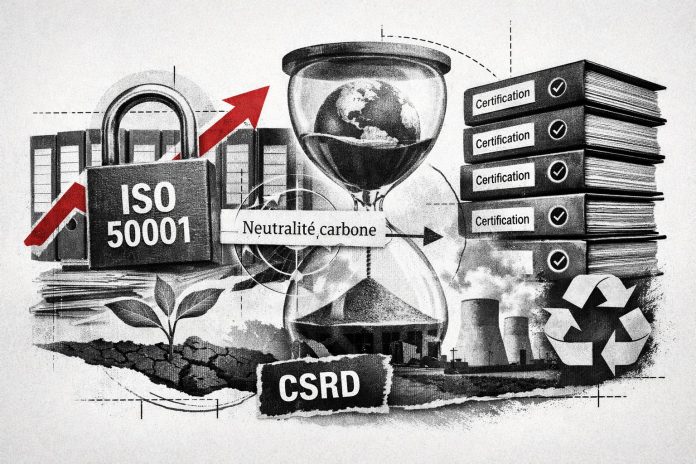
SCC France has simultaneously received the Level 2 Digital Responsibility Label and ISO 50001 certification, bringing the total number of ISO certifications held by the company to seven. These two endorsements validate a quantifiable decarbonization trajectory: an annual energy consumption reduction of 5 to 10%, aiming for carbon neutrality by 2040, with an interim goal of a 50% reduction by 2030.
The acquisitions of these certifications arise in a market context where environmental performance is transitioning from a distinguishing feature to a prerequisite for tender agreements. According to Numeum-PAC forecasts, the French IT market is expected to grow by 4.3% in 2026, while regulatory demands for energy performance and responsible purchasing are intensifying, particularly under the effects of the CSRD directive and the integration of ESG criteria into the qualification processes for major suppliers. For a service provider like SCC France, possessing audited frameworks recognized by independent bodies minimizes the justification burden during client evaluations and enhances the traceability of CSR commitments throughout the value chain.
SCC France’s certification journey did not begin in 2026; the company initiated a voluntary certification process as early as 1995. ISO 50001 represents the seventh ISO certification obtained by the group, positioning these two new recognitions in a framework of structural continuity rather than a reactive approach to regulatory compliance. The Level 2 Digital Responsibility Label, awarded by the Institute of Digital Responsibility, and ISO 50001 cover two complementary scopes: one evaluates the integration of environmental, social, and ethical issues into digital activities broadly, while the other structures the operational management of energy consumption with an auditable cycle of continuous improvement.
A Multi-Year Action Plan for All Departments
The Level 2 Digital Responsibility Label requires the demonstration of effective, measurable actions integrated into operational processes. For SCC France, achieving this level is supported by four main axes: establishing a team of Digital Responsibility ambassadors internally, completing a double materiality analysis that identifies the company’s impacts on its environment and the environmental risks it faces, enhancing reuse activities through its subsidiary SCC Recycling, and incorporating quantified objectives into a multi-year action plan encompassing all departments.
The double materiality analysis is a central element of this framework. Mandatory for companies subject to the CSRD, it allows for the identification of priority issues on which to focus CSR efforts, intersecting the financial impacts for the company with the effects on external stakeholders. For SCC France, whose activities generate significant flows of end-of-life IT equipment, double materiality positions reuse and electronic waste management as material issues, justifying the strengthening of SCC Recycling as an operational lever rather than a peripheral initiative.
Patricia Oudart, CSR-QSE Manager at SCC France, elaborates on the significance of the labeling: “This is not merely a statement of intent; it’s a structured program that engages all our departments and is designed for the long haul.” This underscores a common pitfall in the CSR approaches of IT service companies: a concentration of commitment on the CSR department without diffusion into purchasing, sales, and operational processes. Achieving Level 2 attests that SCC France has crossed this boundary of transversal engagement.
ISO 50001: Annual Consumption Reduction of 5 to 10%
The ISO 50001 certification organizes energy management according to a PDCA cycle: Plan-Do-Check-Act. This translates into defining an energy policy, identifying significant uses, setting measurable objectives, implementing action plans, auditing, and reviewing. For SCC France, this framework translates to a commitment to reduce energy consumption by 5 to 10% annually, a quantifiable and auditable commitment that goes beyond simple declarations. Anne-Sophie Laurent, CSR-QSE Project Manager, emphasizes this goal as aligning their decarbonization strategy with followed and audited operational actions.
ISO 50001 has direct regulatory relevance for companies subject to the obligations of the tertiary decree, which mandates a progressive reduction in energy consumption for buildings over 1,000 square meters: 40% by 2030, 50% by 2040, and 60% by 2050 based on a reference year. The energy management system established by ISO 50001 provides the measurement, monitoring, and reporting framework necessary to demonstrate compliance with these obligations while anticipating administrative audits. For an IT service provider operating across multiple sites, this coherence between voluntary frameworks and regulatory obligations reduces the duplication of management systems.
SCC France’s trajectory towards carbon neutrality by 2040 is built on this energy management foundation. The interim target of a 50% reduction by 2030 necessitates a sustained improvement pace over five years, which the annual ISO 50001 audit cycle will facilitate verification and adjustment. Absent this management framework, a target set for 2040 would remain an unenforceable projection; with it, each annual review becomes a point of accountability for both internal and external stakeholders.
With the Level 2 Digital Responsibility Label and ISO 50001, SCC France possesses a CSR management system grounded in seven ISO certifications and two sector-specific labels, encompassing information security, quality, environmental management, and now energy performance. This architecture of frameworks responds to a reality in the B2B IT market: large public and private organizations increasingly incorporate verifiable CSR criteria into their supplier selection grids, rendering certification not merely a competitive advantage but a prerequisite for qualification.