

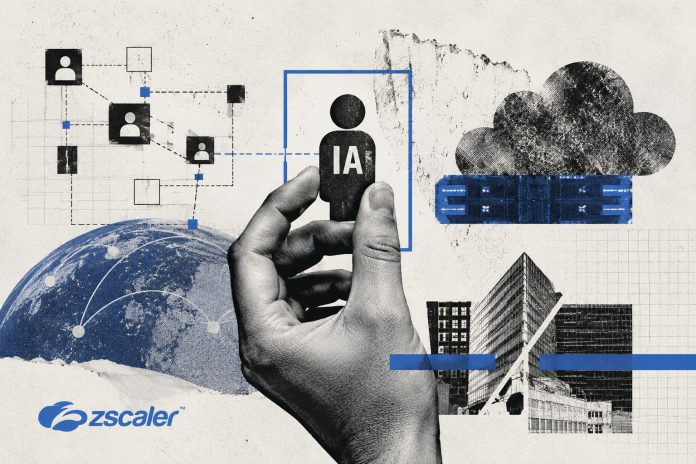
During its Zenith Live conference, Zscaler unveiled a series of announcements aimed at expanding its Zero Trust Exchange platform into the realm of artificial intelligence. The company is focused on securing autonomous agents, fostering a partner ecosystem for security signal sharing, and revamping its SASE (Secure Access Service Edge) offering with an agent-based management framework. This marks a shift in security from a model centered on human users to one that encompasses machine identities, especially in light of the AI Act obligations coming into effect in August 2026.
At Zenith Live, its annual conference held in Vienna and Paris, Zscaler outlined its strategic moves to enhance its Zero Trust Exchange platform, particularly in the context of AI security. The California-based company described a fundamental shift in defense perimeter approaches. Traditionally, organizational security has been built around known human identities and predictable access patterns. However, with the rise of autonomous agents that act on behalf of users—and sometimes independently—creating ephemeral identities and orchestrating sub-agents, classic security controls struggle to keep pace.
These behaviors escape the oversight designed for human users. An agent invoking another agent, opening a session for a task and then closing it, while operating with machine speed permissions, creates activities that conventional visibility tools fail to track. In response to this challenge, Zscaler outlined three complementary announcements. First, the company asserts that it has created the industry’s first comprehensive Zero Trust platform specifically dedicated to AI agents, a claim it has not substantiated with comparative benchmarks. Governance of AI agents is becoming a prerequisite for their deployment by 2026.
Securing Agents and Endpoints
The first announcement focuses on the protection of the agents themselves. Zscaler AI Broker secures communications between agents through MCP and A2A exchange protocols, integrating an agent registry that logs each agent’s access rights to enforce organizational-wide controls. The goal is to assign identities and permission scopes to software entities that, without such registration, operate without centralized oversight. Concurrently, Zscaler Endpoint AI Security targets AI-related threats hidden within browsers, extensions, and locally installed AI tools—layers typically overlooked by existing endpoint protection solutions.
These functions leverage the AI Access Graph, stemming from Zscaler’s acquisition of Symmetry Systems, which maps connections between identities, applications, agents, and data sources. They build upon Zscaler AI Protect, launched in January 2026, which includes the detection of agents and MCP servers in cloud environments and features a simulated attack on those servers. The focus remains on visibility and access control, without absolving operators of responsibility for actions carried out by autonomous agents on their behalf.
An Ecosystem Alliance for Signal Sharing
The second announcement extends the AI-Guardian initiative to a set of technology partners. Zscaler emphasizes that no single provider can solely secure an AI environment, as security teams often contend with siloed solutions that do not share contextual information. This initiative combines the Zero Trust Exchange with AI, cloud, and infrastructure players to foster the sharing of security signals, identity context, and policy enforcement mechanisms. Detection on one platform can trigger security actions on another.
Among the listed partners are AWS, Databricks, Google Cloud, OpenAI, CoreWeave, Equinix, Glean, and Saviynt, joined by integrators Coforge and NTT DATA, along with founding integrators Cognizant, EY, HCLTech, Infosys, TCS, and Wipro. This focus on AI security through a single orchestrator merits careful evaluation by IT leadership, as while interoperability reduces silos, it also creates a dependence on the platform unifying the signals. Most of these partners are also subject to the Cloud Act, which exposes processed data to U.S. jurisdiction regardless of hosting location.
A Revamped and Agent-Managed SASE
The third announcement centers around the restructuring of the Zero Trust SASE offering through a framework referred to as ZAgent. This framework orchestrates agents that automate platform management, from configuration to troubleshooting, via natural language queries. Additionally, Zscaler is extending SASE to unmanaged endpoints by introducing an extension and corporate browser that replace traditional virtual desktop and VPN infrastructures, facilitate partner connectivity without network exposure, and enhance micro-segmentation in Kubernetes environments, along with a security gateway for Google Cloud, complementing existing AWS support.
The company claims to operate the largest online security cloud, capable of securing over 750 billion transactions daily, a volume that it links to a continuous feeding of its AI capabilities. According to the analyst firm Omdia, referenced by Zscaler, this announcement signals a transformation in the SASE market where traditional approaches reliant on firewalls and VPNs can no longer keep pace with AI advancements. However, this assertion, made by an analyst cited by the company, should be verified against actual deployments.
A Strategy with Blind Spots
The three announcements outline a cohesive trajectory: Zscaler is broadening Zero Trust from human users to encompass autonomous agents, partner ecosystems, and access architectures. This consistency addresses a genuine need for visibility and governance over a population of agents that is growing faster than governance tools can keep up. However, it raises questions that security leaders will need to address. Control over agents applies only to those communicating via MCP and A2A that are registered, which implies that any deployed agent must indeed be reported; any agent outside this scope remains invisible.
The distinction between an autonomous agent, which executes chains of actions without intermediate validation, and a co-pilot under human supervision shifts responsibility from the user to the operator of the agent, a transition that grants the CISO increased power and legal exposure that legal and compliance teams must anticipate. Decision-makers will need to weigh how much of their AI security they are willing to entrust to a single non-European orchestrator and their ability to ensure no agents escape registration. The window is closing rapidly: obligations under the AI Act for high-risk systems will come into effect in August 2026, and mapping agents in production will be a prerequisite.



