

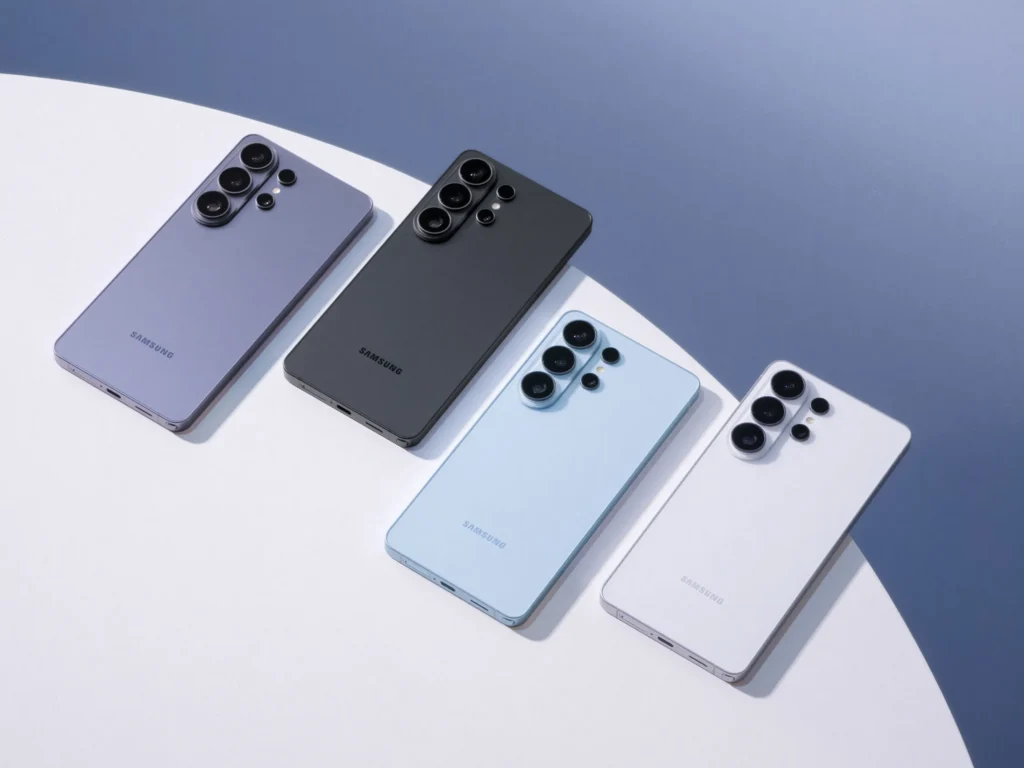
Galaxy S27: Samsung preparing few innovations for its standard model
Initial rumors about the upcoming Galaxy S27 lineup are surfacing, but they may disappoint loyal users of the standard version. According to various reports from the Korean supply chain, Samsung does not expect to introduce major changes for the Galaxy S27.
This strategy contrasts with market expectations, as competitors are increasingly integrating new technologies in artificial intelligence, photography, and displays.
If these reports prove accurate, the Galaxy S27 could become one of the most conservative upgrades in the Galaxy S series.
Little change expected in display and camera
According to the Korean leaker Lanzuk, Samsung is currently not developing any new major components for the standard Galaxy S27. The two most impacted areas would be the display and the rear camera module. This source indicates that no significant activity has been detected among suppliers typically involved in the development of new screens or sensors.
In short, the Galaxy S27 may reuse much of the technical specifications from the Galaxy S26.
The most notable information concerns photography. Samsung is expected to continue using the same main camera system as seen in several previous generations. If this rumor holds, the Galaxy S series would have maintained a largely similar camera architecture across the Galaxy S22, S23, S24, S25, S26, and now S27. On paper, this might suggest stagnation.
In reality, Samsung continues to enhance its image processing algorithms, color accuracy, and exposure management. Thus, photographic performance can improve without necessarily changing the hardware.
However, facing competition that is rapidly increasing sensor sizes and optical innovations, this strategy may become harder to defend.
BOE issue raises questions
This lack of innovation could also explain some recent rumors regarding the Galaxy S27’s display. Several reports have discussed the possibility of Samsung using a display manufactured by Chinese company BOE.
The idea was straightforward: if no new screen is being specifically developed for the Galaxy S27, Samsung could outsource part of the production to cut costs.
However, more recent information suggests that Samsung may have revised this strategy. The reason is not related to the quality of BOE’s displays but rather the intention to support its own industrial ecosystem and maintain Samsung Display’s profitability.
A strategy driven by rising costs?
This more conservative approach might have an economic explanation. The entire tech industry is facing significant cost increases in memory (DRAM), NAND storage, AI components, and advanced semiconductor production.
Apple recently acknowledged that these increases would likely lead to price hikes on its future devices. Samsung may therefore be seeking to minimize development costs for the Galaxy S27 to maintain a competitive pricing position.
Nevertheless, the smartphone is expected to benefit from a new generation of processors, ensuring performance gains and advancements related to artificial intelligence.
Is Samsung trying to push users toward the Ultra model?
This strategy also raises another question. Samsung could be intentionally emphasizing the differences between the standard Galaxy S27 and the upcoming Galaxy S27 Ultra.
For several years, the Ultra model has housed most of the innovations: exclusive camera sensors, more advanced displays, larger batteries, and premium features. Limiting the upgrades to the base model could make the Ultra version even more appealing to consumers willing to spend more.
This approach resembles that adopted by Apple with its increasingly differentiated iPhone Pro models compared to standard versions.
A decision yet to be confirmed
However, caution is warranted. The Galaxy S27 is not expected to launch for several months, and Samsung’s plans may still change. Current information primarily relies on supply chain analysis rather than official announcements.
Yet, if this trend confirms, Samsung may prioritize software and algorithmic evolution over major hardware redesigns for its next premium entry-level smartphone.
This strategy could be an effective way to control costs, but it risks increasing criticism regarding the lack of innovation in standard models.



