

Ping Identity Launches Identity for AI: A New Standard for Trust in Autonomous Agents
Ping Identity has announced the launch of Identity for AI, a comprehensive solution designed to guide the integration of artificial intelligence agents in enterprise settings. This initiative aims to transform identity management into a foundational pillar of digital trust within an ecosystem increasingly characterized by autonomous interactions. This announcement marks a significant strategic step for a market grappling with the need for control, visibility, and governance over agents capable of acting, deciding, and delegating.
As agent-based computing solidifies itself as a new organizational frontier, the issue of accountability comes to the forefront. Organizations are deploying agents to automate tasks, interact with core systems, or orchestrate third-party services, yet existing control frameworks struggle to keep pace. Ping Identity seeks to capitalize on this uncertainty by positioning identity as a common foundation and a guarantee for tracking the decisions made by AI.
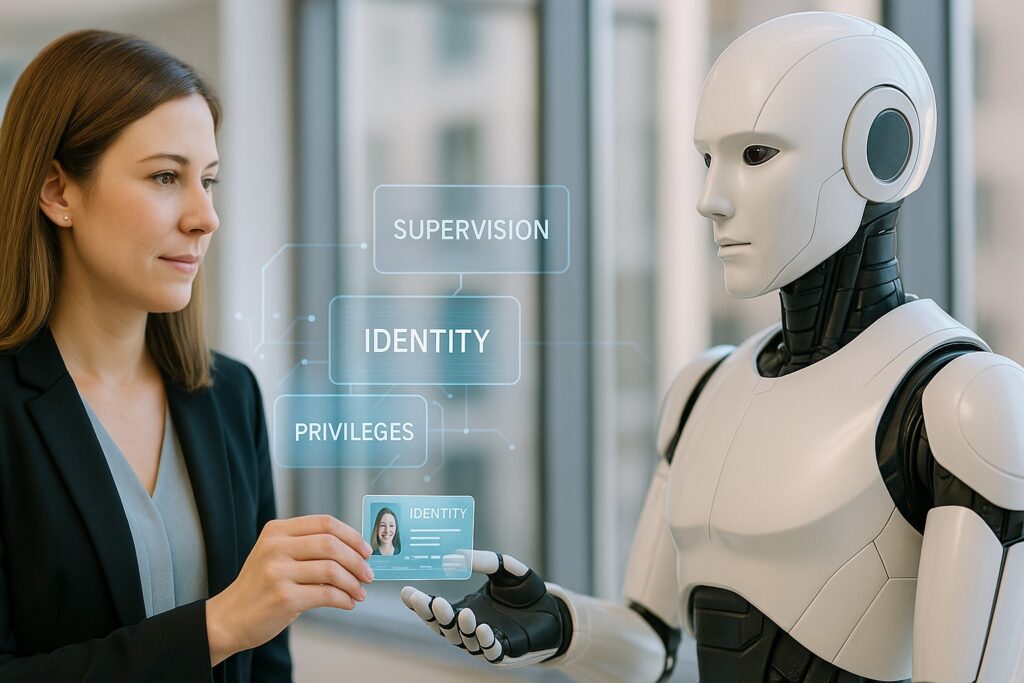
The proposition set forth by Ping Identity aligns with a growing trend in corporate architecture, where non-human identities—whether persistent or ephemeral—operate autonomously in domains where traditional controls are often inadequate. With Identity for AI, the company aims to provide a unified view of the lifecycle of these new software entities, from their discovery to the supervision of their activities, and through to delegation and authorization. This approach mirrors the logic established for human employees and technical accounts but is adapted for the specificities of agent behavior.
Governance of Agents Through Lifecycle Management
This announcement comes at a pivotal moment as IT departments rethink their priorities under the dual pressures of advancing orchestration protocols like MCP, which facilitate inter-agent connectivity, and the rapid proliferation of tools that can directly interact with business environments. This combination not only enhances efficiency but also heightens risks related to privilege escalation, error propagation, and exposure of sensitive data. Ping Identity aims to fill this gap by implementing a comprehensive control plan that reconciles security, performance, and scalability. Founding CEO Andre Durand emphasizes the need to scrutinize every action and ensure the reliability of automated decisions, positioning identity as the “universal trust layer” in a world dominated by agent interactions.
The first step taken by Ping Identity focuses on the capability to discover, inventory, and classify agents already operating within the enterprise. This is a critical challenge given that agents from SaaS applications, internal platforms, or automated scripts often coexist without proper registration or monitoring. The company offers a consolidated visibility solution that reconstructs the mapping of interactions, dependencies, and privileges assigned.
Rethinking Access Control for Autonomous Interactions
This discovery approach is complemented by a centralized registration and management mechanism, referred to as an agent identity registry. This provides a single source of truth for tracking versions, rights, responsibilities, and actions performed. In a climate where companies are increasingly experimenting, this registry stabilizes operations that are often fragmented across various tools, services, and teams. Security leaders gain a framework to manage rapidly evolving deployments, while architects acquire a tool to harmonize practices.
Intelligent access control emerges as one of the key innovations unveiled. Ping Identity extends its identity management capabilities to assign authentication and authorization rules to agents that are equivalent to those applied to human employees. This equivalence rests on the principle that an agent can only act based on a verified identity, a clearly defined action scope, and explicit human oversight. The introduction of dynamic minimal privileges further reflects this evolution—agents gain rights only when their actions necessitate them and for a strictly limited duration.
The MCP gateway plays a central role in this framework, acting as a filter, safeguard, and inspection point for agent traffic. By monitoring agent activities and implementing contextual rules, it enables near real-time supervision of operations while injecting ephemeral identifiers. This security layer strikes a balance between flexibility and control, allowing agents autonomy while ensuring auditability. Its capability to detect data exposures or abnormal behaviors provides security leaders with vital indicators to validate or halt sensitive actions.
Human Oversight as a Principle of Accountability
Ping Identity firmly rejects the notion of complete autonomy for agents, reaffirming the essential role of human oversight in the accountability chain. Delegation mechanisms emphasize mandatory checkpoints, such as reviews of sensitive actions, explicit validation, and informed consent. By positioning human leaders as arbiters and guarantors of the process, the company aligns with recommendations from several emerging regulatory frameworks regarding auditability, accountability, and risk management.
This vision is part of a broader movement reshaping AI policies. Organizations are striving to secure their transition to agent-based systems without causing organizational disruption, necessitating a tight linkage between automation and safety mechanisms. Ping Identity’s approach stands out for its continuity. The same identity model applies to humans, agents, resources, and services, fostering a common language among security teams, business units, and compliance officers. This unification minimizes operational friction and paves the way for faster, better-controlled, and more transparent deployments.
Defense, Detection, and Combatting Agent Impersonation
The company also introduces a defense mechanism focused on identifying unknown or malicious agents. This issue extends beyond cybersecurity concerns; in environments where agents directly interact with critical systems, the risk of a counterfeit agent executing unauthorized actions is substantial. Distinguishing legitimate agents from impersonators becomes an essential resilience factor, especially as traditional mechanisms—such as static signatures, certificates, and long-term stored secrets—prove inadequate in a landscape dominated by dynamic identifiers.
Threat protection also comes in the form of continuous behavior and trajectory analysis. By supplying alert signals based on the consistency of interactions, Identity for AI enables the detection of anomalies, deviations, or attempts at circumvention. This behavioral approach complements conventional data loss prevention tools, introducing an observability framework appropriate for multi-agent environments. The outcome transforms risk management into a proactive process capable of tracking the expansion of agent-based economies and anticipating critical divergences.
A Comprehensive Roadmap for Future Standardization
Ping Identity has announced a progressive timeline extending through 2026, incorporating features focused on governance, advanced protection, privilege management, and deeper visibility. This roadmap reflects the market’s maturation, as the decade ahead is poised for a complete restructuring of access architectures to favor a model grounded in collaboration between humans and agents. The company aims to cement itself in this movement by promoting implicit standardization based on consistent practices that can be exported from one environment to another. This ambition fits within a market increasingly seeking shared frameworks and reference points.
The announcement also underscores the growing presence of a competitive landscape dominated by players capable of providing trustworthy infrastructures for agents. The rapid evolution of contextual protocols, programmability, and multi-LLM interactions necessitates a rethinking of identity management beyond traditional approaches. By offering a unified foundation, Ping Identity contributes to structuring this emerging ecosystem while highlighting the inherent risks of fragmentation. For large enterprises, this coherence represents a crucial advantage in securing their transition toward agent-based systems without adding to their organizational debt.



