

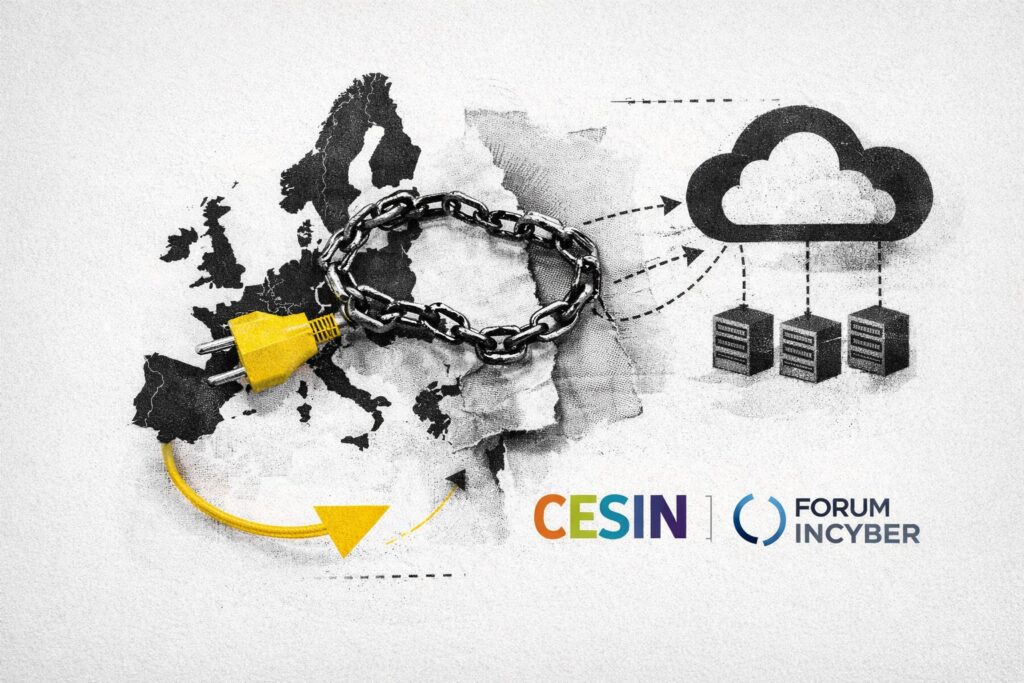
Nearly Two-Thirds of European Organizations Concerned About Sovereignty and Trusted Cloud Issues, Says Cesin-Opinionway Report
A recent survey by Cesin and the Forum InCyber, coinciding with the InCyber Europe 2026 Forum, reveals that nearly two-thirds of European organizations are alarmed by challenges relating to digital sovereignty and trusted cloud services. As digital dependencies become deeper and more widespread than ever, the newly released white paper titled “Mastering Our Digital Dependencies: Towards a Managed and Chosen Digital Autonomy” highlights not a quest for total independence—which is deemed unrealistic in a globalized context—but rather the need to regain certain degrees of maneuverability.
Digital sovereignty has been a topic of conversation for several years, yet it has not always translated into tangible outcomes. The white paper takes a contrary stance, noting that the choices made over the past fifteen years—such as the massive adoption of cloud services, outsourcing of skills, and reliance on a limited number of platforms—have led to real gains but have simultaneously created an architecture of dependency that organizations are now beginning to understand. Indeed, 53% of companies report an increase in state-sponsored threats amid escalating geopolitical tensions. The most significant perceived risk has shifted to service interruptions, revealing a structural exposure to critical infrastructures and suppliers.
The white paper underscores the diffuse nature of these dependencies. They are not isolated to a single component or provider but are interwoven through industrial chains, technical standards, contractual clauses, available internal skills, and even the cognitive models shaped by the tools themselves. This dependence manifests as a continuous erosion of maneuverability, without any visible abrupt breaks. It is this invisibility that makes the issue so critical, prompting a transition of the digital dialogue from a technical focus to one of strategy and governance.
AI Amplifies Existing Dependencies
Artificial intelligence (AI) plays a central role in the discussion, with the white paper identifying two contrasting effects. On one hand, AI consolidates critical resources—computing power, training data, foundation models—within a small number of players while becoming embedded in organizations’ decision-making processes. This does not introduce new dependencies per se, but rather amplifies existing ones. Conversely, AI offers tools that simplify the identification of these dependencies, enabling organizations to map opaque systems, analyze complex interdependencies, and regain local control over legacy infrastructures.
This shift is foundational, influencing the trajectory of future events. Alain Bouillé, General Delegate of Cesin, states that dependencies on external solutions “must now be treated as systemic risks at the executive committee level.” This shift in discourse—from IT to the executive committee—reflects an evolving perception of risk: it is no longer confined to IT continuity but encompasses the organization’s strategic decision-making freedom.
From Endured Dependency to Managed Interdependence
Guillaume Tissier, Managing Director of Forum InCyber, proposes a beneficial conceptual framework that delineates critical boundaries. Mutual interdependence can fuel prosperity and, on a geopolitical scale, contribute to stability. However, problems arise when these interdependencies become asymmetric, allowing one party to leverage dependency as a means of pressure. The white paper encourages organizations to identify and rectify these asymmetries by distinguishing between acceptable dependencies and those that are no longer tenable.
The suggested methodology revolves around several key areas: incorporating reversibility into the design of architectures and contracts, diversifying technological ecosystems, and reinvesting in internal skills to maintain the organization’s decision-making authority. It cites the Digital Resilience Index as a valuable tool for assessing an organization’s ability to anticipate, withstand, and recover from incidents affecting its systems.
Breaking free from digital dependencies does not mean severing all ties, but rather ceasing to be passive. Certain technological decisions are as much political as they are economic. Organizations that have scaled up without re-evaluating their perspectives continue to navigate technical choices rather than strategic negotiations. Making these negotiations explicit, mapping dependencies, assessing their risk levels, and consciously deciding which are acceptable represents the paradigm shift that the authors of the white paper advocate for.



