

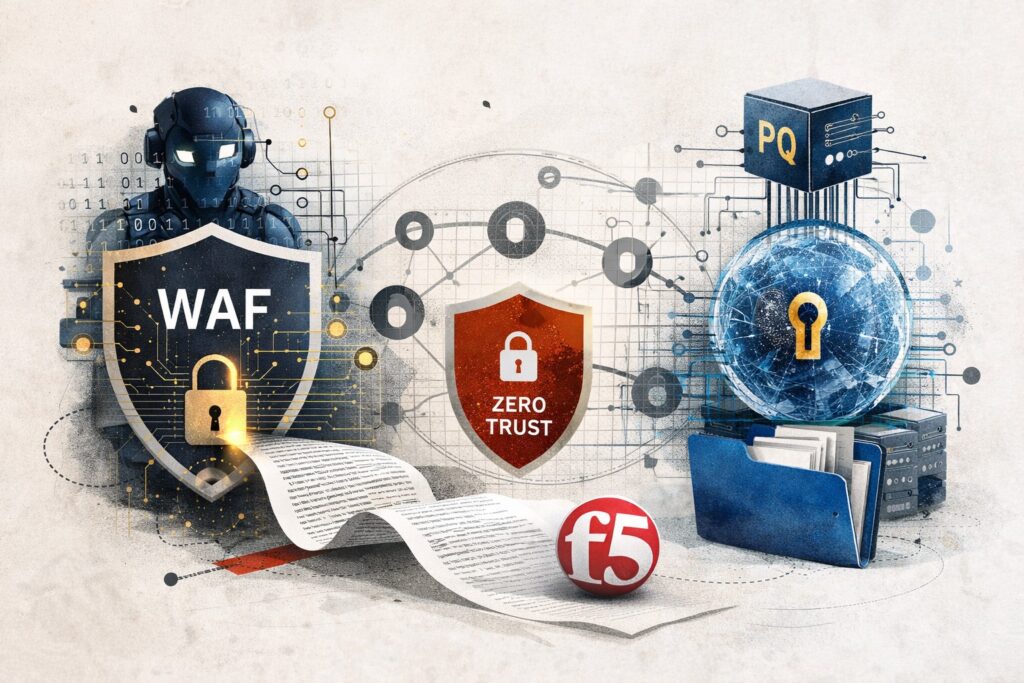
F5 Enhances Application Security Architecture with AI, Zero Trust, and Quantum-Resistant Cryptography
In response to the growing presence of AI agents introducing non-human traffic within corporate environments, F5 is strengthening its application security architecture around three key pillars: AI-driven protection, zero trust access, and post-quantum cryptography. This announcement, made at the AppWorld conference in Las Vegas, marks the evolution of the F5 Application Delivery and Security Platform (ADSP) toward a unified model for application traffic governance.
The newly integrated security features within the F5 ADSP are designed to address a threefold challenge: automating the detection and remediation of vulnerabilities in AI-driven applications, distinguishing and managing AI agents within traffic, and preparing cryptographic infrastructures for a post-quantum world. F5’s product management emphasizes that security teams require fewer alerts and more robust defenses — a sentiment echoed by Kunal Anand, the company’s Product Director, during the event.
F5’s positioning in this announcement cycle reflects a fundamental trend: application security vendors can no longer address application protection, access governance, and cryptographic preparation as separate entities. These three dimensions are converging due to the pressures from AI agent architectures, making automated traffic indistinguishable—without specialized tools—from legitimate human activity or automated attacks.
Introducing AI Remediate: Bridging Detection and Remediation
A hallmark of this update is F5 AI Remediate, a new module that integrates with two existing products: F5 AI Red Team, which identifies vulnerabilities in AI models, and F5 AI Guardrails, which enforces protections during execution. Previously, transitioning from identification to remediation required manual intervention by security teams to create and validate protection rules. AI Remediate automates this chain, generating, optimizing, and validating targeted safeguard packages—all of which must be human-approved prior to deployment in production.
This architecture—comprising automated identification, remediation, and human validation—addresses a critical operational challenge in environments where AI models are in production. The window of exposure between discovering a vulnerability and addressing it is a gap that SecOps teams cannot afford to close manually at scale. The Distributed Cloud WAF also introduces a new AI-driven risk scoring feature, incorporating outcome-focused blocking policies that reduce reliance on signatures and manual adjustments—a crucial improvement for organizations managing extensive application portfolios.
Distinguishing Human, Bot, and AI Agent Traffic
The expansion of F5’s Distributed Cloud Bot Defense introduces a distinctly new category of traffic—AI agents—into the application security taxonomy. The platform now differentiates between three types of interactions: human, bot-automated, and AI-driven, each governed by specific policies. Only verifiable and trusted AI agents are permitted to engage with applications, while ungoverned or malicious agents face blockage.
This granularity addresses a growing concern for CIOs and CISOs deploying agent-based architectures: AI agents can generate legitimate application traffic, yet their automated behavior may be hijacked or amplified by malicious actors. Without the ability to distinguish at the application firewall level, existing protection rules—even those calibrated for human traffic or simple bots—become ineffective. Additionally, F5 enhances integration between Distributed Cloud Web App Scanning and BIG-IP Advanced WAF, facilitating automated vulnerability detection through penetration testing and the deployment of targeted virtual patches without service interruptions.
BIG-IP Zero Trust Access and Hybrid Access Overhaul
F5 is rebranding its BIG-IP Access Policy Manager (APM) as BIG-IP Zero Trust Access, reinforcing its zero trust application access (ZTAA) capabilities as a central element of the ADSP. This renaming reflects a functional evolution: in contrast to purely SaaS ZTNA solutions, BIG-IP Zero Trust Access supports hybrid zero trust operations with identity and context validation on a per-request basis, encompassing modern, cloud, SaaS, and legacy applications.
The request-based validation—rather than session-based—minimizes lateral movement risk in the event of account or device compromise. The platform supports Identity Aware Proxy, SSL VPN, and IPsec VPN modes on a post-quantum cryptography-ready architecture. In this regard, F5 implements hybrid TLS encryption groups aligned with NIST standards, enabling a gradual transition to post-quantum cryptography while maintaining compatibility with existing traffic flows—an approach dubbed “crypto-agility.” The hypothetical “Q-Day,” when a sufficiently powerful quantum computer could break current asymmetric encryptions, lacks a specific timetable, but significant organizations require years for cryptographic migrations, underscoring the need for early preparation.
API Security and Isolated Environments
New discovery and security options for APIs in F5 Distributed Cloud API Security extend out-of-band visibility across multiple data planes: BIG-IP, NGINX, Kong, and Apigee. F5 has also introduced a deployable version for isolated network environments—air-gapped networks, heavily regulated sectors, or cloud-restricted areas—allowing comprehensive API oversight without an external connection. This capability directly addresses data sovereignty and regulatory compliance requirements that shape deployments in finance, healthcare, and the European public sector.
Overall, these updates reflect F5’s platform strategy to streamline security layers by integrating WAF, API protection, bot management, zero trust access, and post-quantum readiness into a unified control plan. Gartner specifically recommends this approach in a note from April 2025, highlighting the risks of “proxy overload”—the accumulation of disparate security proxies leading to performance and availability issues for organizations that fail to adopt a consolidated platform logic. For security leaders seeking to optimize their architecture amid budget constraints, the argument for convergence is an essential selection criterion.



