

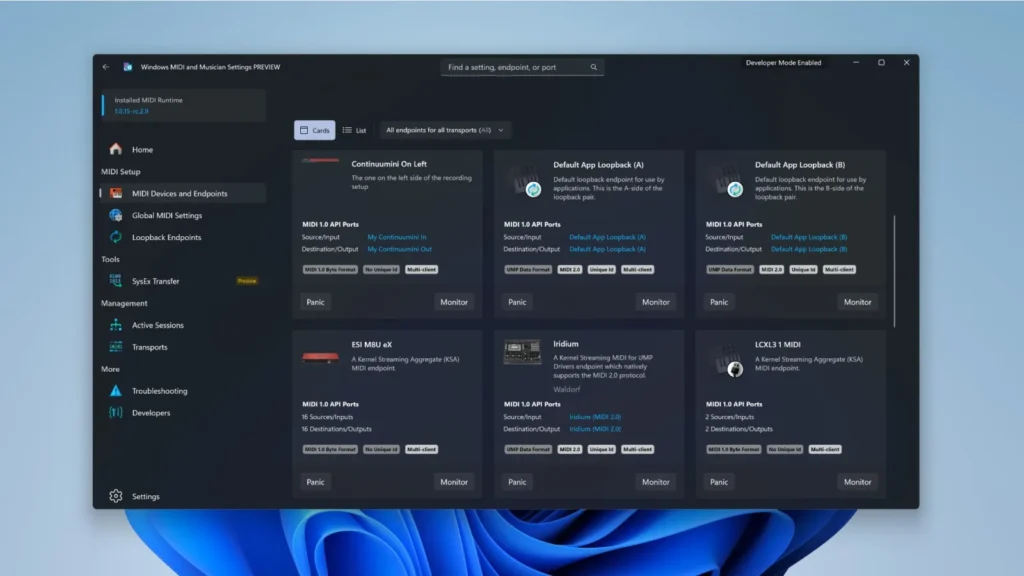
Windows 11: Microsoft launches Windows MIDI Services with native support for MIDI 2.0
For decades, Windows has relied on an essential yet outdated MIDI implementation. It worked adequately, but came with the limitations of another era: ports often “locked” by a single application, makeshift routing through third-party drivers, and limited potential for timing precision.
Today, Microsoft announces a complete overhaul: Windows MIDI Services, a new architecture that brings native support for MIDI 2.0 while preserving MIDI 1.0 compatibility.
MIDI hasn’t changed… but our usage has
Created in 1983, MIDI enabled instruments, controllers, and software to communicate in a common language. However, the “historical” limits (controller resolution, expressiveness, device discovery, metadata, etc.) have become apparent as music production has professionalized and workflows have evolved to involve multiple applications.
In response to these challenges, the MIDI Association has formalized MIDI 2.0 and the Universal MIDI Packet (UMP), which serve as a foundation for modern interactions while remaining interoperable with the MIDI 1.0 ecosystem.
A unified stack designed for production, not legacy
Windows MIDI Services replaces outdated components with a single stack designed to accommodate both MIDI 1.0 and MIDI 2.0 seamlessly, improving communication with devices, enhancing precision and scheduling, and facilitating modern workflows where multiple applications need access to the same endpoints.

Microsoft emphasizes a key point: your existing MIDI 1.0 applications should continue to function without modification, as the new stack manages compatibility at the system level.
Concrete benefits: multi-client, native loopback, simpler routing
This is perhaps the most “musical” aspect of the announcement, as it impacts daily use:
- Multi-client access: multiple apps can use the same MIDI port without any of them monopolizing the device
- Integrated loopback and app-to-app routing: Windows provides dedicated endpoints (with creation/management planned via MIDI Settings tools in an upcoming Tools package)
- Automatic translation between MIDI 2.0 and MIDI 1.0: allowing you to connect new hardware while maintaining compatibility with DAWs or plugins that still operate on MIDI 1.0.
In short, there will be less reliance on third-party utilities and reduced friction when linking DAWs, virtual instruments, and live tools.
Microsoft also highlights timestamping capabilities and the ability to schedule message sending via the SDK to improve synchronization (a critical aspect when it comes to groove, electronic drums, or live setups).

Availability: a gradual rollout in Windows 11
The rollout will take place in phases: the components will be integrated into relevant Windows 11 versions, but activation will occur progressively based on deployment waves. Microsoft even published a “known issues / workarounds” post and a verification tool to check if the new stack is active on your machine.
Microsoft seeks to take control of Windows’ musical “plumbing”
This launch has implications beyond just musicians: it reflects a broader trend at Microsoft, modernizing system components that have long remained static (audio, devices, low-level APIs) to accommodate workflows in 2026: multi-app, low-latency, hybrid tools, and increasingly “smart” devices.
And crucially, Windows MIDI Services arrives at an opportune time: MIDI 2.0 is not merely about “higher resolution.” It represents a vision where devices describe themselves, negotiate their capabilities, and become more expressive and reliable within mixed environments.
If Microsoft successfully navigates this transition without disrupting the ecosystem, Windows could once again — quite literally — become the “plug-and-play” OS of choice for studios and live setups.



