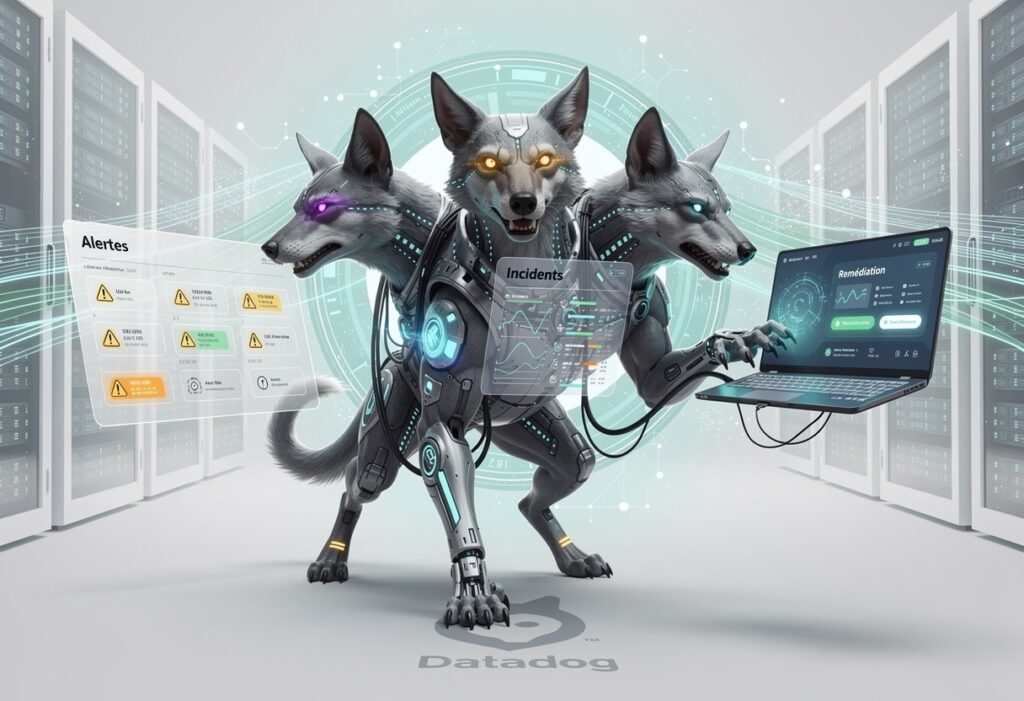
Datadog Unveils Bits AI SRE: An Autonomous AI Agent for Incident Resolution
Datadog has announced the general availability of Bits AI SRE, its autonomous AI agent designed to troubleshoot incidents without human intervention. Capable of investigating alerts, logs, and metrics, this innovative agent promises swift diagnostics and signifies a significant step toward fully automating SRE workflows in complex cloud environments.
As distributed architectures, microservices, and multicloud setups complicate incident root cause detection, manually managing alerts places a heavy burden on operations teams. With every minute of downtime potentially affecting customer satisfaction, revenue, or a company’s reputation, automating this critical phase is seen as a vital lever for ensuring service continuity and operational responsiveness.
Bits AI SRE is activated automatically when a monitor triggers an alert. Without the need for manual instructions, the agent gathers contextual information about the alert, queries telemetry, consults related runbooks or previous investigation histories, and simultaneously generates and tests multiple hypotheses for root causes. By eliminating unsupported hypotheses, it converges on a definitive diagnosis, often communicating its findings within minutes—often before an engineer has even logged in. This fundamentally different approach fosters faster investigations and reduces the mean time to resolution (MTTR).
Real Incident Models as a Reference
The agent’s methodology draws from Datadog’s extensive database, which aggregates telemetry, architectural metadata, incident histories, and application flows from thousands of production environments. This operational grounding ensures that Bits does not reason based on theoretical or simulated scenarios, but rather on real incident models, enhancing the relevance of its analyses.
When Bits identifies a likely cause, it presents its findings complete with evidence and references—such as logs, traces, and correlations—directly within collaboration tools (like Slack, mobile devices, and the Datadog dashboard). This allows engineers to focus on in-depth analysis, validation, or remediation, rather than the tedious tasks of data collection and correlation. Additionally, Bits AI SRE features a conversational mode, enabling users to request explanations, check investigation statuses, extract metrics, review recent changes, or explore dashboards—all in natural language, accompanied by contextualized responses.
Gradual Automation Toward Remediation
Beyond detection and diagnosis, Datadog aims to expand Bits AI SRE’s capabilities by integrating it with a second agent, the Bits AI Dev Agent. This integration could enable Bits to generate patch proposals or action plans—code, patches, or remediation strategies—ready for a developer’s approval. Together, these agents may cover the entire incident lifecycle, from alert to correction, enhancing efficiency.
Datadog reports that thousands of organizations have already deployed Bits AI SRE in production during its limited availability, with positive feedback on the speed and reliability of investigations. The agent supports regulated contexts with role-based access controls (RBAC) and enterprise contracts with validated AI partners, making it viable for organizations under compliance constraints to adopt AI agents without jeopardizing security or data privacy. The scalable, integrated nature of the agent also limits tool fragmentation, as AI capabilities are woven into Datadog’s unified platform, preventing the accumulation of disparate solutions and reinforcing the coherence of monitoring, alerting, and remediation processes.
The general release of Bits AI SRE reflects a strategic trajectory toward generating automated remediation workflows and patches, potentially revolutionizing SRE practices. In this context, the agent is poised to enhance system resilience, reduce operational costs associated with on-call duties, and improve team responsiveness—while still maintaining human oversight of the process. The AI is not merely an assistant; it operates as a partner capable of industrializing incident management.