

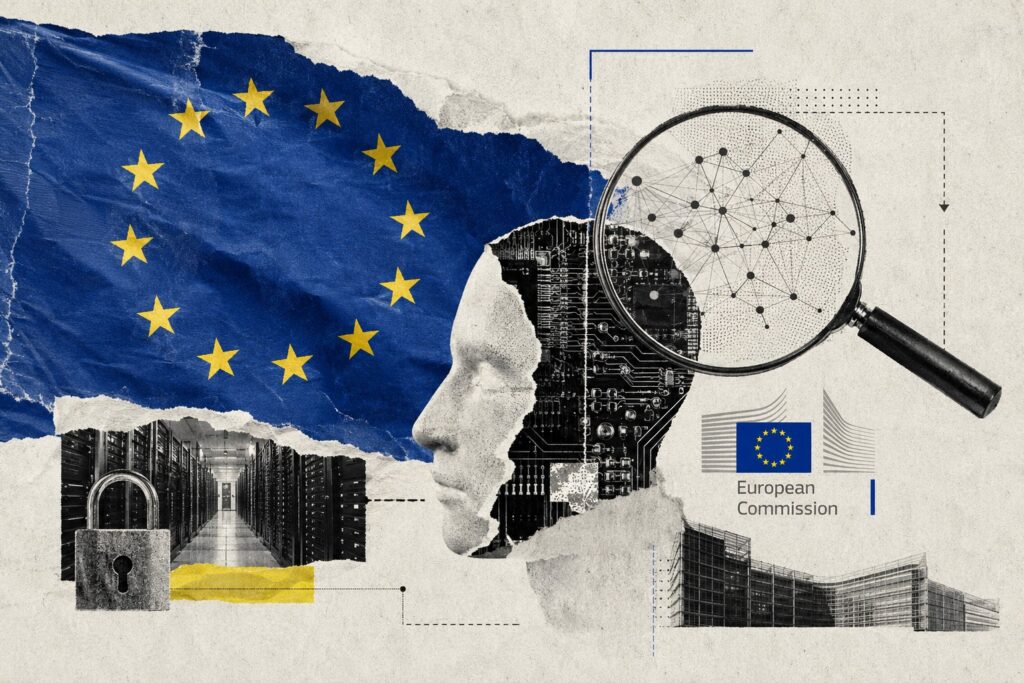
European Commission Unveils Cybersecurity and AI Action Plan
On July 7, the European Commission unveiled a comprehensive action plan for cybersecurity and artificial intelligence (AI) in Strasbourg. Labeled a “roadmap,” this non-binding document outlines the Union’s response to the emerging threats posed by advanced AI models in cyber defense, structured around four key pillars and nine significant actions through to 2027.
The plan takes the form of a communication directed at the European Parliament, the Council, and advisory committees, emphasizing its advisory rather than obligatory nature. It creates no new legal obligations but mandates existing authorities, including the Commission, the European Union Agency for Cybersecurity (ENISA), and member states, to operate within existing frameworks. “AI is fundamentally transforming the very nature of cybersecurity, and we must keep pace,” stated Henna Virkkunen, the Commission’s Executive Vice President responsible for technological sovereignty, security, and democracy. The Union prefers to build upon its existing capabilities, networks, and legal frameworks rather than drafting new legislation.
The Commission directly acknowledges the escalating challenges posed by advanced models, which swiftly uncover vulnerabilities and automate cyberattacks on an unprecedented scale while simultaneously enhancing detection and incident response capabilities. However, these cutting-edge capabilities are concentrated in a limited number of models developed outside Europe, with access often subject to ambiguous foreign decisions. Fortunately, the EU is equipped with regulatory tools such as the AI Act, the Cyber Resilience Act, the NIS2 Directive, and the DORA Regulation, which already establish a foundational framework applicable to critical sectors.
Evaluating and Accessing AI Models Before Deployment
The first pillar emphasizes evaluating, accessing, and testing advanced models for cyber applications. Beginning August 2, 2026, the Commission will exercise oversight powers as set out in the AI Act for general use models deemed to present systemic risks, including cybersecurity threats, with potential fines of up to 3% of global revenue. Due to the majority of independent evaluators currently operating outside the EU, the Commission plans to initiate a call for the establishment of a European AI model evaluation capability focused on cybersecurity, expected to launch in 2027.
Additionally, the Commission will collaborate with ENISA to define a structured European access framework for cutting-edge AI capabilities for cybersecurity, slated for the fourth quarter of 2026. This framework will outline access criteria for institutions, national authorities, critical infrastructure operators, and researchers, along with contingency measures should a third-party supplier or authority restrict or withdraw access to a model. A recent global blackout of the Claude language model, lasting eighteen days due to US export controls, has underscored the reality of this risk. A secure testing platform operated by ENISA and the Joint Research Centre will complement this initiative by the same deadline.
Fundamentals to Apply Without Delay
The second pillar focuses on fundamental cybersecurity practices deemed increasingly critical in light of swift advancements in threats. The Commission calls on member states to promptly transpose and implement the NIS2 and DORA regulations, urging operators to reevaluate their risk management strategies in anticipation of more frequent and rapid cyberattacks. Key priorities include improving cyber hygiene, reinforcing systems, implementing zero trust approaches, and reducing patching timelines, alongside addressing AI-specific risks like data poisoning and malicious prompt injections.
The action plan further addresses critical open source software, which pervades nearly all codebases and harbors numerous high-risk vulnerabilities within critical infrastructures, as reported in the 2026 Black Duck Open Source Security and Risk Analysis. ENISA plans to launch a pilot initiative for enhancing the resilience of critical open source projects in the fourth quarter of 2026, leveraging voluntary sponsorship to connect projects with organizations willing to support their maintenance. Recommendations to safeguard against threats amplified by AI are scheduled for release in the third quarter.
Sovereignty: A Declared Ambition Amidst Investment Challenges
The third pillar focuses on scaling the European ecosystem. The Commission highlights the 200 million euros already allocated through the Horizon Europe and Digital Europe programs, alongside 100 million euros destined for strategic defense technologies from the European Innovation Council fund by the end of 2026. It also announces, in collaboration with ENISA, a major European challenge aimed at addressing AI-assisted vulnerabilities. The establishment of AI “factories” and large-scale computing “gigafactories” will serve as sovereign data and computing infrastructures.
However, the Commission cautions that achieving sovereign advanced capabilities necessitates investments in the hundreds of billions of euros, far surpassing the limits of public funding alone, and calls for the urgent mobilization of private capital. “Without computing, models, and data infrastructure, Europe risks remaining a vulnerable consumer of advanced AI systems designed elsewhere, systems that others can disable overnight,” the Commission warns. The distinction remains clear between what is actionable—AI Act oversight—and what exists merely as part of the roadmap, including challenges and AI factories.
For Chief Information Officers (CIOs) and Chief Security Officers (CSOs), immediate utility lies less in investment announcements than in the tools and timelines being sketched out. The evaluation capacity and access framework will provide enforceable criteria for model vendors, while the testing platform will serve as a sandbox for experimentation before deployment. Contingency measures will address the risk of outages like those seen in the Claude and Mythos incidents. The underlying question posed by the plan remains: What resources will the EU muster to ensure it is not merely a consumer of models designed elsewhere?



