

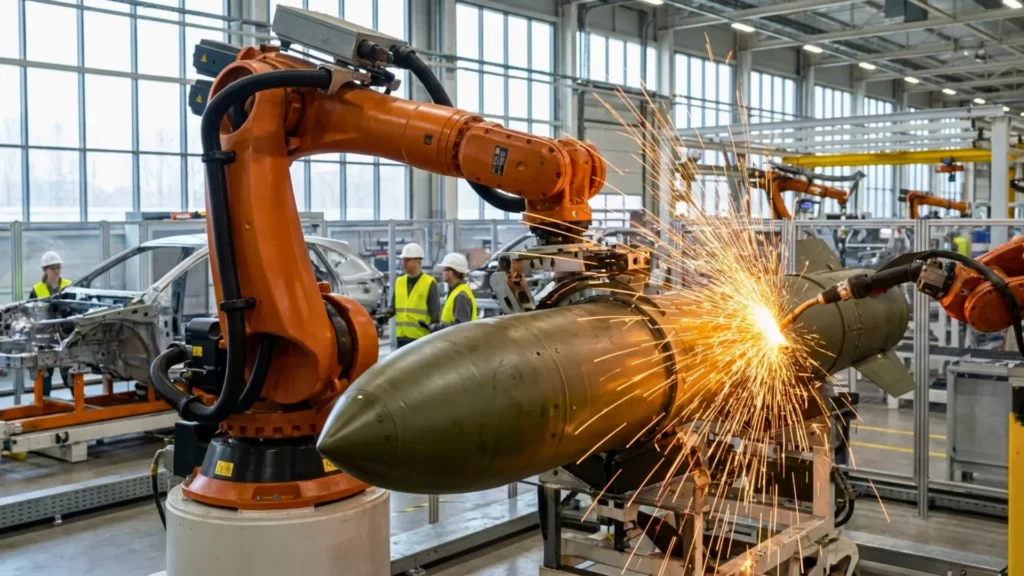
Since mid-April 2026, Washington has been actively urging its leading civilian industries to accelerate arms production. The wars in Ukraine and Iran are dangerously depleting military reserves. To compensate, the Pentagon is asking General Motors and Ford to convert their factories into production lines.
Munitions: Current Wars in Ukraine and Iran Are Draining U.S. Military Reserves.
Four weeks after the start of American strikes in the Middle East, the state of the stocks is worrying Washington. The fighting has consumed hundreds of interceptor missiles. Several experts are urgently seeking alternatives to compensate for these colossal losses. The command wants to maintain a credible deterrent force.
This situation directly undermines the national security of the country. Defense Secretary Pete Hegseth is calling for a general mobilization of the civilian industry. Such an approach has become essential to revive military arms production. The goal is to prevent a shortage from paralyzing future overseas operations.
Record Budget: An Unprecedented Allocation of $1.5 Trillion to Convince Civil Manufacturers.
In mid-April, the administration unveiled a historic budget proposal. The government plans to allocate massive funds to companies capable of manufacturing tactical components. Moreover, top officials are already increasing meetings with major multinational companies. Teams are meticulously assessing their immediate technical capabilities.
Several renowned manufacturers are willingly participating in these initial roundtables. However, altering an automobile assembly line overnight poses a complex logistical challenge. Engineers must adapt existing infrastructures to design munitions or drones.
Reviving Arms Production: The Pentagon Looks to General Motors and Ford’s Giant Factories.
Currently, the leaders of these automotive brands are discussing strategies with military strategists. General Motors already has a division specializing in light armored vehicles. Their expertise greatly facilitates the transition to government-focused contracts on national security.
Additionally, Oshkosh Corporation is proactively anticipating government needs. The company usually produces postal trucks but also dedicates a part to tactical transport. Its executives are actively exploring how to increase their production rates to supply the military swiftly.
Other major companies, such as GE Aerospace, are also joining the negotiation tables. The aim is to build a robust ecosystem capable of withstanding global crises. Authorities want to eliminate bureaucratic barriers that traditionally slow down public procurement processes.
A Historic Industrial Shift Echoing the Arsenal of Democracy from World War II.
Historically, this American initiative is not unprecedented. During the 1939-1945 conflict, Detroit factories halted the assembly of civilian cars. Workers were heavily delivering tanks and planes. Such mobilization enabled Allied forces to achieve victory.
Today, the growing interdependence between commercial and military technologies facilitates a rapid conversion. Modern anti-drone systems share many electronic components with standard automotive industry products. Thus, manufacturers already possess the necessary material resources to start technical adaptations.
Soon, other major players will likely sign similar agreements to capture a fraction of the budget. The boundary between sectors is rapidly disappearing. To initiate the movement, Oshkosh plans to submit its first adaptation proposals by the end of the month.



