

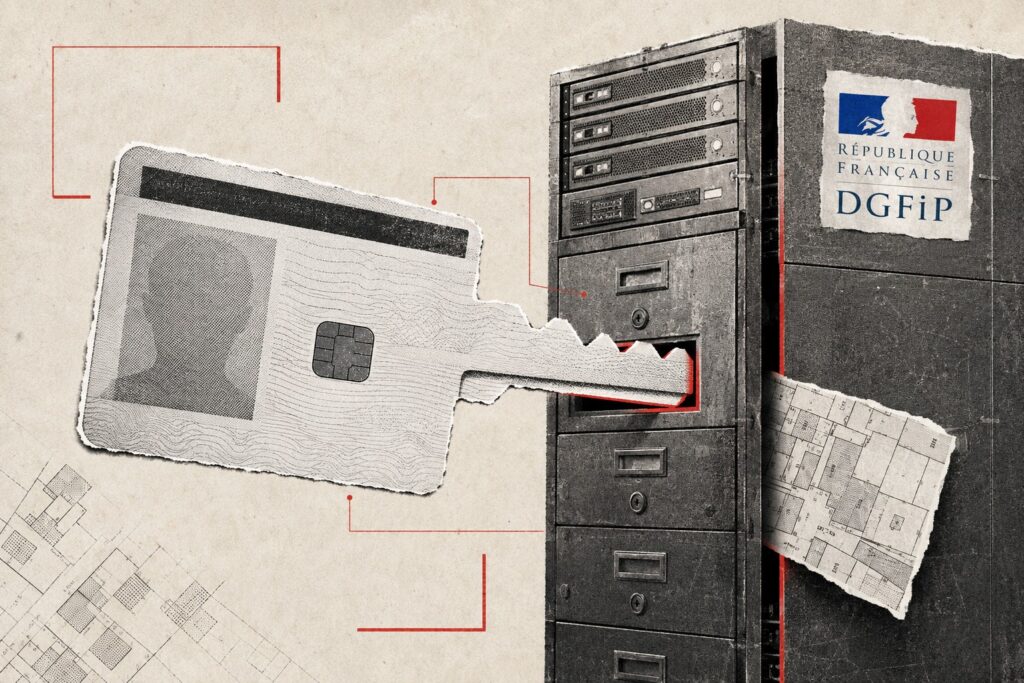
Cybersecurity Breach at France’s Public Finance Agency Raises Concerns
The Directorate General of Public Finances (DGFiP) has confirmed an unauthorized access to its information system, achieved through identity theft. The Ministry of Economy has not disclosed either the volume of data compromised or the number of affected users. An unverified claim suggests that this breach may involve cadastral data pertaining to over two million property owners.
The DGFiP managed to terminate this illicit access by the end of June as part of its monitoring efforts. However, it acknowledged that this breach facilitated both the consultation and extraction of personal and professional data. The entry point was identified as an identity theft incident, rather than a flaw in software vulnerabilities or data encryption. The compromised access was specifically related to professional entry controls.
On August 12, a malicious actor going by the name ZeroBytes claimed responsibility for the breach, as reported by FrenchBreaches, a website dedicated to tracking cybersecurity incidents in France. The Ministry of Economy released a statement the following day, stating that DGFiP teams are collaborating with the national defense and security office and the National Cybersecurity Agency (ANSSI). The administration also announced plans to inform the French Data Protection Authority (CNIL), file a complaint, and notify the affected users.
Identity Theft: The Key to Unauthorized Access
The Ministry of Economy’s announcement highlighted that the breach was facilitated solely by the “identity theft” technique, without mentioning anything about patched vulnerabilities, ransomware, or malware. The attacker successfully obtained legitimate access rights, while the administration failed to differentiate this access from a regular, authorized one.
According to the attacker’s account shared with FrenchBreaches, they infiltrated internal servers and gained access through a virtual private network (VPN) to a tool designed for researching both individuals and professionals. They claim to have automated data extraction before being disconnected, which they assert occurred during the exfiltration process.
These three components—compromised servers, VPN access, and internal tools—represent access rights rather than coding defects. Thus, identity functions as a control layer that ultimately governs actual exposure, more than any inventory of applied patches.
This access surface is tied to the 651 digital products that the DGFiP manages, as publicly reported by the agency itself. With over 5,000 IT personnel and systems serving up to 40 million individuals for personal taxation alone, each product necessitates service accounts, operational accesses, and consultation authorizations, creating numerous legitimate access points that must be adequately distinguished.
Subsequent Claim and Mult-factor Authentication Bypass
On August 14, the same hacker claimed access to the DGFiP’s professional parcel data server. According to FrenchBreaches, this encompasses 252,149 entries relating to 2,041,778 individuals, with multiple owners potentially linked to a single parcel. The attacker describes an authentication process followed by a bypass of the multi-factor authentication mechanism, which lasted long enough to automate part of the data retrieval.
These entries contain fields detail-oriented enough to link an identity to real estate assets, including name, gender, birthdate and place, owner’s address, land identifier, municipality, section, and parcel number, as well as rights associated with the property and other stakeholders tied to the same parcel. The attacker reportedly decided against further data extraction due to the lengthy process it would require. Neither this method nor the volume of data has been verified, and a direct connection to the access acknowledged by the Ministry has yet to be established. Despite implementing a second authentication factor for professional access, the challenge remains: while a second factor increases the cost of identity theft, it does not eliminate the possibility, and sufficient time spent on an access can facilitate automation of data extraction.
Figures from the Attacker, Not the Ministry
FrenchBreaches estimates about 678,437 individuals are included in the initial data set, with 392,867 of them being private individuals and 285,570 professionals. These figures stem from files the attacker has distributed, with the Ministry being the only entity capable of verifying them, yet it has not published any. The data file is reportedly being offered for sale for several thousand euros. Furthermore, this same source associates ZeroBytes with previous claims involving Intermarché, Eva GG, and the French Handball Federation, suggesting a pattern of recurring malicious activity rather than isolated opportunism.
The examined samples by FrenchBreaches include detailed financial references and income tax withholding rates, distinctively separating this extraction from mere address lists. The data comprises identifying information, tax addresses, family situations, number of shares, fiscal reference income, withholding rates, contact details, and the history of certain inquiries made to tax services. A fraudster aware of an active process undertaken by a taxpayer at their public finance center can craft a significantly more credible message than a generic email. Notably, there are 26,805 individuals in the sample reporting incomes of at least 100,000 euros, with 386 surpassing one million and eight exceeding ten million.
The attacker further claims that the tool they accessed provided entry to several tens of millions of individuals. This estimate is solely their own and does not indicate any actual data extraction or identifiable victims.
Meanwhile, the DGFiP will notify the CNIL and inform affected users regarding the data that may have been accessed, as they continue to determine the scope of the breach through ongoing investigations. The gap between the termination date of access at the end of June and the claim made on August 12 reveals that an access shutdown does not disclose what data has already been extracted.
As a direct consequence of this incident, an IT director has indicated that their access controls will require reassessment. The logs confirming the shutdown do not verify the extent of data extracted, prompting the data processing officers to quantify their notifications accordingly. The head of security will now personally oversee this matter, amplifying the significance of the exfiltration assessment.



