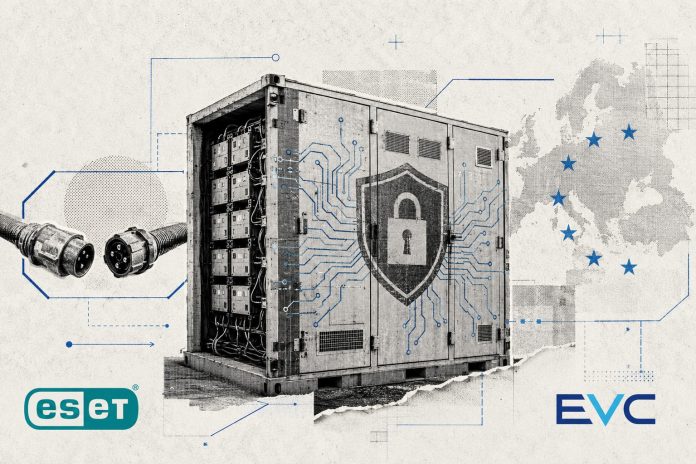
ESET and the EVC Group have signed a memorandum of understanding aimed at the development, certification, and marketing of a new generation of secure energy storage battery systems, termed CyberSec BESS, tailored for the European market.
This agreement establishes a cooperative framework between the two companies, focusing on integrating cybersecurity from the design phase of the battery storage systems, rather than retrofitting it onto already deployed equipment. “Battery energy storage systems are becoming essential components of energy infrastructure and must be secured from the outset,” said Martin Talian, Director of Business Solutions at ESET.
As the share of intermittent renewable energies grows, battery energy storage systems play a crucial role in stabilizing the European power grid. This connectivity exposes these systems to the same risks faced by other digital components in critical infrastructure. “A safe and resilient energy infrastructure cannot simply rely on adding technological components. It requires a comprehensive and cohesive approach,” explained Oliver Garaj, CEO of the EVC Group.
The Role of Battery Storage in the Digital Expansion of Power Grids
A battery storage system encompasses electrochemical cells, a battery management system, and communication gateways that connect it to the grid operator, facilitating remote control of charge and discharge cycles. This instrumentation turns it into a fully digital asset, subjected to similar risks as industrial automation systems or IoT gateways.
ESET and the EVC Group aim to achieve certification and design that inherently combine system integration expertise, cybersecurity, and industrial battery manufacturing, rather than merely applying patches to existing product lines. For an IT department overseeing connected sites, the distinction between security considered in the design phase and security added later determines the attack surface available once the system is operational.
A Sector-Specific Approach to ESET PRIVATE
Martin Talian leads ESET’s PRIVATE line, which was globally launched in May 2026 under this name, previously known as Corporate Solutions. This line is explicitly targeted at large enterprises, governments, critical infrastructure operators, and manufacturers with legacy operational technology systems. ESET’s 2025 Annual Report highlights industrial security and critical infrastructure as growth areas, alongside artificial intelligence and managed detection and response (MDR).
“ESET’s role is evolving from a convenience provider to a strategic partner that delivers tailored security solutions,” summarized David Během, Vice President at ESET, regarding the PRIVATE line. CyberSec BESS extends this approach to battery energy storage, linking the EVC alliance to a pre-existing strategy rather than presenting it as a standalone incursion.
A Regulatory Timeline Driving Resilience from the Ground Up
Battery storage systems will likely be governed by multiple overlapping European regulatory frameworks set to take effect by 2028, including the NIS2 directive for the resilience of critical energy infrastructure operators and the Cyber Resilience Act, aimed at products containing digital elements. Both regulations converge on the requirement for built-in resilience, reinforcing the argument made by ESET and the EVC Group for CyberSec BESS.
By integrating certification from the outset, ESET and the EVC Group preemptively address obligations that will eventually fall to end-users, shifting part of the compliance burden from the customer to the provider, presenting both a competitive and resilience-oriented advantage over rivals whose offerings remain subject to post-hoc security measures.
The memorandum of understanding established between the two companies outlines a framework for collaboration but does not yet specify certification timelines, commercialization dates, or identified industrial clients for the initial rollout of CyberSec BESS. As is typical with such agreements, it sets the groundwork for a shared working approach rather than dictating delivery contracts with established timelines. The gap between announcing a collaborative framework and bringing a certified product to market is a crucial point that procurement and infrastructure leads should verify with ESET and the EVC Group before integrating CyberSec BESS into their energy roadmaps.
Two European Companies Competing Against Established OT Security Specialists
ESET, based in Slovakia, differs from established players in the field of industrial system and critical infrastructure security, such as Claroty (founded in Israel and now based in New York), Dragos, and Nozomi Networks, both based in the United States. A declared end-to-end European partnership is rare in such a capital-intensive segment as battery energy storage.
This European origin does not exempt the need for a technical and pricing comparison with existing offers among critical infrastructure integrators, similar to the partnership between AVEVA and Assystem focused on critical infrastructure.