

Honor Robot Phone: the brand unveils a 200-megapixel sensor, a custom photo chip, and an unprecedented partnership with ARRI
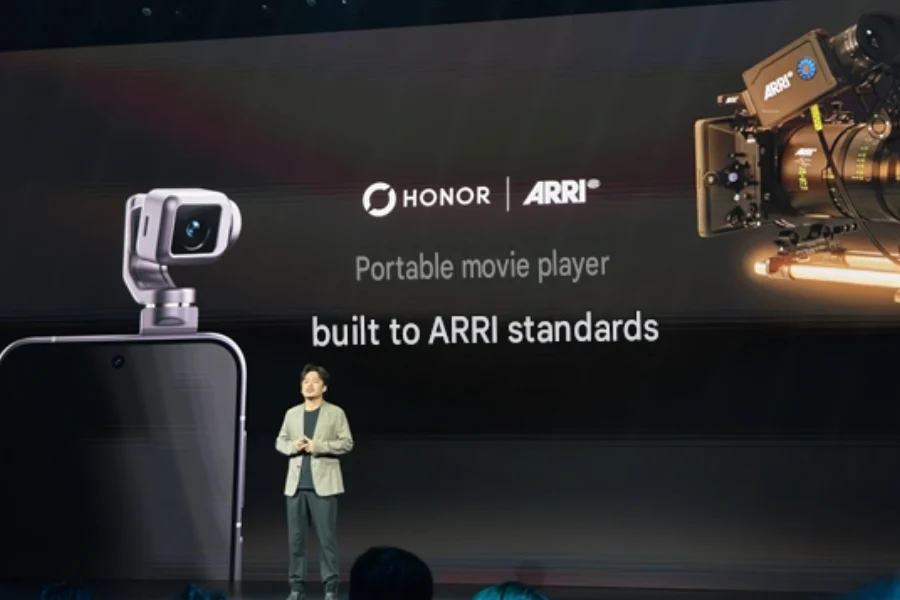
With the official launch just days away, the Honor Robot Phone continues to reveal its ambitions. During a dedicated imaging technology event held in Hengdian, China, Honor unveiled the full range of photographic features of its upcoming smartphone. This was also the perfect opportunity to announce its strategic partnership with ARRI, a global reference for professional cinema cameras.
Beyond a simple marketing collaboration, Honor aims to introduce tools from the film industry directly into a smartphone for the very first time.
A Triple Camera Setup Dominated by a 200-Megapixel Module
The Honor Robot Phone, which is set to be unveiled on **August 12th**, will feature a **particularly ambitious photographic configuration**. The rear module will include a **200-megapixel primary sensor** based on a 1/1.28-inch sensor with an f/1.6 aperture, a 50-megapixel ultra-wide lens, and a periscope telephoto lens also at 200 megapixels.

The main sensor will be mounted on an impressive three-axis motorized gimbal that is a signature of the Robot Phone, aiming to enhance stabilization during photo and video captures.
A New Imaging Chip
Honor is also using this launch to **introduce the Yuguang H1, an internally developed chip designed to accelerate image processing**. This chip works in tandem with a particularly compact stabilization engine.
According to Honor, this motor weighs just 2.6 grams, is 65% more compact than traditional gimbal motors, and offers 35% greater torque density. The company also indicates that the development of the Robot Phone has resulted in the filing of over 100 patents, illustrating the strategic importance of this project.

Image Processing Done Entirely on the Device
On the software front, Honor announces a new real-time image processing architecture operating directly on the smartphone. This platform supports features such as white balance, exposure, tone control, glare reduction, and automatic detail enhancement across multiple sensors.
The Robot Phone will also debut **AIMAGE 2.0, a new stabilization engine designed to maintain smooth sequences both at rest and in motion**.
The goal is to reduce dependence on cloud processing while delivering high performance directly on the device.
ARRI Provides Tools from Professional Cinema
The **partnership with ARRI is one of the main highlights of the Robot Phone**. The smartphone will directly integrate several technologies inspired by workflows used in the audiovisual industry, including Log-C video encoding, cinematographic LUTs for color grading, and manual focus, exposure, and white balance locking.
Honor also notes that the smartphone will be capable of recording certain data related to camera movements, a feature designed to facilitate more advanced video productions.
A Technology Set to Equip Other Honor Smartphones
The manufacturer does not intend to limit these innovations solely to the Robot Phone. Honor confirms that **its new imaging system will be gradually deployed across other models, starting with the upcoming Magic 9 series**.
The company also announces the creation of a joint lab with ARRI, aimed at continuing the development of new photographic and video technologies for future smartphones from the brand.
Honor Aims to Bring Smartphones Closer to Professional Cameras
With the Robot Phone, Honor adopts a strategy that differs from many manufacturers, which primarily rely on artificial intelligence to enhance image quality. The company is also investing in hardware innovations, such as a miniaturized motorized gimbal and a dedicated processing chip, to provide creators with more control over their content.
The partnership with ARRI confirms this direction. Rather than solely seeking mobile photography performance, Honor aspires to bring smartphone usage closer to the standards of professional audiovisual production. If this approach proves successful in initial tests, the Robot Phone could pave a new way in a market where manufacturers are now looking to differentiate themselves through creative tools as well as the sheer power of their sensors.
<!-- related wrap -->


