

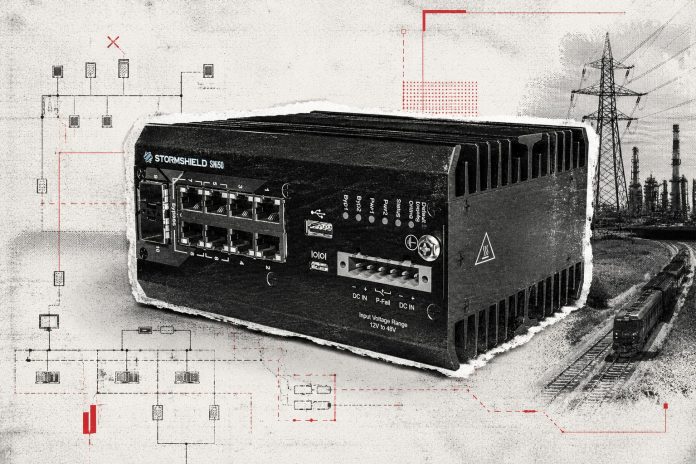
The Stormshield SNi50 is an industrial firewall designed to secure extensive operational environments. This equipment targets critical infrastructures in transportation, energy, healthcare, and industry with a high density of copper and fiber interfaces, redundancy mechanisms, and deep protocol inspection. The firmware, developed in France, has received certification from the French cybersecurity authority, ANSSI.
The SNi50 extends the range of Stormshield’s industrial firewalls to accommodate the most complex sites, including those with multiple production lines or spread across various locations. As a prominent player in European cybersecurity, Stormshield designs its devices to safeguard operational systems, prioritizing production chain availability over all other considerations.
This announcement reflects the ongoing convergence of IT and operational networks, exposing previously isolated automation systems and equipment to the same threats faced by management systems. The increased openness of industrial systems necessitates devices capable of inspecting traffic without disrupting processes that are sensitive to downtime. The Operational Technology (OT) firewall segment addresses this specific concern, where security breaches can be more costly than a temporary shutdown.
A Design Focused on Availability
The SNi50 delivers firewall throughput of up to 20 Gbit/s, 4 Gbit/s for intrusion prevention on mixed traffic, and 2.7 Gbit/s for IPsec virtual private networks. Its dense array of copper and fiber interfaces allows it to integrate into extensive network infrastructures without requiring major redesigns. The equipment operates within a temperature range from -40 to +70 degrees Celsius, meets the IP40 protection rating, and complies with various industrial standards. It also supports native installation on DIN rails.
Continuity of operations is a guiding principle in its design. The device incorporates two pairs of interfaces with bypass functionality, automatic failover, and backup power supply. Stormshield claims a mean time between failures of 108 years, a statistical indicator of hardware reliability that does not account for protection against attacks. In the event of a failure, these mechanisms ensure production chain availability, even across installations at multiple sites.
This emphasis on availability sets the industrial firewall apart from its enterprise counterparts. In a management network, a security device may block a suspicious flow as a precaution. However, on a production line, the same blockage can interrupt a physical process, sometimes at a remote site that is difficult to access. Enhanced security modes and bypass interfaces address this dilemma by allowing traffic to continue instead of cutting off the line when the device malfunctions. Here, continuity takes precedence over security—a deliberate choice in infrastructures where downtime is not an option.
Three Use Cases for Networking
The first use case involves network segmentation within industrial environments. The firewall establishes security zones and controls access to isolate sensitive assets, combining routing and transparent bridging to integrate seamlessly without altering the existing architecture. This segmentation and access control align with best practices outlined in the NIS2 directive and the IEC 62443 standard, with the SNi50 providing controls to support their implementation.
The second use case focuses on securing commands sent to machines. Deep packet inspection verifies protocol compliance and checks transmitted values to ensure that no instruction disrupts operational processes. The third use case addresses remote access for maintenance operators, whose access can facilitate interventions but also expose networks. By utilizing a virtual private network client, this exposure is limited to identified operators, and coupling this with packet inspection restricts what these accesses permit.
These three use cases create a layered defense for operational systems, where zone isolation, command filtering, and remote access control work in tandem. For OT security teams, often separate from IT teams and less equipped, the challenge lies in integrating these functions without overhauling a trusted architecture. The hybrid deployment that combines routing and transparent bridging addresses this hesitation, avoiding the reconfiguration of a network whose stability is critical to production. The decision to adopt an OT firewall frequently hinges on this factor, rather than on the available features of the device.
ANSSI Standard Certification for the Firmware
Stormshield emphasizes its French design and development, alongside certification from European agencies. The firmware of its firewalls holds the ANSSI Standard Qualification in France and a similar certification from the National Cryptologic Center in Spain. This qualification verifies a recognized level of trust for network security products, distinct from the SecNumCloud qualification, which pertains to cloud computing services and does not apply to hardware equipment.
For security officials at vital infrastructure operators, the French origin and ANSSI qualification mitigate exposure to non-European legislation regarding a sensitive element of the industrial network. This argument is particularly relevant, given that border and remote access equipment are among the most frequently targeted entry points by ransomware operators, who aim to breach networks through remote access gateways before moving laterally within. Therefore, controlling the supply chain of the protection device itself becomes as crucial as its performance, since a compromised security device can directly open the door it was meant to secure.
The SNi50 launches at a time when the French transposition of the NIS2 directive is still underway, and operators of critical infrastructures are preparing for upcoming obligations. Decision-makers evaluating the equipment should differentiate what the hardware offers—segmentation and traffic inspection—from broader compliance efforts that also involve governance and procedures. Understanding the interplay between NIS2 and operational resilience is essential to contextualize the firewall within a framework that exceeds its independent features.



