

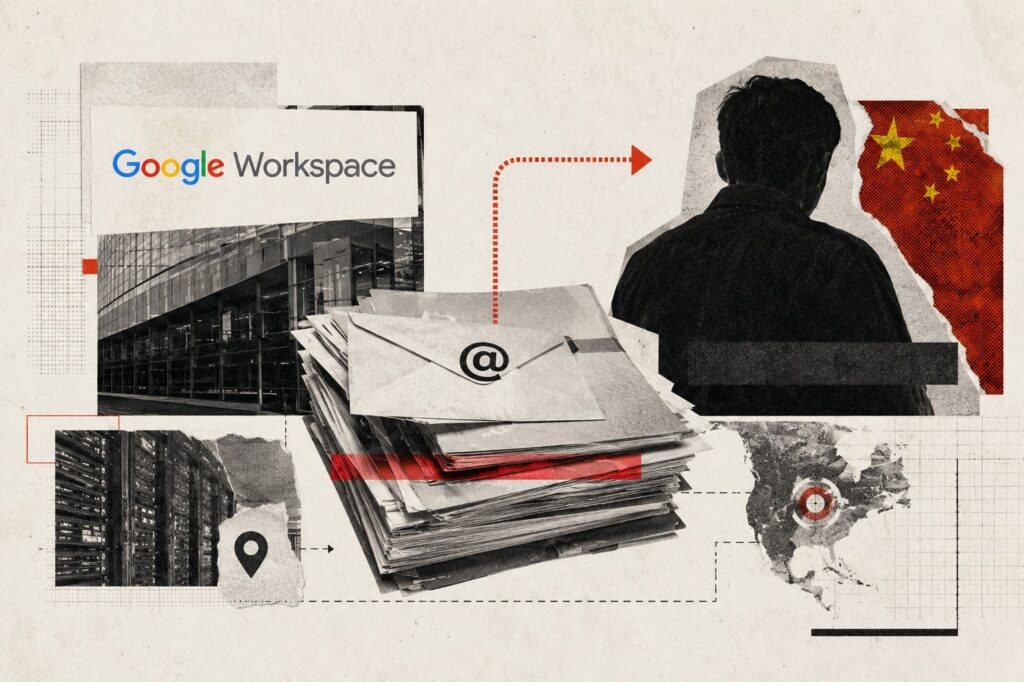
Google’s Threat Intelligence Group has linked a China-affiliated actor, known as UNC6508, to an espionage campaign that exploited a native feature of Google Workspace to exfiltrate sensitive emails. The attacker repurposed a compliance rule to covertly copy emails to an address under their control. The initial entry point was a series of compromised REDCap medical research servers in North America, with the intrusion remaining undetected for over a year.
A report released this week by Google’s threat intelligence team outlines an attack chain that unfolded from September 2023 to November 2025. UNC6508 initially targeted exposed REDCap servers on the internet, a data collection software used by medical and academic research institutions. The actor deployed custom malware, dubbed INFINITERED, designed to capture legitimate user login credentials.
The persistence mechanism leverages a highly effective obfuscation technique. INFINITERED infects REDCap’s system files and hijacks the software update process so that each new version re-injects the malware instead of removing it. The malware captures usernames and passwords from the login page, storing them encrypted in local tables and acting as a backdoor that receives instructions via HTTP cookies with each page load.
The choice of initial target is no accident. REDCap servers host clinical and academic research data, often exposed online to facilitate remote input by distributed teams. By embedding itself in the software rather than on individual workstations, the actor established a sustainable observation point, bolstered by the update cycles rather than eliminated by them. This resilience, achieved through the hijacking of the update process, sets the campaign apart from a mere opportunistic intrusion.
Compliance Rule Turned Exfiltration Channel
More than a year after the initial breach, UNC6508 reused credentials obtained from the REDCap servers to gain access to an administrator account within the domain and subsequently to the victim’s internal network. At this stage, the actor employed a novel technique identified by researchers. Once in possession of the domain admin rights, they added a malicious content compliance rule that secretly copied any email matching defined keywords to an address controlled by the attacker.
This hijacked function is legitimate and common in most hosted office suites, typically used to enforce compliance policies on messages, such as archiving or inspecting certain communications. When repurposed by a compromised administrator, it transforms into a discreet exfiltration channel that requires no malware on devices or suspicious outgoing connections from the victim’s network. The keywords in the rule aligned with the actor’s collection priorities, including geostrategic issues, military strategy and equipment, advanced technologies such as AI and autonomous vehicles, offensive cyber operations, and medical research.
The Risks of Hosted Office Suites
This attack highlights a category of threats that does not rely on software vulnerabilities. No flaws in Google Workspace were exploited; the adversary abused an intended administrative function from a legitimate account that had been compromised. Thus, the security of the tenant relies entirely on the management of privileged accounts and monitoring of configuration changes. SaaS applications and their data protection settings present a vulnerable surface that traditional defense tools, which focus on endpoints and networks, inadequately address.
The subtlety of this approach explains the prolonged duration of the intrusion. A compliance rule that copies messages does not trigger any network leak alerts because the traffic originates from the email servers themselves. Detection requires auditing the domain’s administrative rules and their modifications, telemetry that many organizations do not collect. Consequently, UNC6508 operated undetected for over a year.
The profile of collected information reconstructed by Google places this campaign within the realm of long-term strategic espionage, distinct from financial crime. The selection of emails based on keywords related to defense, AI, and medical research indicates an actor who utilizes patience as a weapon and prioritizes the value of intelligence over immediate impact. For research organizations, laboratories, and their industrial partners, the signal is clear: a hosted collaborative suite becomes a prime target when it contains sensitive communications.
Auditing Privileged Accounts and Domain Rules
For Chief Information Security Officers (CISOs), the response revolves around governance of administrator access and reviewing configurations rather than implementing new tools. Periodic reviews of content compliance rules, monitoring of privileged account activity, and enhanced authentication for administrative access can close the channels exploited by the attacker. Assessing exfiltration activity must also account for internal channels within the office suite, not just outgoing flows to the internet.
The lesson extends beyond the REDCap case. A compromised administrative account in a hosted suite provides access to governance functions whose malicious use can closely resemble legitimate activity. French organizations subjected to data protection obligations and exposed to research espionage should inventory the administrative functions of their collaborative suites and implement enhanced monitoring, before an attacker conducts the inventory for them.



