

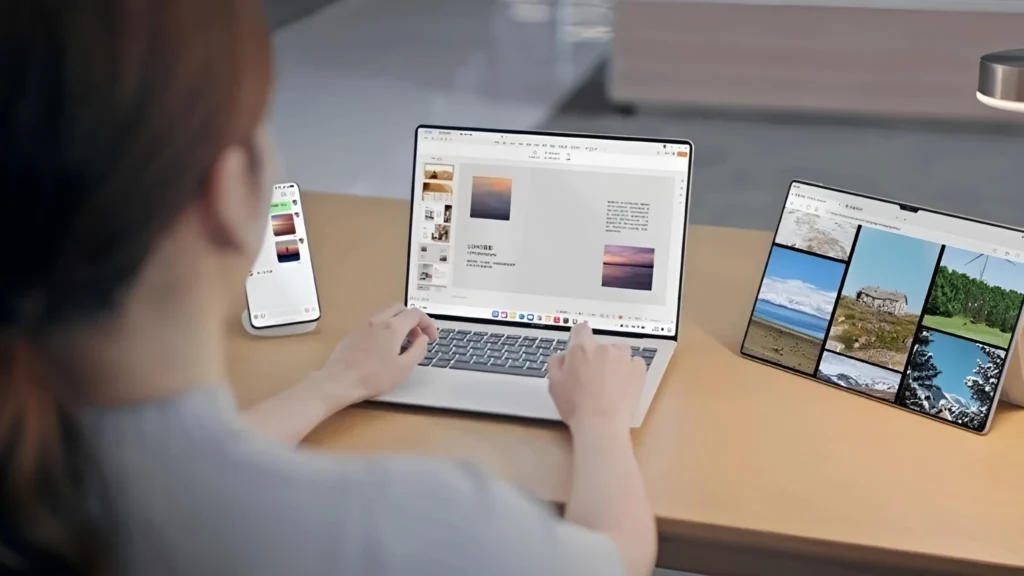
Huawei accelerates in professional PCs: HarmonyOS set to land in companies starting September
After conquering smartphones, tablets, and connected devices, Huawei is now targeting a much more strategic area: enterprise computing.
During the HDC 2026 developers conference, the Chinese company confirmed the official launch of its first professional computers running HarmonyOS starting in September. This is a significant step for the company as it pursues its strategy of technological independence by building a comprehensive ecosystem capable of competing with the dominant market platforms.
Beyond merely changing the operating system, Huawei aims to impose its own vision of the modern workplace, focused on security, software integration, and control over the entire technology chain.
PCs Designed From The Ground Up For Businesses
The announcement was made by Zhu Dongdong, president of Huawei’s Tablet and PC division, during the “HarmonyOS Office” forum held at the event. According to the executive, the first pilot programs aimed at businesses are expected to start between July and August, with an official launch planned for September.
Huawei has already revealed two models intended for this new push: HM740 and HM940. Unlike the consumer PCs equipped with HarmonyOS, these machines are specifically tailored to meet business needs.
The clear goal is to address the growing demands for cybersecurity, regulatory compliance, and protection of sensitive data.
Enhanced Security And Proprietary Architecture
One of Huawei’s key selling points is security. The new professional PCs feature a dedicated security chip, strengthened protection mechanisms, tools for compliance in professional environments, and a digital separation of personal and business spaces.
This “dual space” function allows users to isolate their private data from their business data within the same device, thereby reducing the risks associated with the increasingly common hybrid use in organizations.
In a context where digital sovereignty is becoming a major issue for many administrations and large companies, Huawei clearly bets on this argument to attract decision-makers.
The HM740 Showcases The New Generation
Among the first models revealed, the HM740 embodies Huawei’s ambitions. The device measures only 14.5 mm thick, weighs just 1.32 kg, features a 14.2-inch OLED display with a 120 Hz refresh rate, and boasts up to 21 hours of advertised battery life. On paper, these specifications position it more as a premium ultraportable than merely a professional terminal.
Huawei aims to combine mobility, battery life, and software integration in a format capable of meeting the needs of modern workers.
HarmonyOS Becomes A True Computing System
For several years, HarmonyOS was primarily viewed as a response to restrictions imposed on Huawei in the mobile sector. However, in 2026, the situation has changed. The operating system is now present on smartphones, tablets, smartwatches, televisions, connected devices, and now, computers.
With HarmonyOS 7 recently unveiled, Huawei pushes further the integration of artificial intelligence, cloud services, and device interconnectivity.
The arrival of professional PCs therefore represents a logical progression in this strategy. The goal is no longer just to offer an alternative system but to build a comprehensive computing platform capable of operating independently from Western ecosystems.
A Strategic Market For Huawei
This offensive comes at a time when the PC market is undergoing a profound transformation. Artificial intelligence, cybersecurity, and digital sovereignty are becoming just as important in purchase criteria as hardware performance.
For Huawei, the professional segment represents a major opportunity.
Companies are increasingly seeking secure environments, customizable systems, better data control, and smooth integration across different devices. By offering a unified experience between smartphones, tablets, and computers, Huawei tries to replicate the ecosystem logic that has made companies like Apple successful in the business world.
Huawei Aims To Control The Entire IT Experience
The announcement of the first professional HarmonyOS PCs goes far beyond simply launching new computers. It marks a new milestone in Huawei’s transformation into a comprehensive IT platform provider. The company is no longer just looking to compete with hardware manufacturers; it now seeks to rival the major software ecosystems that have shaped the industry for decades.
While international adoption remains uncertain, the Chinese market could serve as a large-scale laboratory to demonstrate the viability of a fully integrated alternative, from the operating system to the hardware.
One thing is already clear: HarmonyOS is no longer just a mobile system. Huawei aims to make it the backbone of its future IT empire.



