

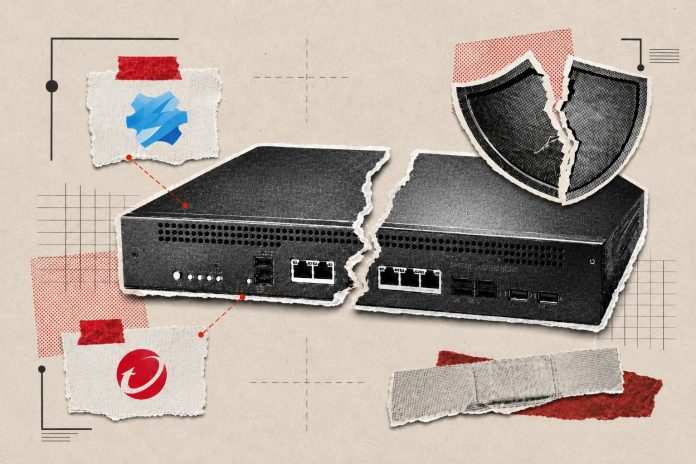
Two critical vulnerabilities have been discovered in widely deployed enterprise security products: Stormshield Network Security firewalls and Trend Micro’s Apex One endpoint protection suite. The CERT-FR has issued a warning regarding the Stormshield vulnerability, rated CVSS 9.1, which allows for remote code execution without authentication. Additionally, CVE-2026-34926, targeting Apex One, has been included in CISA’s catalog of actively exploited vulnerabilities since May 24, with a CVSS score of 8.8. Both vendors have released patches for these vulnerabilities.
As of late May 2026, two protective solutions are simultaneously exposed to active attacks, highlighting a concerning trend. Tools that are supposed to safeguard information systems have become prime entry points for attackers, reflecting a pattern identified in ANSSI’s reports on the threat landscape in France over the past three years. The recurrence of such vulnerabilities in products used by thousands of organizations across France and Europe poses immediate operational risks for security teams.
The timing of these alerts exacerbates the threat. The CERT-FR notification regarding Stormshield (CERTFR-2026-ALS-006) was published on May 26, 2026, coinciding with a holiday bridge across several European countries. This period typically sees reduced security team presence and tighter windows for deploying patches. Attackers are acutely aware of this timing and exploit it. The inclusion of Apex One in the KEV catalog just two days after Trend Micro’s patch release indicates that exploitation had likely begun before most organizations were able to respond.
Stormshield SNS: Remote Code Execution Without Authentication
The vulnerability affecting Stormshield Network Security allows an unauthenticated remote attacker to execute arbitrary code on the appliance. With a CVSS score of 9.1, CERT-FR has classified this alert as Critical. The affected versions include SNS 3.x and SNS 4.x prior to the corrective versions released on May 26, specifically SNS 3.11.27 and SNS 4.7.7. The attack vector lies on the administration interface exposed to the network, with the level of exposure varying based on whether this interface is accessible from a dedicated, segmented administrative network or a broader area. Organizations that have not segmented access to this interface are particularly vulnerable to undetected exploitation.
Stormshield is a French cybersecurity provider certified by ANSSI, with its SNS products deployed by critical infrastructure operators and entities subject to NIS2 regulations. The timeliness of applying patches is a significant audit criterion for essential and important entities under this regulation. CERT-FR recommends immediate application of the update, restricting access to the administration interface to trusted IP addresses, and reviewing the access logs from the past 30 days for any unusual connections that may have occurred prior to the patch.
Trend Micro Apex One: Privilege Escalation Confirmed by CISA
CVE-2026-34926 affects Trend Micro Apex One, a widely-used endpoint protection solution in large enterprises and regulated environments. This vulnerability enables an attacker with limited local access to escalate their privileges to the SYSTEM level in Windows. CISA added this CVE to its catalog of actively exploited vulnerabilities on May 24, 2026, confirming that exploitation was occurring in real-world conditions. Trend Micro issued Patch 6.220 on May 22, resulting in just a two-day window between the patch’s availability and the documented active exploitation, highlighting a significant reactive shortfall in affected environments.
This vulnerability requires prior local access, positioning CVE-2026-34926 within an attack chain rather than as an initial entry vector. In practice, attackers typically exploit this privilege escalation after a successful phishing attempt or perimeter vulnerability exploitation to gain full control of the machine before moving laterally through the network. The fact that the security solution itself serves as the leverage for escalation complicates detection for standard event log monitoring tools. CISA has set a deadline of June 13, 2026, for U.S. federal agencies to apply the patch; for French organizations, the presence of this vulnerability in the KEV catalog leaves little justification for delay.
Security Products: Recurring Attack Vectors Since 2023
The coincidence of these two alerts underscores a structural trend that has emerged since 2023. Security solutions have become prime targets for advanced threat actors. These products inherently have elevated privileges on the systems they protect, continuously access sensitive data, and communicate with centralized management infrastructures—traits that make them prime pivot points once compromised. An attacker who takes control of a firewall or EDR agent can blind defenders by stealthily altering filtering rules or disabling alert notifications to the management console.
For security teams, the operational lesson is twofold. Security products must undergo the same patch management processes and adhere to the same SLA for application as any other critical infrastructure component. Despite this being an evident necessity, it remains inadequately reflected in practice, according to observations from CESIN. Furthermore, monitoring the integrity of these products—which includes tracking unexpected configuration changes, unplanned service outages, and abnormal outbound connections—should also be integrated into detection scenarios for security operations centers. Both vendors have confirmed the immediate availability of their respective patches. No long-term workarounds are provided as substitutes for the updates.



