

Wikipedia Turns 25: How the Human Encyclopedia Became the Brain of AI
On January 15, 2001, Wikipedia launched with just a hundred pages. Twenty-five years later, the encyclopedia has evolved into one of the invisible infrastructures of the Internet: over 65 million articles, nearly 15 billion page views per month, and its vast usage flows into research as well as AI chatbots.
Wikipedia: The Backbone of the Web in the Age of Generative Models
The Wikimedia Foundation emphasizes in its anniversary message: Wikipedia is currently among the most visited sites in the world and remains a noteworthy exception— a knowledge pillar run by a nonprofit organization. In a web saturated with automated summaries, its value resides in what AI struggles to produce alone: a corpus that is written, reviewed, contested, and consolidated by humans.
This tension—between reliability, participation, and technological pressure—serves as the central theme of this anniversary.
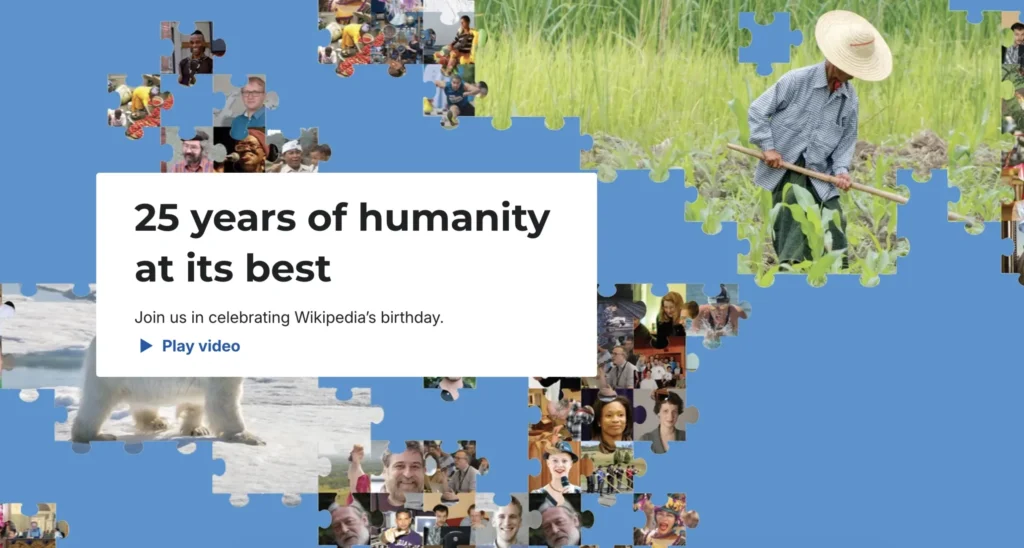
To celebrate the occasion, the Wikimedia Foundation is releasing a mini-series of clips showcasing 8 volunteer editors from around the world. The selection serves as a manifesto: Wikipedia is not a “database”; it is a collective effort.
Among the featured profiles:
- “Hurricane Hank,” a contributor since 2005, notably associated with the page on Hurricane Katrina
- Netha, a doctor in India, who mobilized her expertise to counter misinformation during the Covid pandemic
- Joanne (UK), who created a page after discovering a subject on Instagram (Eloise Butler, a figure in a public wildflower garden in the US)
- Gabe, dedicated to better documenting and representing historical Black figures
The underlying message is clear: as AI summarizes everything, Wikipedia emphasizes those who source, correct, and embrace nuance.
A “Time Capsule” and a Livestream: The Anniversary as a Digital Object
Wikimedia is also launching a digital time capsule, including an audio message from Jimmy Wales and reminders of moments when Wikipedia faced surges in traffic, such as during the spike after Michael Jackson’s death in 2009.
For the celebration, a livestream event is scheduled for 5 PM tonight, and individuals can sign an online birthday card.
The Anniversary Comes at a Time When Wikipedia is Regaining “Strategic” Importance
This 25th anniversary is more than a mere symbol: it represents a turning point. As generative models train on vast corpuses and search engines transform, Wikipedia is emerging as a “reference” resource—and thus as an economic, political, and cultural stake.
On the same day, Reuters reports that Wikimedia has signed new agreements with several major players (including Microsoft, Meta, and Amazon) to provide paid access to its content in formats suited for AI training—a strategy to compel the ecosystem to cease scraping content for free and to fund a platform whose server costs are skyrocketing with the rise of AI.
Despite ongoing accusations of bias from certain political leaders, the platform continues to attract substantial traffic, with over 1.5 billion unique devices accessing it each month, according to communications tied to the anniversary.
At 25, Wikipedia has not only survived; it has become one of the most contested pieces of the modern web—because everyone needs knowledge, but few know how to produce it.



