

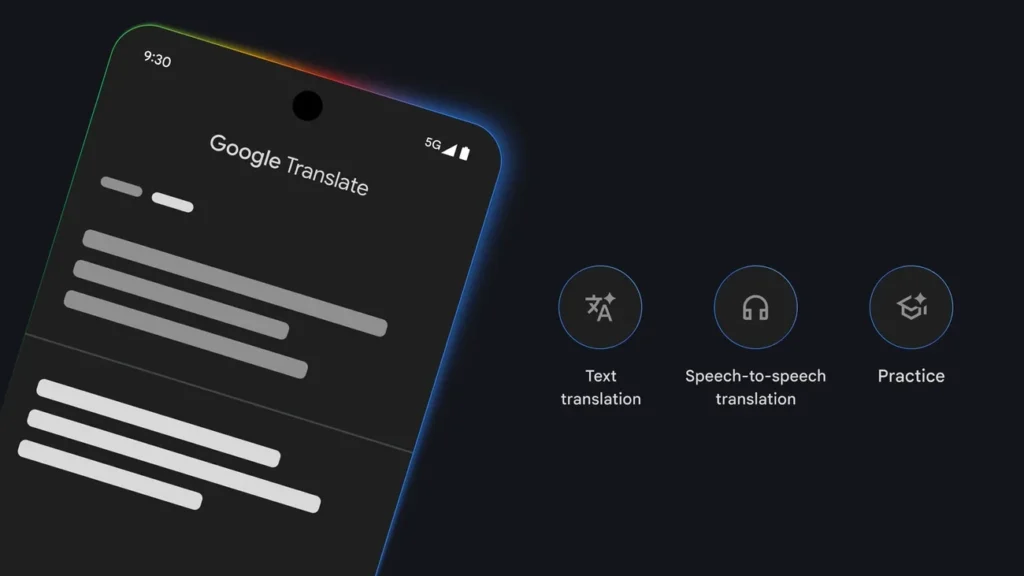
Google Translate: Soon Three Translation Variants for Choosing the Right Tone
Over the past month, Google Translate has been revitalized with Gemini, resulting in more natural translations and tools that behave more like “assistants” rather than mere “dictionaries.”
The next step seems to be on the horizon: a button that can display multiple variants of the same translation, allowing users to select the appropriate tone instead of settling for a single option.
Google Translate is Evolving into an AI Product, Not Just a Translation Service
On December 12, 2025, Google announced the integration of “state-of-the-art” translation capabilities from Gemini into Google Translate, aiming to enhance fluency, tone interpretation, expressions, and colloquial language — essentially addressing shortcomings traditionally associated with automated translation.
This shift marks a clear trend: Google Translate is no longer designed merely as an “input → output” mechanism but as an interface where users can understand, adjust, and soon engage in dialogue with the results.
The discovery originated from an APK teardown identified by Android Authority in the version Android 10.0.36.855137688.3-release. While the feature is not currently available to the general public, it appears when forcing a display of buttons still in development, namely “Understand” and “Ask.” In this context, a new button labeled “Show alternatives” is presented beneath the translation.
By clicking this button, the application would reveal three alternative translations that are similar yet slightly different — a minor change in phrasing, a tonal nuance, or a varied level of politeness.
Why This is a Significant Upgrade: Nuance Finally Treated as a Choice, Not a Flaw
In real life, a “good” translation isn’t always the most literal one; it’s the one that respects social context. Politeness levels, language registers, honorifics (like in Japanese), and idiomatic expressions are precisely the areas where a singular outcome can feel awkward or even incorrect.
With built-in alternatives, Google Translate could alleviate current friction: instead of rewriting your original sentence to “force” a different rendering, you would choose the variant that best fits the situation. Android Authority points out that this feature seems particularly geared towards navigating differences in formality.
Google is Steering Google Translate Towards a “Language Assistant” — in Line with Gemini
This button isn’t appearing out of nowhere; it ties in with the features “Understand” (to explain why a translation is phrased in a certain way) and “Ask” (to request a more suitable reformulation). Together, these elements indicate a more interactive Google Translate experience: options + justification + iteration, resembling a mini language editing suite.
Of course, it’s important to maintain the typical caution with analyzed APKs: what exists in the code may be delayed, altered, or may never be released. However, the direction is clear and aligns with Google’s initiative launched in December with Gemini: to make translations more contextual, more “human,” and essentially more useful when nuance is crucial.



