

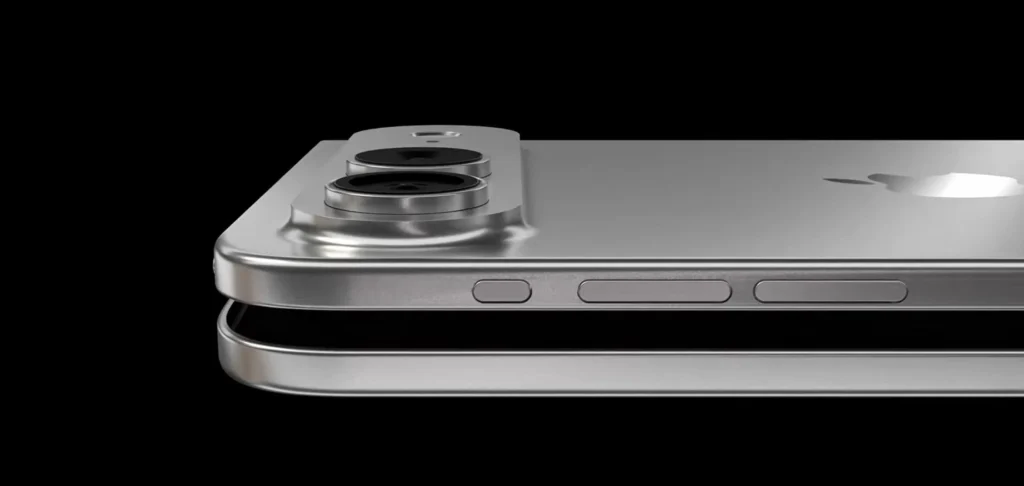
iPhone Fold: Apple bets on Liquidmetal and a revised titanium for its hinge
As the iPhone Fold comes into clearer view, one persistent concern remains: the hinge — that mechanical pivot point where the promise of foldability could also turn into a vulnerability.
Recent rumors introduce an ambitious combination: Liquidmetal hinge and a titanium chassis, while the last few months had seen the aluminum chassis scenario gaining traction.
Why Are Materials the Real Mystery Behind the First iPhone Fold?
A foldable smartphone is fundamentally a feat of engineering: fatigue resistance, microscopic tolerances, frame rigidity, and wear management—all under constraints of weight and thickness. In other words, material choice isn’t just an aesthetic detail; it’s a structural decision.
However, the unfolding saga of leaks is contradictory: an initial wave suggested “titanium + Liquidmetal,” then shifted to the idea of an aluminum chassis (less expensive, easier to industrialize), and now there’s a resurgence of titanium claims from a source with an irregular track record.
Liquidmetal for the hinge, revised titanium for the chassis
The rumors today source from yeux1122 (Naver): Apple may be utilizing a Liquidmetal hinge (an amorphous metallic alloy) and a reworked titanium chassis, touted as more durable while allowing for weight reduction at comparable surface area.
What’s intriguing here is not just the formulation but the underlying message: Apple seems to be focusing on securing the reliability of the hinge mechanism with a material crafted for repeated stress, while also maintaining a premium exterior.
Liquidmetal: Finally a Credible Structural Application
Apple has a notable history with Liquidmetal: since 2010, the company has held an exclusive licensing agreement with Liquidmetal Technologies, using the material solely for smaller components (like the SIM eject tool).
Indeed, a hinge is where the amorphous alloy could make sense, given its toughness, deformation resistance, and ability to be molded with precision—attributes sought for a compact part subjected to thousands of cycles.
Titanium: Premium Yes — But Costly and Not Always Logical
Titanium certainly ticks the “premium” box, but it also raises concerns about costs and industrial complexity. For a first foldable device, Apple is already contending with the challenges of foldable screen yields, more intricate assembly, stricter quality control, and potentially limited volumes. Kuo himself recently warned of production constraints that could affect availability until 2027.
In this context, aluminum (or a titanium/aluminum hybrid) remains a “pragmatic” scenario to balance weight, cost, and throughput—which explains why many rumors have favored it.
And What About the Timeline: 2026, But with Gradual Ramp-up?
Regarding timing, few changes are anticipated: several sources continue to suggest a launch in 2026, with initial volumes kept limited and a clearer ramp-up afterward—a classic approach for a complex first-generation product.
In short: while Apple strives for mechanical excellence, they can afford to be slow—but not at the expense of reliability. And for a foldable smartphone, the hinge is the ultimate test.



