

WhatsApp strengthens its security with multiple passkeys and a more robust two-step verification
WhatsApp is enhancing the security of its accounts. The Meta messaging platform is rolling out several new features aimed at preventing account takeovers, streamlining authentication across multiple devices, and assisting users in easily identifying suspicious calls.
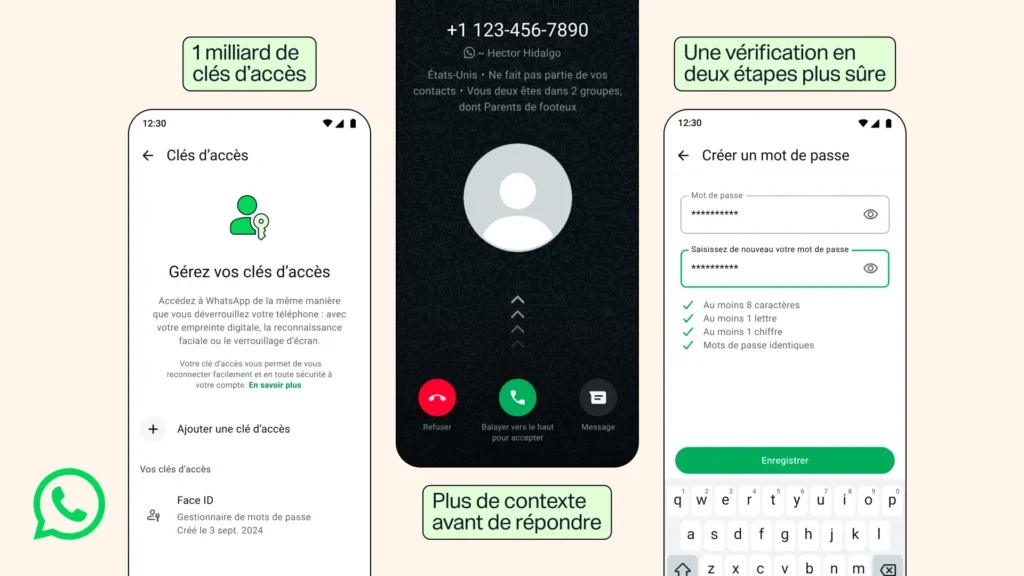
Among the significant changes are the ability to store multiple passkeys on the same account, a two-step verification process now compatible with real passwords, and more information displayed before answering unknown numbers on Android.
Over a billion users have adopted passkeys
WhatsApp claims that more than a billion people are now using passkeys to secure their accounts. The concept is straightforward: instead of entering a code received via SMS, users can confirm their identity using the security mechanisms already available on their device, such as a fingerprint, facial recognition, or unlock code.
This approach has several advantages.
It notably reduces reliance on SMS, which can be intercepted during certain attacks, while eliminating some of the passwords or temporary codes that users have to remember or write down.
WhatsApp is taking a step further by allowing users to associate multiple passkeys with a single account.
Multiple passkeys for switching between iPhone and Android
Previously, using passkeys could become less convenient for those with multiple devices or switching between different ecosystems. WhatsApp now allows users to register several. For example, someone with both an Android smartphone and an iPhone can have a passkey adapted to each of their devices, without being limited to a single hardware environment.
Configuration can be done via: Settings > Account > Passkeys. This change may seem minor, but it makes the technology much more relevant for practical use.
Passkeys become truly interesting when they can travel with a user across multiple devices without recreating the limitations of the passwords they aim to replace.
The two-step verification moves away from the simple six-digit PIN
WhatsApp also strengthens its two-step verification mechanism. Until now, this additional protection relied on a six-digit numeric PIN. The platform now allows users to employ a full password, which can include letters, numbers, and special characters.
The benefits are clear: the combination space becomes much larger.
A simple numeric code offers some additional protection against certain takeover attempts, but remains relatively limited against automated attacks or users choosing predictable combinations.
An adequately constructed alphanumeric password makes it significantly more challenging for attackers.
A second barrier against account theft
Two-step verification becomes particularly important in scenarios where an attacker has already managed to retrieve a first login code. Scams targeting WhatsApp accounts often rely on social engineering. An attacker may try to convince a victim to share a code received via SMS, sometimes pretending to be a close contact or tech support.
If this code is compromised, the additional verification acts as a second line of defense.
Transitioning from a simple PIN to a more complex password enhances this protection without fundamentally changing how the service operates.
WhatsApp provides more information before answering an unknown number
The third new feature concerns incoming calls. On Android, WhatsApp now displays more context when an unregistered number attempts to call. The interface can indicate if the number is from another country, as well as whether the caller and recipient share any WhatsApp groups.
These two pieces of information help evaluate the legitimacy of a call even before answering.
An unknown foreign number with no shared groups can prompt more caution compared to an unregistered contact that shares multiple common groups.
WhatsApp aims to slow down scam operations
This function directly addresses the methods employed in many scams. Fraudsters often try to create a sense of urgency: respond immediately, send money, verify an identity, or disclose sensitive information. Displaying additional context before answering can give users a few extra seconds to analyze the situation.
This approach is part of a broader strategy by WhatsApp to provide more information around interactions from unknown accounts.
The company had already introduced various tools for detection, reporting, and protection against suspicious messages or groups.
Security now goes beyond message encryption
WhatsApp frequently reminds users that personal messages and calls are protected by end-to-end encryption by default. However, encryption does not resolve all security issues. A conversation can be perfectly encrypted while still being accessible to an attacker who has managed to take control of the user’s account. Similarly, a scam can be transmitted through a fully secure connection.
This is why the security of modern messaging platforms is gradually shifting toward additional layers: authentication, identity, device control, detection of suspicious behavior, and prevention of social engineering.
The new features announced by WhatsApp align perfectly with this strategy.
Meta is gradually building layered security
These developments come after previous initiatives launched in recent months. WhatsApp has introduced enhanced account settings aimed at individuals particularly susceptible to sophisticated cyberattacks, such as journalists or certain public figures.
The platform is also preparing to implement usernames, allowing communication with new people without having to expose one’s phone number.
Taken together, these changes highlight an evolution in WhatsApp’s security model.
While the phone number remains central to the service’s identity, Meta is progressively developing additional complementary mechanisms to mitigate the risks associated with this dependency.
Passkeys are gradually becoming the new standard
The announced adoption of over a billion users is arguably the most significant takeaway from this update. For a long time, passkeys were mainly presented as a promising technology set to replace passwords.
WhatsApp demonstrates that they are now beginning to reach a genuine mass-market scale. Their advantage lies in a fundamental shift: the user no longer possesses a secret that they can inadvertently share with an attacker. A fingerprint or local validation on a device cannot be as easily duplicated as a code received via SMS and sent to someone under pressure.
Authentication thus becomes less dependent on the user’s constant vigilance.
WhatsApp aims to make attacks more challenging at every step
None of the newly announced features is a revolution on its own. However, their combination gradually complicates attack scenarios. Stealing a login code becomes less useful with a robust second protection in place. Transitioning accounts across multiple devices becomes easier for the legitimate user with multiple passkeys. And contacting a victim from a suspicious number becomes slightly less effective when additional context is presented before the call.
It is likely this accumulation of small barriers is what matters most.
With billions of users, WhatsApp cannot prevent all attempts at fraud. However, the platform can progressively increase the number of obstacles that an attacker must overcome.
In the realm of consumer cybersecurity, a few extra seconds of doubt or a well-designed authentication step can sometimes make all the difference.



