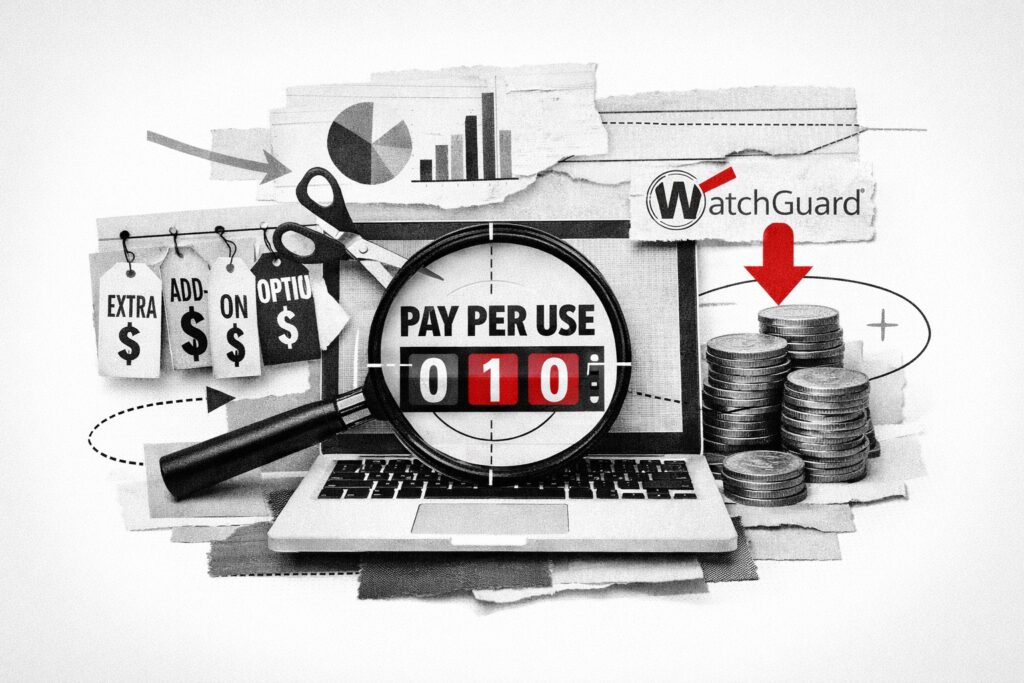
WatchGuard Revamps Endpoint Security Portfolio with Usage-Based Licensing Model
In a significant shift from traditional pricing, WatchGuard has restructured its endpoint security offerings around a usage-based licensing model, aiming primarily at managed service providers (MSPs) targeting SMEs and mid-sized businesses with smaller teams. This restructuring includes core features that many competitors reserve for premium tiers and relies on a single agent managed via a centralized console.
Historically, the EDR market has catered to dedicated security teams with pricing models calibrated for stable endpoint volumes and predictable monthly billing cycles. In contrast, MSPs serving SMEs operate under completely different conditions: varied client portfolios, fluctuating volumes, and pricing pressures that complicate the absorption of add-on features. According to Adam Winston, Vice President of Endpoint Security and MDR at WatchGuard, years of limited innovation from several providers, combined with high billing for cloud storage and basic functions like vulnerability assessment and URL filtering, have widened the gap between the value delivered and the price demanded.
Moreover, WatchGuard’s Threat Lab reports a staggering 1,500% increase in new malware variants targeting endpoints, making automated detection essential for teams unable to manually process such volume. In this evolving landscape, WatchGuard is repositioning its offerings.
Four Licensing Tiers with Built-in Features
The revamped portfolio comprises four tiers—Basic, Prime, 360, and Elite—each embracing a common rule: proactive visibility into vulnerabilities, URL filtering, and device control are included at all levels without additional costs. Core protection against ransomware, attack surface reduction, and device control make up the foundational layer. Higher tiers introduce Zero Trust application controls and advanced investigation tools, while add-ons such as 24/7 MDR via WatchGuard Core MDR, patch management, SASE, and multifactor authentication can be activated with a single click from the WatchGuard cloud, eliminating the need for agent redeployment.
The single agent and centralized management console stand out as key operational advantages for understaffed IT teams. Multi-tenant management and policy inheritance enable MSPs to standardize configurations across their entire client portfolio without the need for repetitive setups from account to account. “MSPs and IT teams need to deliver better protection with fewer resources. This portfolio helps organizations enhance their security while scaling without added complexity,” states Andrew Young, Director of Products at WatchGuard.
Device Billing No Longer Reflects Delivered Value
The shift to a usage-based license is the most structural change of this announcement for procurement and IT managers evaluating their MSP contracts. The traditional per-device model charges providers based solely on the number of deployed agents, regardless of the volume of incidents handled or the level of automation applied. As MSPs enhance their detection and response automation, their value produced per managed endpoint increases—a figure that per-device billing doesn’t account for. The usage-based model reconciles billing with actual consumption, providing MSPs with the flexibility to offer competitive rates without bearing disproportionate fixed costs.
“Mid-sized companies now face threats comparable to those of larger enterprises, without the necessary resources to combat them. Unified platforms that simplify management are becoming essential,” confirms Jay McBain, Principal Analyst at Omdia. For IT leaders in organizations outsourcing their endpoint security to an MSP, existing contracts based on per-device pricing warrant reevaluation in light of this pricing repositioning; upgrading to higher protection levels should remain feasible without requiring a complete renegotiation of contracts.