

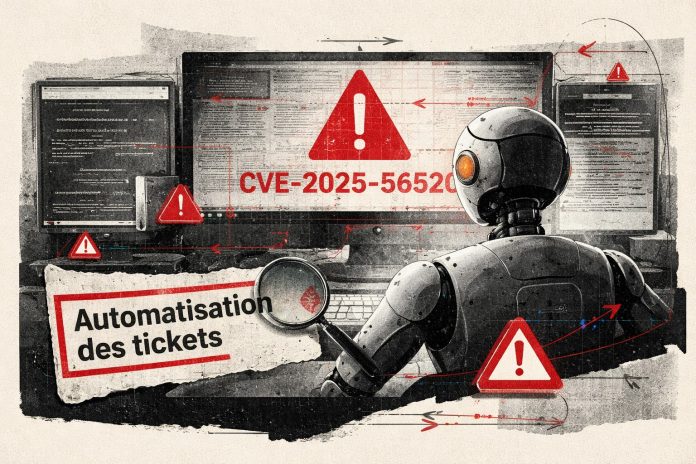
An unpatched vulnerability in the open-source platform Dify, actively exploited according to CrowdSec, highlights an unexpected angle: the reporting of the issue was prematurely closed by an automated bot while the flaw remained exploitable. This incident raises significant questions about security governance within rapidly industrializing AI ecosystems.
<p>Application orchestration platforms based on large language models (LLMs) now account for a growing segment of enterprise AI experiments and deployments. They connect third-party APIs, manipulate internal data, and orchestrate conversational flows, often intertwined with critical business systems. Their exposure to traditional application vulnerabilities presents a direct operational risk.</p>

<p>The community detection network has recently reported a surge of exploitation attempts targeting the CVE-2025-56520 vulnerability identified in Dify, an open-source platform designed for LLM-based application development. According to the follow-up report, the exploit is currently observable online, with no official patch available at this time.</p>
<h4><strong>Server-Side Request Forgery</strong></h4>
<p>The CVE-2025-56520 vulnerability pertains to server-side request forgery (SSRF). This type of flaw enables an attacker to compel a server to issue requests to arbitrary destinations. In a modern architecture, this could allow access to unexposed internal services, administrative interfaces, or infrastructure metadata.</p>

<p>In the context of an LLM orchestration platform, the potential impact extends beyond the application scope. These environments incorporate connectors to databases, storage tools, SaaS services, and internal APIs. An exploitable SSRF can serve as a pivot point to other components within the information system.</p>

<p>The distinguishing factor lies in the reporting management process. The vulnerability, flagged by a researcher, was reportedly marked as "stale" by an automated bot responsible for managing the open-source project’s tickets. This closure was likely based on procedural rules related to ticket inactivity rather than an actual code correction.</p>
<h4><strong>A Disconnect Between Exposure and Project Status</strong></h4>
<p>However, CrowdSec’s report indicates that exploitation attempts are indeed being detected. The automation of the workflow does not necessarily account for the real-time state of the observed threat online. A bot follows a timeline-driven logic, failing to dynamically assess the actual risk exposure.</p>

<p>Open-source LLM platforms are evolving rapidly. The use of development assistant tools accelerates feature production and the release of successive versions. While this fosters innovation and business team adoption, software security relies on distinct mechanisms: code reviews, static analysis, penetration testing, and human validation of critical vulnerabilities. When maintenance flows and reporting triage are partially automated, a disconnect can arise between the reality of exposure and the administrative status of the project.</p>

<p>For CIOs and CISOs incorporating open-source LLM orchestration components, this scenario necessitates compensatory measures: strict network segmentation, filtering of outgoing requests, monitoring of application traffic, and active vigilance regarding CVE references associated with software dependencies.</p>
<h4><strong>Strong Governance of Vulnerability Life Cycle</strong></h4>
<p>The situation surrounding CVE-2025-56520 extends beyond the specific case of Dify. It underscores a critical point for all open-source AI ecosystems: workflow automation in development does not guarantee robust governance of the vulnerability life cycle. The industrialization of AI usage within enterprises increases the exposure surface of information systems. Platform performance should not be assessed solely by the speed of innovation or functional richness; it also relies on the ability of communities and integrators to manage critical vulnerabilities with qualified human oversight and formal remediation processes.</p>

<p>For organizations, the operational lesson is clear: integrating open-source AI components must be accompanied by an independent audit and control strategy to prevent a closed administrative state from masking an ongoing technical risk.</p>
<div class="td-a-rec td-a-rec-id-content_bottom td-rec-hide-on-p tdi_3_962 td_block_template_1">
    <style>
        /* custom css */
        .tdi_3_962.td-a-rec-img {
            text-align: left;
        }
        .tdi_3_962.td-a-rec-img img {
            margin: 0 auto 0 0;
        }
    </style>
</div>


