

TeamViewer Unveils Strategic Shift for TeamViewer ONE at 2026 Partner Summit
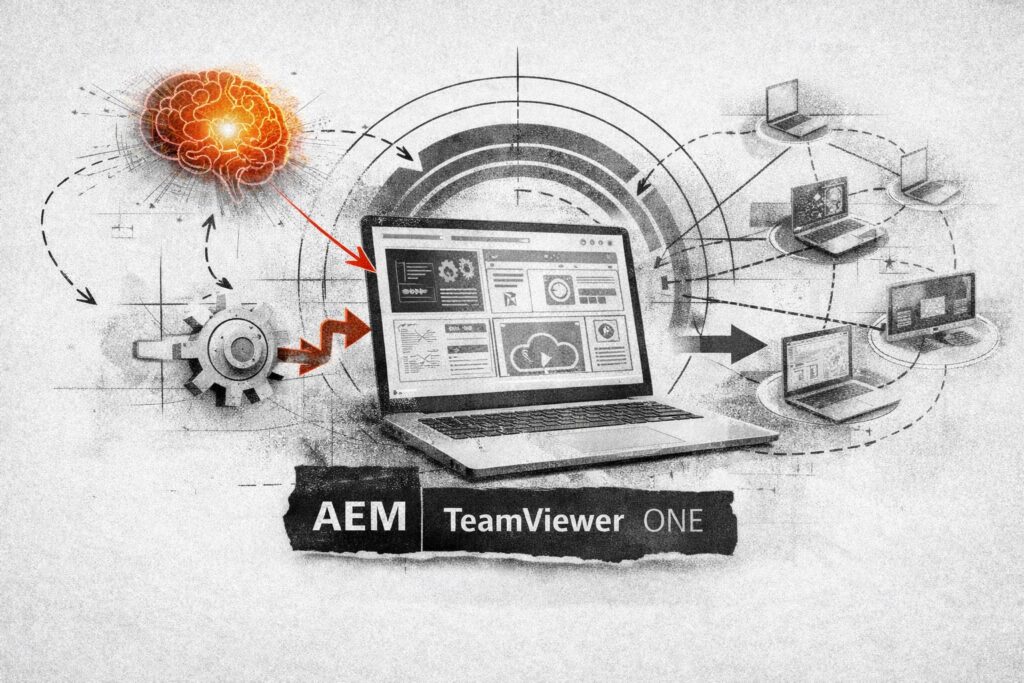
At the 2026 Partner Summit, TeamViewer announced a significant strategic repositioning of TeamViewer ONE, now branded as an Autonomous Endpoint Management (AEM) platform. This redefined offering unifies remote monitoring and management (RMM), secure connectivity, employee experience (DEX), and an in-house AI engine known as Tia, all under a single license.
This pivot represents a break from the company’s traditional focus on remote support, aligning with a structural market convergence identified by industry analysts at Gartner and Forrester. The event brought together TeamViewer’s reseller partners, distributors, and managed service providers (MSPs), where Andrew Hewitt, VP of Strategic Technology at TeamViewer and former Forrester analyst, alongside Product Manager Sebastian Schrötel, presented a roadmap anchored by three key pillars: the integration of Tia into workflows, enhancement of existing best-of-breed solutions, and exclusive capabilities for TeamViewer ONE stemming from the convergence of endpoint telemetry and session intelligence.
The core message of the Partner Summit emphasized the merging markets of Unified Endpoint Management (UEM), RMM, DEX, and remote support as an evolving trend. Schrötel succinctly addressed the partners, stating, “This isn’t just our terminology; the market is calling for it, as our clients see the advantages of combining these disciplines.” In a forward-looking statement, Hewitt projected, “By 2030, 30% of organizations will automate 80% of their digital workplace tasks. Today, that figure is effectively zero.”
Tia at the Heart of Autonomous Resolution Cycle
The foundation of this strategy is backed by data from a TeamViewer study revealing that 81% of employees experience at least one critical task delay per month due to digital friction, equating to an average loss of 1.3 days of productivity monthly. Hewitt highlighted the business impact of these delays, noting, “That’s roughly two full weeks lost each year due to technology failures.”
From the IT leadership perspective, 72% of IT managers believe that between 10% and 50% of their service desk workload could be automated. However, this leads to a lack of trust, with 57% of users expressing doubts about IT’s ability to resolve their issues promptly. The commercial pressure is palpable; 59% of IT decision-makers feel the era of best-of-breed tools is coming to an end. A cited CIO study revealed that 95% of IT leaders are considering consolidating their vendors within the year, with 80% highlighting the need to reduce the number of specialized solutions.
Tia Uses Proprietary Data for Enhanced Outcomes
TeamViewer ONE is powered by Tia, an AI engine that leverages two streams of data: real-time telemetry from managed endpoints and records from remote support sessions. Schrötel emphasized the competitive edge of leveraging proprietary data, contrasting it with competitors that rely on public AI models. “If you think you can successfully implement an AI approach with public models and prompts, any competitor can replicate that in minutes. An AI approach that doesn’t leverage proprietary data will struggle to succeed.”
The demonstrated processing cycle follows a closed-loop logic. When the telemetry detects an anomaly, the system automatically generates a case, Tia joins the remote support session in real-time to assist the technician, diagnoses the issue, and suggests or executes the necessary remediation. Tia then summarizes and analyzes the session, generating a correction script in Scale—TeamViewer’s proprietary scripting language, which is agnostic to operating systems—and deploys the automation across affected endpoints. Lastly, a triggering rule is created for the correction to be applied automatically in the future.
According to Schrötel, “From the occurrence of a problem, the user is affected; in a predictive model, the problem doesn’t occur because we fix it before it happens.” However, Hewitt cautioned about the essential trust factor for this model, saying, “LLMs have an hallucination rate of around 25%. Clients aren’t afraid of automation; they fear uncontrolled automation that they can’t explain.”
Three Editions: Tailored for SMBs to Enterprises
TeamViewer ONE is available in three editions, priced per endpoint. The Standard edition is aimed at organizations with fewer than 100 endpoints, starting at €29.90 per endpoint. The Advanced edition, designed for companies with 100 to 5,000 endpoints, focuses on endpoint management, security, compliance, and patch management. The Enterprise edition, for organizations exceeding 5,000 endpoints, includes advanced DEX capabilities tailored for large firms with dedicated employee experience IT teams.
The platform natively integrates with Microsoft Intune, ServiceNow, and Jamf, positioning itself as an added-value layer rather than a competitor. Mei Dent, Chief Product and Technology Officer at TeamViewer, articulated the central argument: “In the face of growing pressure to consolidate fragmented tech stacks, enhance security, and meet shifting compliance standards, TeamViewer ONE combines intelligence, automation, and visibility within a centralized platform.” Its endpoint-based pricing model with a single license covering all features is highlighted by TeamViewer as a key adoption driver anticipated in 2025, alongside platform consolidation and operational leverage for lean IT teams.
Roadmap Toward Greater Autonomy for Tia
The presented roadmap revolves around three key initiatives. The first focuses on integrating Tia across workflows, with availability in remote support sessions by Q2 2026, support for script generation via a web development environment (Scale Code Studio), and conversational reporting in natural language for enterprise teams. The second initiative aims to enhance existing best-of-breed solutions with advanced integration with Intune, multi-tenancy for MSPs, the introduction of a Security Center to guide organizations toward security standards, and zero-trust access for IT and OT environments. The third initiative is unique to TeamViewer ONE, involving the automated generation of automations from session insights, mobile DEX on Android by Q2, and a new DEX-based patch management engine by Q4.
During the session, Schrötel confirmed that Tia will be accessible to end users in the second half of the year: “If you train the agent, why not offer it?” In conclusion, Hewitt emphasized the overall dynamic: “Autonomy won’t happen overnight. It will be developed through trial, error, and continuous improvement. Autonomous endpoint management is the gateway. Digital workplace autonomy is the destination.”



