

AWS European Sovereign Cloud Achieves SOC 2 and C5 Type 1 Reports, Alongside Seven ISO Certifications
AWS European Sovereign Cloud (ESC) has announced the attainment of SOC 2 Type 1 and C5 Type 1 reports, as well as seven ISO certifications that encompass 69 services. In tandem, Eviden has made its external key management system available on this infrastructure, utilizing a hardware root of trust that remains outside AWS’s ecosystem. These developments underscore the offering’s relevance for organizations with workloads that are not particularly sensitive, irrespective of the number or nature of the certifications obtained.
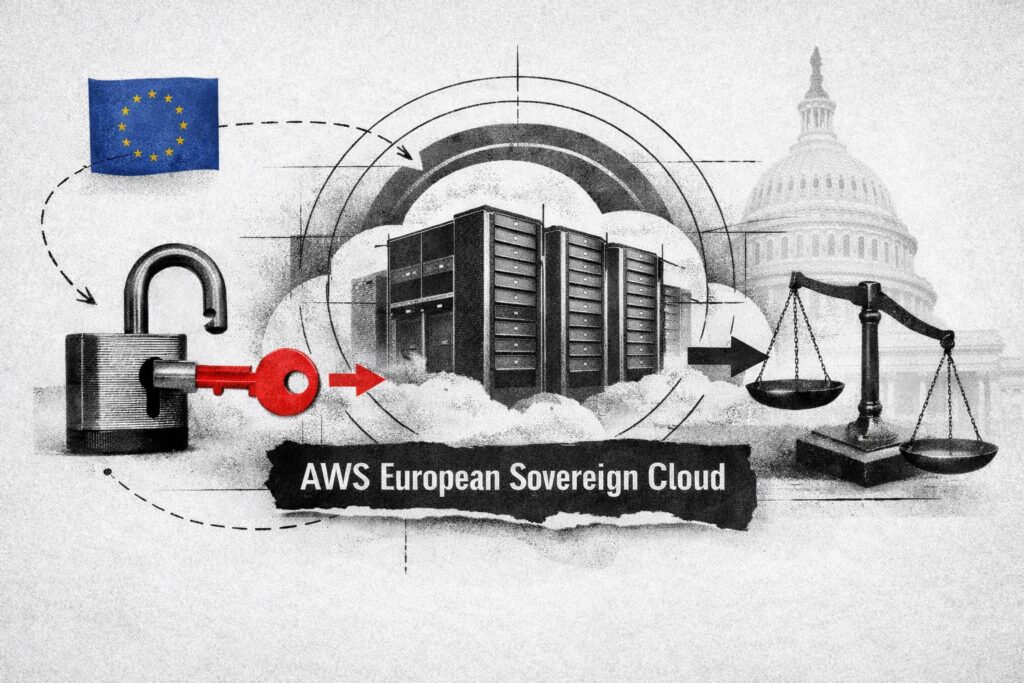
The AWS ESC solution provides a technically isolated hosting environment suitable for data that must adhere to intermediate residency and regulatory compliance requirements, as well as for non-sensitive data where American extraterritoriality is not a concern. However, it should not be viewed as a strictly sovereign offering. The perceived limitations are not due to the absence of specific certifications but rather stem from AWS’s capital structure. The relationship between AWS and its parent company, Amazon.com Inc., exposes its European subsidiaries to legal obligations under the Cloud Act and FISA, regardless of data location or operator profiles. No certification can eliminate this legal risk—it is a jurisdictional issue, not a technical one.
Independent Attestation Reports Released
AWS ESC has published its first independent attestation reports. The SOC 2 Type 1 report covers three AICPA criteria—Security, Availability, and Confidentiality—and incorporates controls linked to AWS’s Sovereign Reference Framework (ESC-SRF). This framework formalizes commitments to independent governance, data residency, and operational isolation. Meanwhile, the C5 Type 1 report, issued under the German BSI standard, confirms the design of controls based on fundamental criteria such as organizational security, access management, encryption, and business continuity, as well as additional criteria for sensitive data.
Accompanying these attestations are seven ISO certifications: ISO 27001:2022 for information security management, ISO 27017 and ISO 27018 for cloud-specific controls and personal data protection, ISO 27701 for privacy management, ISO 22301 for business continuity, ISO 20000-1 for IT service management, and ISO 9001 for quality. These certifications apply to all 69 services currently available in the region and can be accessed by clients through AWS Artifact. A Type 2 attestation, which validates operational effectiveness over time as opposed to just design, will follow in a later phase.
Eviden’s External Key Management with European HSM
For organizations subject to DORA or NIS 2 audit requirements, this documentation provides essential assurance resources for internal audits and communications with regulatory authorities. It details the rigor of the implemented technical and organizational controls but does not address the risk of extraterritorial requisition, which pertains to the governing laws of the parent entity rather than the quality of the infrastructure controls.
Eviden, the cybersecurity product division of Atos Group, has made its Key Management System (KMS) available on AWS ESC. This solution relies on a European-origin Hardware Security Module (HSM) operated by Eviden, which acts as the root of trust. The master key is stored outside the AWS infrastructure. This external key management (EKM) approach offers a reassuring technical effect, as AWS does not hold—and cannot extract—the key necessary to decrypt customer data.
Yann Vincent, Global Head of Cybersecurity Products at Eviden (Atos Group), positions this capability as a means of alleviating the burdens of particularly sensitive workloads for clients with some of the most stringent sovereignty and compliance demands. The architecture indeed addresses a tangible operational constraint: in a native AWS KMS encryption model, the keys remain under AWS control. By utilizing EKM tied to an HSM operated by a European legal entity, the master key is shielded from AWS’s control.
While this separation minimizes exposure of data at rest, it does not entirely mitigate the risks associated with extraterritoriality, as AWS ESC’s corporate structure remains unchanged, and legal directives may target vectors beyond just the stored encrypted data. Similar to the certifications, the technical robustness of the solution does not alter the jurisdictional risk.
A Relevant Level of Protection
AWS ESC, combined with Eviden’s external key management, offers a relevant protection level for workloads facing intermediate regulatory constraints. For organizations whose data lacks particular sensitivity, this offering provides localized hosting within the EU, managed by European residents, alongside a robust foundation of certifications. It remains a suitable choice for data and workflows that are not influenced by American laws’ extraterritoriality.
However, it is not appropriate for data requiring stringent legal protection against U.S. law—such as classified data, defense or health-related information, and data protected under professional secrecy in sectors exposed to transatlantic litigation. In such scenarios, infrastructures completely disconnected from any non-European control remain the only viable solution.



