

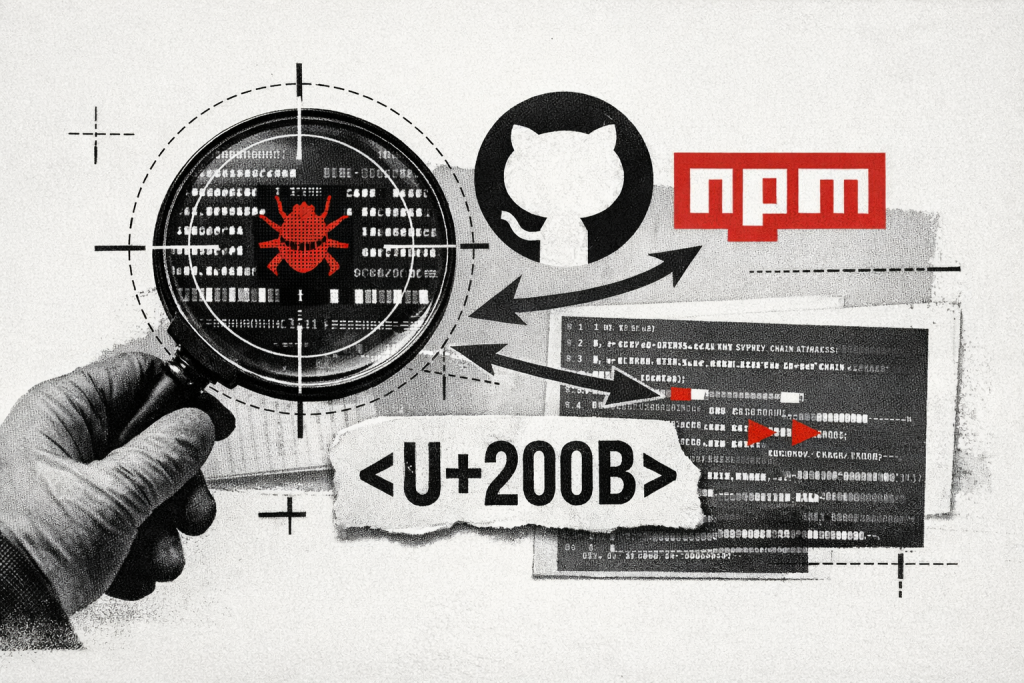
Security Alert: Glassworm Campaign Compromises Over 150 GitHub Repositories with Invisible Unicode Characters
Between March 3 and March 9, a malicious actor compromised at least 151 GitHub repositories by hiding payloads within invisible Unicode characters that evade detection by common editors, terminals, and version control tools. This attack also extended into the npm ecosystem and the VS Code extensions marketplace. Standard visual defenses and linting tools are unable to identify what they cannot see.
On March 13, Aikido Security, a security firm based in Ghent, released a comprehensive technical analysis of this campaign, conducted by researcher Ilyas Makari. Findings from Endor Labs, which specializes in software supply chain security, further corroborate and expand on the npm aspect of the breach. The actor behind this campaign, known as Glassworm, has been active since March 2025 and has previously been reported for malicious npm packages and Open VSX extensions before this third wave, which represents a significant escalation in scale and sophistication.
Unpacking the Unicode Exploit
The attack exploits a little-known property of the Unicode standard: Private Use Area characters, represented by the hexadecimal ranges 0xFE00 to 0xFE0F and 0xE0100 to 0xE01EF, render as zero-width spaces in development environments. An attacker embeds these characters within a string that appears empty in the source code. Upon execution in JavaScript, an embedded decoder extracts the invisible bytes and executes a secondary script. In previously documented incidents, this script utilized the Solana blockchain as a command-and-control channel for exfiltrating access tokens, credentials, and infrastructure secrets.
A Swiftly Expanding Breach
The scale of the March 2026 wave distinguishes this campaign from its predecessors. A search within the GitHub codebase for the decoder pattern identified at least 151 corresponding repositories, a figure that likely undercounts the actual scope, as many repositories were reportedly removed by their owners by the time of the analysis. Among the identified targets were prominent projects within the open-source ecosystem, including Wasmer (a WebAssembly platform) and Reworm, as well as opencode-bench developed by anomalyco, the organization behind OpenCode and SST. The targeting of actively maintained projects is no coincidence; the attackers aim for maximum impact on the software supply chain by infecting dependencies relied upon by numerous downstream applications.
Not limited to GitHub, two npm packages and a VS Code extension were compromised using the same technical method during this timeframe, indicating deliberate ecosystem coordination. Aikido Security has also identified 72 additional malicious extensions on Open VSX since January 31, 2026, targeting common development tools ranging from code formatters to AI-assisted coding assistants.
Advanced Techniques at Play
What sets Glassworm apart from traditional supply chain attacks is the quality of its camouflage. Malicious injections do not appear as suspicious commits or erratic changes. Surrounding changes—such as version increments and minor fixes—are stylistically consistent with each targeted project, enabling them to evade even the most attentive human reviews. Ilyas Makari, an Aikido Security researcher, emphasized this point: “Malicious injections do not arrive in obviously suspicious commits. The surrounding changes are realistic and stylistically consistent across each targeted project.”
The customization of 151 distinct contributions across different code bases significantly surpasses what a human operator could produce manually. Aikido Security speculates that the attackers are leveraging large language models to generate convincing cover commits at this scale. This use of AI as a tool for offensive social engineering represents a notable shift, transferring the cognitive load of detection entirely to automated tools, rendering manual reviews structurally blind to this type of manipulation.
Underestimating External URL Dependencies
Endor Labs highlighted another risk vector in its analysis of the compromised npm packages. As of March 12, 2026, the operator of the packages had replaced the exfiltration payload with a benign message without releasing a new version. This silent modification illustrates a structural exposure inherent in modern package ecosystems: once a package loads code hosted outside its original registry, its behavior can be altered at any time with a simple server change, lacking traceability in version history. For security teams relying on version pinning or hash verification, this external dependency presents a notable blind spot.
What DevSecOps Teams Must Review
The Glassworm campaign challenges several prevailing assumptions in software supply chain security programs. Rigorous visual code reviews cannot detect zero-width Unicode characters. Standard linting tools do not consistently activate rules for detecting unusual Unicode characters, especially in JavaScript environments. Hash verification of a package does not provide protection against dynamically loaded payloads from an external URL at execution time.
Available countermeasures can be implemented at three levels. At the tooling level, ESLint rules can be used to detect suspicious Unicode characters in JavaScript files; the Rust compiler warns about confusing identifiers. Specialized malware scanning tools—such as Aikido Safe Chain, an open-source example—can intercept malicious packages before installation. At the governance level for dependencies, organizations must go beyond version pinning to audit the actual content of consumed packages, incorporating integrity checks for resources loaded at runtime. In terms of traceability, tools like Sigstore can provide cryptographic signatures for software artifacts and establish their provenance without inspecting the code itself for this type of manipulation.
Glassworm is not an isolated incident. The campaign reflects a growing trend dating back to 2024: invisible Unicode characters, initially exploited for injecting malicious instructions into AI engines through hidden prompts, have shifted toward conventional software supply chain attacks. The combination of invisibility in development environments, the cover provided by large language models, and multi-ecosystem distribution outlines an attack model whose sophistication is likely to continue evolving. For CIOs and CISO teams overseeing development pipelines that incorporate open-source dependencies, the only credible control perimeter is now the automated analysis of package content, not merely their appearance.



