MediaTek Dimensity 8500: The New King of Affordable Gaming Has Arrived
MediaTek continues to blur the lines between mid-range and “small flagship” devices. With the official announcement of the Dimensity 8500 during an event where the brand also unveiled the Dimensity 9500s, the chipmaker is pursuing a familiar strategy: focusing on powerful cores while enhancing efficiency through advanced manufacturing and proprietary scheduling software.
The Dimensity 8500 as a “light flagship” for 2026
In its release, MediaTek presents the Dimensity 8500 as a “light flagship” designed for intensive use (gaming, multitasking, AI, photography) at a more accessible price point.
This approach aims to strengthen its grip on the affordable premium segment, where performance perception and “real” battery life are crucial in today’s competitive landscape.
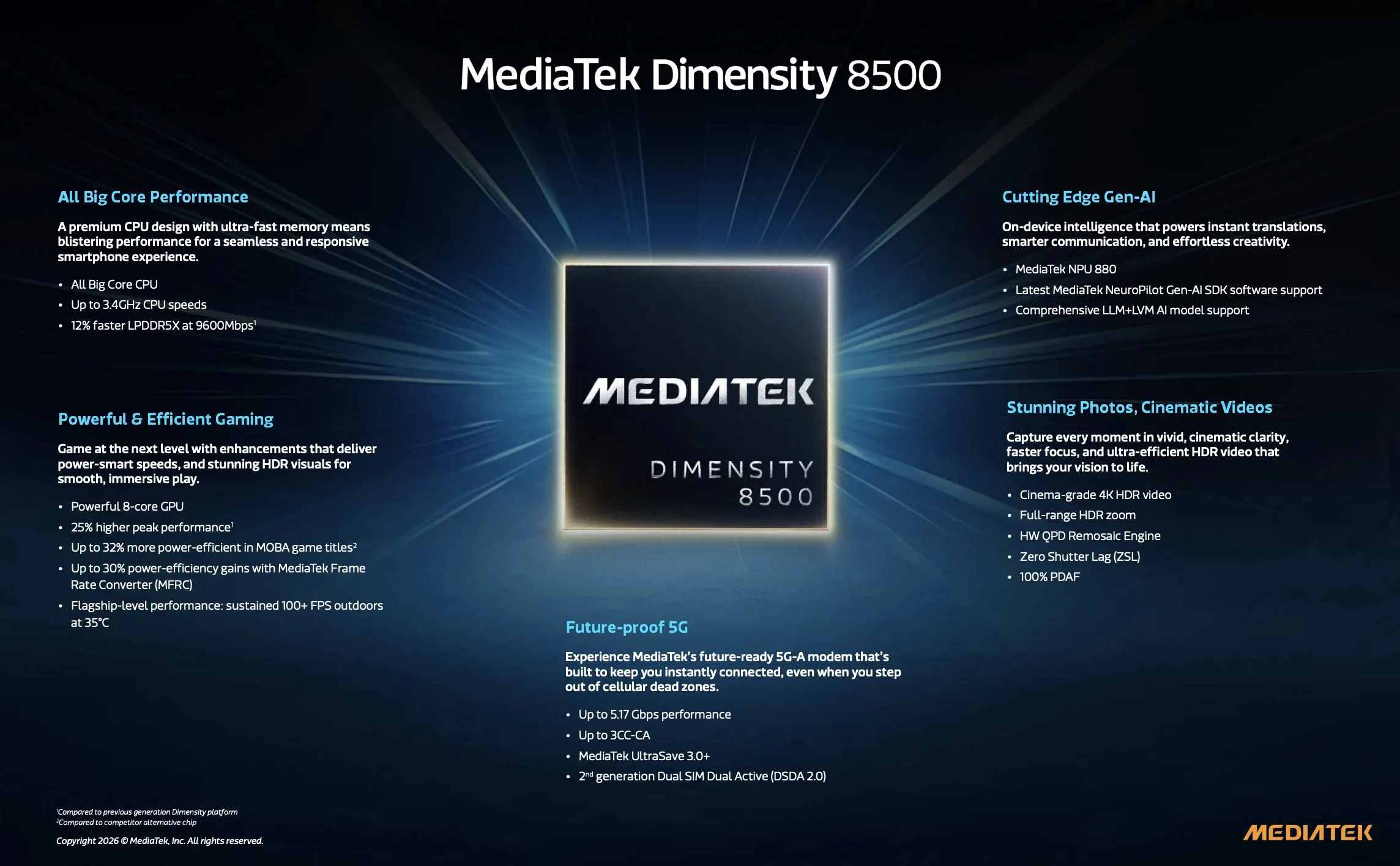
The Dimensity 8500 is fabricated on a 4 nm process (TSMC) and features an 8-core Cortex-A725 CPU, with a maximum frequency claimed to reach 3.4 GHz.
Specifically, multiple sources indicate a configuration of 1+3+4:
- 1 core at A725 3.4 GHz
- 3 cores at A725 3.2 GHz
- 4 cores at A725 2.2 GHz
MediaTek claims about a +7% improvement for this “second generation” of all-big-core architecture, and it also adds support for LPDDR5X memory speeds of up to 9600 Mb/s for increased bandwidth.
The Mali-G720 MC8 GPU and the “democratization” of ray tracing
On the graphics front, the Dimensity 8500 aims to make a significant impact: MediaTek announces a Mali-G720 (8 cores) that delivers +25% peak performance compared to the previous generation, while consuming -20% power at peak loads. The company also emphasizes the introduction of more “realistic” rendering through ray tracing at this price point.
In terms of gaming, MediaTek highlights several marketing claims (stability above 110 fps even outdoors at 35°C, energy savings via framerate management technology, etc.). These should be interpreted as lab figures, but they set a clear tone: the Dimensity 8500 targets “gaming-friendly” devices at an attractive price.
AI, Photography, Connectivity: NPU 880, AI Imaging Tools, 5G Capable of 5.17 Gb/s
Unsurprisingly for 2026, AI is central to the product narrative. MediaTek confirms the inclusion of its NPU 880, emphasizing image generation (including Stable Diffusion) and compatibility with LLM/MLLM models — in short, on-device AI that serves as both a selling point and functionality.
For photography and video, MediaTek mentions AI-enhanced imaging features (such as “ultra-clear” telephoto, semantic segmentation, and reflection/glare removal), focusing on practical applications rather than just technical specifications.
On the connectivity front, reports indicate a 5G modem capable of speeds up to 5.17 Gb/s, along with carrier aggregation and energy-saving optimizations (UltraSave).
The “all-big-core” strategy normalizes — but the true test will be heat management
The “all-big-core” approach looks promising on paper: enhanced responsiveness, smoother multitasking, and sustained performance under load… but it will depend on effective thermal management. MediaTek specifically emphasizes precise scheduling and the efficiency of the 4 nm process to keep the performance/watt curve in check.
The implicit comparison also lies with competing “mid-premium” chips: if the Dimensity 8500 can deliver on its GPU promises (and ray tracing) without draining the battery, it could become the benchmark for “flagship-like” smartphones at a more accessible price — a segment expected to dominate volumes in 2026.
Perhaps the most intriguing message is that MediaTek is no longer just attempting to “keep up” with the high-end. They aim to redefine what mid-range devices are capable of delivering.