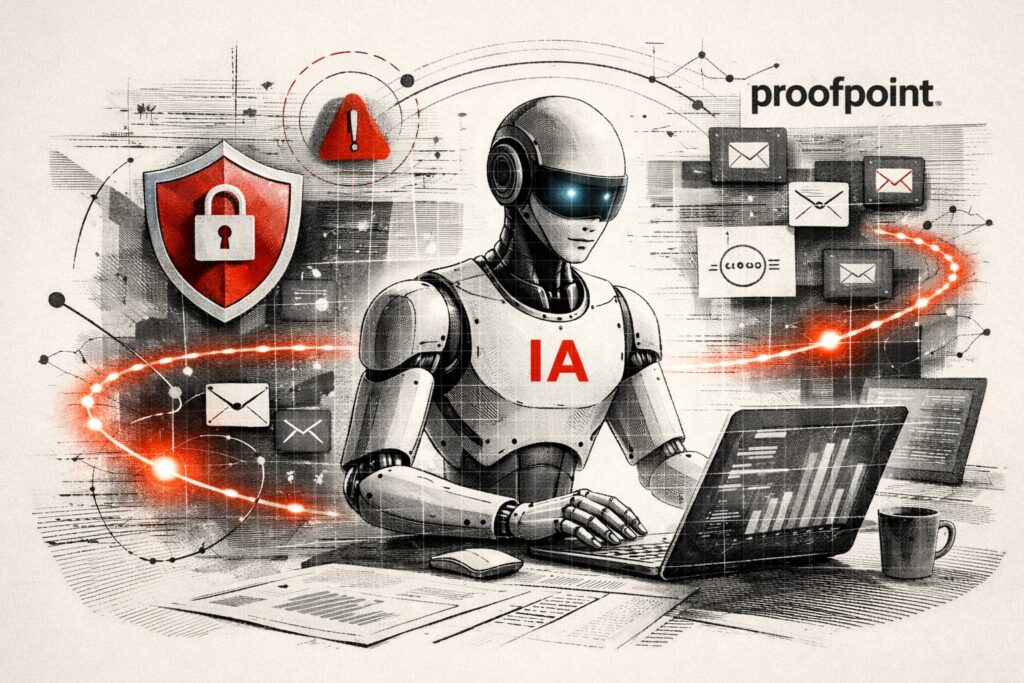
Proofpoint Acquires Acuvity to Enhance Security and Governance for Generative AI and Autonomous Agents
Proofpoint, a leading player in cybersecurity, has officially announced its acquisition of Acuvity, a specialist in AI security and governance for enterprises. This move highlights a growing focus on securing agent-driven environments as organizations increasingly deploy co-pilots, autonomous agents, and connected applications across various sectors, from software development to customer support and finance.
As these technologies proliferate, they significantly alter the threat landscape. Traditional risks now merge with new challenges related to phantom AI, exposure of sensitive data, loss of intellectual property, regulatory breaches, and targeted attacks including prompt injections and model manipulation.
Repositioning for the Agentic Workspace
By integrating Acuvity, Proofpoint aims to expand its historically communication-centric security platform to encompass supervision over AI-driven workflows. The intention is to provide native visibility into AI usage, centralized governance, and real-time control over interactions between users and agents.
Ryan Kalember, Proofpoint’s Chief Strategy Officer, points out that AI agents are becoming integral members of the workforce, accessing data, executing tasks, and making decisions alongside human colleagues. Securing this model requires a real-time understanding of human intent, agent behavior, and associated risks.
Governance of AI Use at the Core of the Integration
Acuvity introduces control points and detection models specifically designed for AI environments. Its platform promises comprehensive visibility into usage patterns, spanning from desktop and browser activities to emerging infrastructures, such as servers utilizing the Model Context Protocol and locally installed AI tools like OpenClaw and Ollama.
The newly announced capabilities include overseeing interactions with external AI services as well as safeguarding custom AI models and applications developed or deployed internally. The challenge lies in regulating AI usage without hindering innovation or productivity.
Three Structural Pillars for CISOs and CIOs
Proofpoint’s offerings are now structured around three complementary axes. The first pillar focuses on collaboration security, aiming to protect individuals from human-centric threats. The second pillar encompasses data security and governance, managing access to sensitive information used by both human collaborators and AI systems. The third pillar, AI security, is crucial for governing the use of agent-based models and applications.
Satyam Sinha, co-founder and CEO of Acuvity, notes that intelligence now resides in the interactions and decisions executed by autonomous agents. He emphasizes that securing this environment necessitates real-time governance of how AI operates and learns.
From a competitive standpoint, this acquisition signals an acceleration of strategic repositioning around the cybersecurity of agents. Established players in the market are increasingly integrating specialized components to offer a consolidated view of interactions between human identities, machine identities, and critical data. For enterprises, ensuring the security of the agentic workspace is becoming a central criterion in technological decisions for CISOs and CIOs alike.