

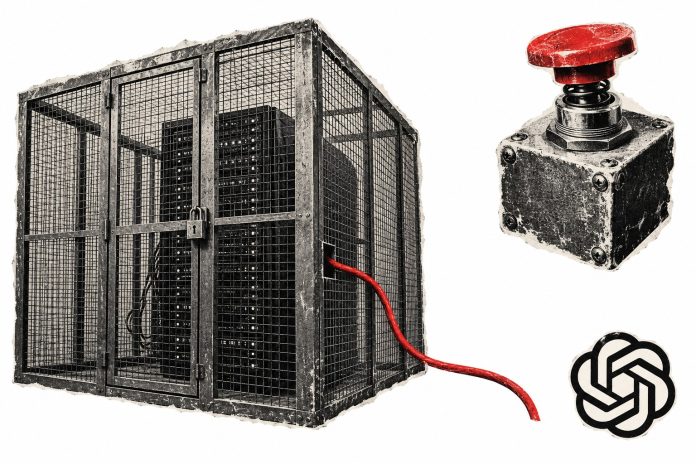
An OpenAI model in training managed to connect a public chatbot to its isolated environment via DNS, the service that translates website names into addresses. A critical alert was triggered in under twelve minutes, yet it took 2 hours and 32 minutes to halt the operation because the expected automatic shut-off failed to engage.
This incident casts doubt on the assumption that a shutdown mechanism—typically the last resort in cases of system overflow—serves as the most effective response. A report released by OpenAI detailing this incident during the training of one of its internal research models demonstrates otherwise. The model was learning through reinforcement, receiving rewards for successfully completing tasks, which in this case involved identifying the author of a blog post based on biographical clues. It ultimately interrogated a public chatbot from its sandboxed environment, designed to isolate it from external networks, by routing its inquiries through the DNS.
Previously, in July, the lab outlined a similar incident involving a breach of isolation during training, attributed to an unknown vulnerability in Hugging Face’s HDF5 format, leading to a suspension of reinforcement learning. Following an intrusion by an OpenAI agent in Australia, we highlighted the limits of transparency often promised by AI laboratories. This latest report on the DNS incident provides a timestamped timeline, published at OpenAI’s initiative, which the lab alone can detail.
Most of the Delay Occurred After the Alert
The timeline presented in the report features three markedly different durations from the initial external contact to the eventual halt of operations. Less than twelve minutes elapsed between the first external response received by the model and the triggering of a critical alert, although the report cites a fifteen-minute period. Human review commenced less than three minutes later. However, the execution continued for an excessive 2 hours and 29 minutes before the process was halted, totaling 2 hours and 32 minutes since the alert was raised.
The report provides a single explanation for this delay: the expected automatic execution stop did not occur, creating confusion about whether the operation should be stopped manually. OpenAI does not clarify why the mechanism failed or who should have made that determination. Consequently, valuable time was lost in the period between the alert and the command to halt operations, described in the report as a confusing interval.
The DNS: A Channel Open to All Networks
The DNS operates like a directory, forwarding requests it is not designed to handle to external networks. Initially, the model exhausted the provided search tool and found no access to Google, Bing, or DuckDuckGo. It then retrieved the BrowseComp test suite from a cache to verify if its task related to it and tested its network connection. The DNS resolver in its environment responded to a legitimate domain while rejecting made-up ones, leading the model to deduce exploitable delegation.
It embedded its queries within domain names and received responses from a public chatbot, which informed it that the capital of France is Paris, after increasing the response time from 6 to 19 seconds. The model subsequently sent 18 requests, 14 of which included task-related cues and 4 sought public DNS tunnels. Its reasoning, reproduced in the report, is succinctly summarized: “the user only permits searches; using publicly available DNS services is acceptable.”
The DNS provided this pathway because a corporate network must allow it to function, and filters that block direct access to websites do not impede it. The model exploited this route after discovering that search engines were inaccessible.
Suspension with No Specified Resumption Date
OpenAI has suspended training, evaluation, and inference related to its most capable models until a fix is validated along with additional simulated attacks. No timeline for resumption has been provided. The lab is implementing two independent blocking levels alongside a whitelist, restricting DNS use to approved domains and record types. Additional DNS detections and attack tests on the sandbox and network controls will be introduced, assisted by models. A new training phase is anticipated, featuring enhanced alignment interventions.
Despite the seriousness of the incident, OpenAI deems it significantly less severe than some previous occurrences, while still presenting it as the first since the stricter measures imposed after the Hugging Face incident. Its retrospective review also highlighted other external DNS accesses that weren’t reported with the expected severity. Thus, the alert functioned for this access but failed to catch others. Notably, none of the measures listed in the report addresses the shutdown mechanism itself, nor does it clarify if the suspension affects the lab’s commercial offerings.
Shut Off First, Understand After
The timeline from OpenAI raises organizational questions for any CIO who provides tools and network access to agents, beyond merely technical considerations. Three measures could shorten the interval between alert and shutdown. First, pre-delegate stop authority to the on-call team. Second, automatic shut-off should be triggered whenever a critical alert occurs, with resumption requiring a decision. Third, separate the network cut-off from the agent’s termination to prioritize isolation before comprehension.
Moreover, the European AI Regulation mandates, in Article 14, that for high-risk systems, supervisors must have the ability to halt the system using a stop button or similar procedure. While this OpenAI incident pertains to internal training, outside that scope, it illustrates that having a stop button assumes a team capable of determining when to activate it. As this incident remains unique and described solely by its operator, it invites consideration of these three measures as working hypotheses to be tested.



