

nLighten and Arqit Expand Cloud Sovereignty with Innovative Proof of Concept
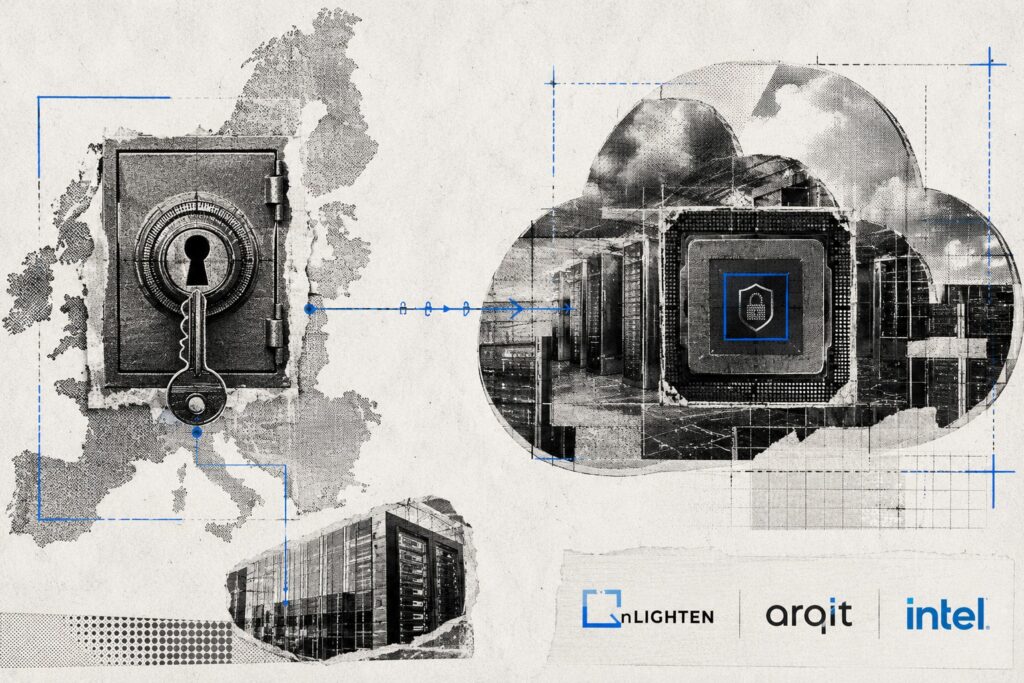
nLighten and Arqit have co-developed a proof of concept demonstrating that sensitive workloads can run on a major public cloud provider while maintaining data and encryption key control within Europe. This demonstration connects nLighten’s data center in Geneva with an unnamed hyperscaler, utilizing Arqit’s post-quantum cryptography and Intel’s confidential computing technology. The initiative specifically targets regulated sectors that are hesitant to entrust sensitive workloads to public cloud environments.
For years, organizations in regulated industries have faced a critical dilemma: while public cloud services offer powerful computational resources and on-demand AI capabilities, the prospect of executing sensitive workloads raises concerns about data governance once it moves outside their own infrastructure. nLighten, a German edge data center provider, and Arqit, a UK-based post-quantum cryptography specialist, claim to have addressed this challenge.
The proof of concept successfully executed a workload in the public cloud, while ensuring that sensitive data and cryptographic controls remained housed within nLighten’s data center in Geneva, where Swiss laws govern data protection. The two companies position this setup as a European infrastructure shielded from American extraterritoriality, though this claim requires careful scrutiny given the origins of the technology providers involved. As of now, no commercial offerings have been announced.
Reversing the Cloud Logic
This approach inverts the conventional logic of public cloud usage. The workload runs on a major hyperscaler, but the sensitive data and encryption keys are retained within nLighten’s infrastructure. Here, control over the keys—rather than the location of execution—provides the necessary assurance of control. In this model, sovereignty shifts from the physical site to the realm of cryptography.
This shift reflects a broader trend in the market, where sovereignty is assessed on a workload-by-workload basis. Highly sensitive tasks remain tethered to controlled environments, while less critical workloads take advantage of the scalability offered by public cloud platforms. nLighten and Arqit propose a third pathway that moves away from merely contractual guarantees and the sovereign cloud offerings from hyperscalers themselves.
Building Trust in Public Cloud Services
The demonstration incorporates three key components. nLighten delivers a physically controlled and auditable data center in Geneva. Arqit’s Symmetric Key Agreement Platform (SKA-Platform) extends this secure environment into the cloud, ensuring that key generation and management remain in European hands. Additionally, post-quantum encryption protects data exchanges with the cloud from threats related to potential future decryption capabilities.
The third component is Intel’s Trust Domain Extensions (TDX), a confidential computing technology that isolates virtual machines and containers at the hardware level, safeguarding them from cloud administrators, neighboring workloads, and unauthorized access during processing. This is crucial, as it is during computation that decrypted data is most vulnerable. By covering data at rest, in transit, and in processing, the trio aims to eliminate potential blind spots in data security.
A Focus on Regulated Industries
The target sectors are clear: financial services, pharmaceuticals, and the public sector all handle sensitive workloads and face stringent compliance requirements, making these organizations particularly cautious about migrating such data to public clouds. This solution allows them to access AI services and scale their operations without relocating their most sensitive assets away from a secure environment.
Furthermore, the partners connect their demonstration to the forthcoming EU Cloud Sovereignty Framework, which seeks to establish guidelines around cloud data sovereignty. While this argument remains prospective as the framework is still being finalized, it aligns the offering with Europe’s regulatory trajectory. For chief information officers (CIOs), the appeal lies in a method that makes sovereignty verifiable through key management and hardware isolation rather than merely contractual agreements.
However, it is essential to recognize the limitations of the approach. While keeping data and keys in Europe protects data at rest and in transit, the actual workloads still run on unnamed hyperscaler hardware, likely of American origin. At the moment of computation, the decrypted data’s security relies entirely on Intel’s confidential computing technology, which is fundamentally based on hardware trust and the assurances provided by an American supplier. A vulnerability in the enclave or legal constraints on any part of this chain could potentially expose the data.
Moreover, the European connections are not as strong as they might seem. nLighten, the German operator housing the data in Geneva, is owned by the American infrastructure fund I Squared Capital. Likewise, Arqit, the UK company supplying the cryptographic keys, is publicly traded on NASDAQ. Thus, while this framework may reduce data exposure, it does not eliminate it entirely, serving more as a risk mitigation strategy through layered defense rather than offering full jurisdictional immunity. This proof of concept showcases technical feasibility, but it has yet to evolve into a fully-fledged service that decision-makers can adopt with guaranteed sovereignty.



