

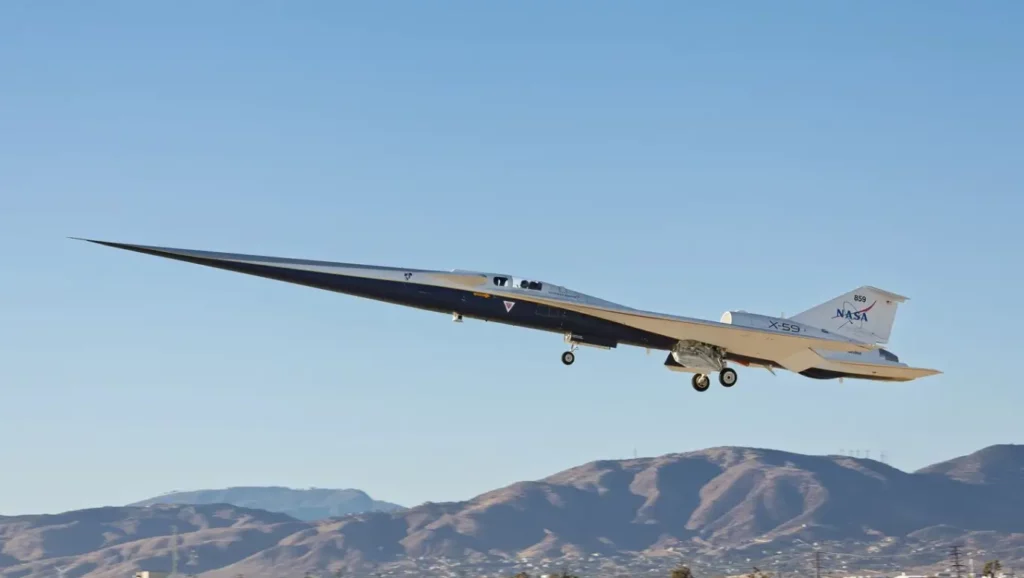
More than two decades after the retirement of the Concorde, the dream of a supersonic aircraft that can connect Paris to New York in a matter of hours is resurfacing. This time, the ambition is dramatically different: to fly faster than sound without producing a sonic boom. The sonic boom still prohibits flights over populated areas. The X-59 project by NASA and Lockheed Martin has just crossed a significant milestone with its first test flight.
The X-59 Aims To Eliminate The Sonic Boom With Its Ultra-Sleek Design
On October 28, 2025, the X-59 QueSST (Quiet SuperSonic Technology) took its very first flight from Palmdale, California. This slender prototype, featuring an extremely elongated nose, aims to reshape the shock waves produced when breaking the sound barrier.
Its goal is to reduce the sonic boom to a sound similar to that of a car door closing. We’re talking about roughly 75 dB, compared to over 110 dB for current aircraft. This reduction is based on a streamlined fuselage that disperses the waves instead of concentrating them.
The cockpit, lacking a front windshield, provides a digital view of the environment through a system of HD cameras and screens.
The First Flight Did Not Target Supersonic Speed But Critical Systems
This inaugural flight aimed not to break the sound barrier but to validate several essential systems: stabilization, instrumentation, and flight data. The aircraft flew for one hour at an altitude of 3,658 meters. Its ultimate target remains 16,000 meters, necessary for supersonic speed testing.
Bertrand Vilmer, an aerospace expert, emphasizes the technical challenges that still lie ahead. He points to noise during takeoff and landing, engine performance, certification, and adapting this design for a true commercial aircraft.
The X-59 has completed its first flight! 🎉✈️
A new era of supersonic flight begins with Skunk Works® and @NASA. pic.twitter.com/iqtNWC6TxJ— Lockheed Martin (@LockheedMartin) October 28, 2025
Evolving Regulations Could Soon Allow Supersonic Flights Over Land
The testing of the X-59 takes place within a favorable American political context. In June 2025, Donald Trump requested the FAA to lift the ban on supersonic flights over the country. This lifting would only apply to aircraft that do not produce a perceptible boom, within 180 days. A specific noise certification rule is also anticipated within the next two years.
This political momentum supports projects like Boom Supersonic. The American company plans to introduce an aircraft called Overture, capable of transporting up to 80 passengers at Mach 1.7 by 2029. Its aim is to halve flight times on over 600 international routes.
The X-59 could play a pioneering role in this revival of supersonic travel, bridging the gap between the Concorde dream and a new generation of fast, silent aircraft suitable for a densely populated world.



