

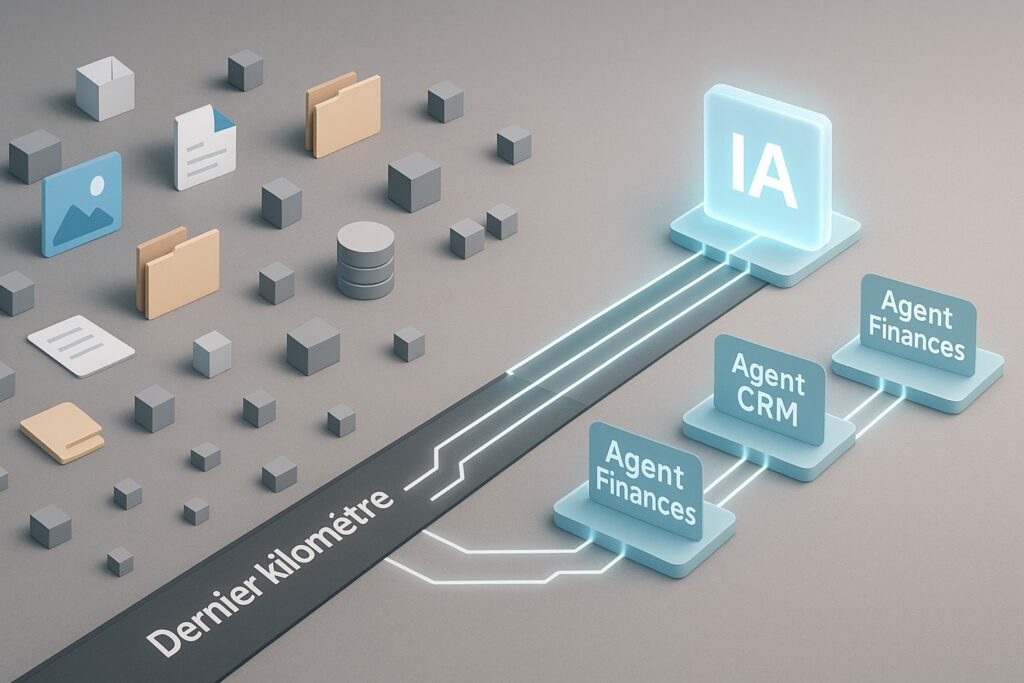
Vast Data Enhances Its AI Operating System with SyncEngine, a Mobility and Cataloging Component to Address Data “Last Mile” Challenges
Vast Data has unveiled SyncEngine, an innovative addition to its AI operating system that aims to tackle the critical “last mile” bottleneck in data management. In an era where distributed inference and agent-based architectures are becoming the norm, ensuring a smooth, continuous, and verifiable flow of information has become essential. This announcement underscores the market’s shift towards platforms capable of unifying data, computation, and AI orchestration without added complexity.
As AI agents and multi-source inference pipelines emerge, data has evolved into a key strategic asset, surpassing the role of mere hardware accelerators. By offering SyncEngine at no extra cost within the Vast AI OS, Vast Data aligns with this transformative trend, reinforcing its competitive position among architectures optimized for large-scale AI.
Data fragmentation has emerged as one of the primary barriers to industrial AI strategies. Many organizations continue to rely on outdated file and object storage systems, supplemented by SaaS applications that capture critical volumes of information. This fragmentation, coupled with a lack of comprehensive visibility, creates bottlenecks between heterogeneous data warehouses and inference pipelines, especially in environments that integrate GPU clusters with embedded AI and internal production agents. SyncEngine addresses this bottleneck by incorporating cataloging, migration, synchronization, and transformation into a single software component. This approach reduces dependencies on third-party tools, streamlines continuous ingestion, and offers immediate visibility into unstructured objects, enabling organizations to access faster, more reliable, and better-governed AI pipelines.
A Central Component for Hybrid Inference
The operational logic behind SyncEngine reflects a broader trend toward unified platforms designed for distributed inference. The rise of RAG workloads, business-assistant agents, decision automation, and contextual AI requires seamless data movement across on-premises, cloud, and SaaS environments. By addressing this need without necessitating heavy replatforming, Vast Data is capturing growing demand from CIOs who face pressures for simplicity, governance, and linear performance. The ability to index trillions of files or synchronize data at scale can become a critical differentiator when it comes to scaling AI operations.
SyncEngine strikes an interesting balance between performance and control in regulated environments. By aggregating data from applications such as SharePoint, Confluence, Google Drive, or Salesforce into a multi-namespace catalog, organizations maintain a local copy of their informational assets, which can be hosted in France or elsewhere in the EU. This capability is particularly relevant for sectors like finance, manufacturing, and public services, where AI initiatives often encounter restrictions around location, compliance, or traceability. By integrating integrity checks, task resumption capabilities, and continuous ingestion, Vast Data provides a robust technical foundation to support hybrid pipelines distributed across various environments.
A Strategic Signal in the Unified AI Platform Competition
The operational mechanics of SyncEngine also simplify the adoption of integrated data preparation tools within Vast AI OS, such as InsightEngine or DataEngine. Automatic chunking and vectorization accelerate ingestion workflows for linguistic models, whether for internal RAG engines or agent chains deployed on platforms like LangChain. This fusion of mobility, transformation, and indexing directly addresses market evolution, where success now hinges not just on model power but on their ability to work with complete, fresh, and contextualized corpuses of data.
Furthermore, the integration of SyncEngine at no additional cost communicates a significant industrial message. The market is moving into a phase where companies prefer unified AI stacks over a disjointed assembly of components. By eliminating multiple licenses and time-consuming migration scripts, Vast Data positions itself at the intersection of three current dynamics: reduction of total cost of ownership from inherited infrastructures, standardization of AI architectures, and the necessity to align processing, governance, and inference. Vendors that control the entire data lifecycle—from ingestion and transformation to storage, indexing, and AI execution—are set to become essential technological hubs for large enterprises.
Aligning with the Rise of Agent-Based Workloads
In a highly competitive market where scale-out approaches, specialized AI orchestration solutions, and governance-focused platforms are vying for attention, Vast Data is broadening its scope by addressing a previously overlooked requirement: ensuring fluid data movement in increasingly distributed, agent-driven environments. This positioning complements the offerings of players focused on contextual protocols, orchestration engines, or abstraction layers between models, reinforcing the essential role of high-performance storage within the AI ecosystem.
By offering this functionality within the Vast AI OS, the company confirms its understanding of the ongoing transformation, where value is no longer confined to training or inference but is found in the capability to render data available without lag, federated, and ready for multi-agent environments. This trend could influence the strategies of other providers, fostering greater integration of storage, governance, and distributed intelligence.



