

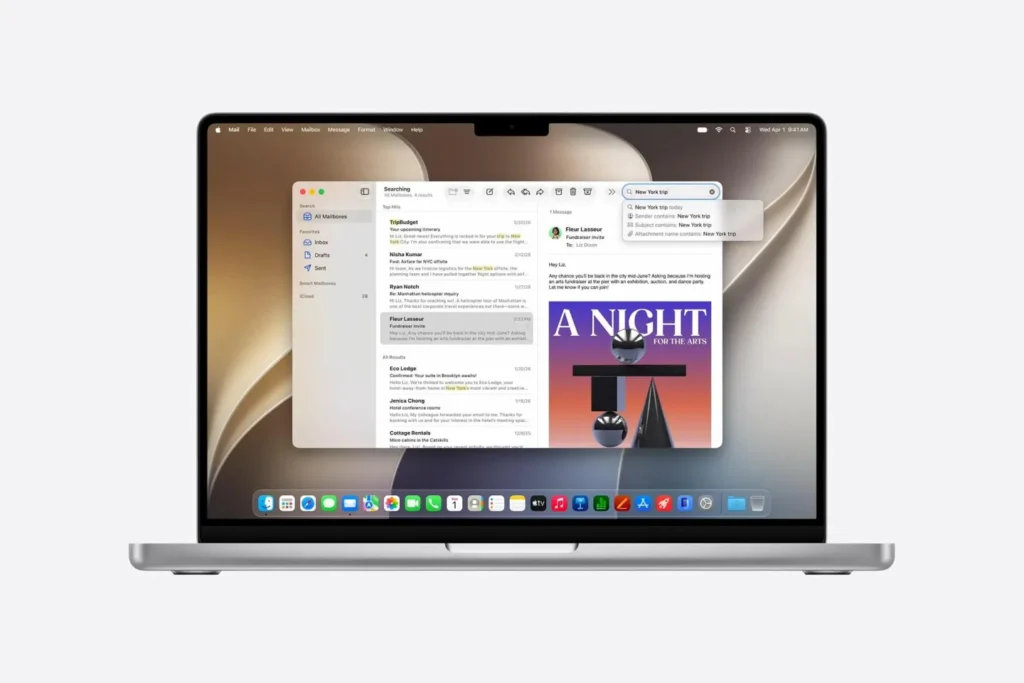
macOS 27 Golden Gate : Apple fixes the excesses of Liquid Glass and places Siri at the heart of the Mac
After a year marked by debates surrounding the Liquid Glass interface, Apple returns with a more balanced approach. Unveiled at WWDC 2026, macOS 27 Golden Gate doesn’t aim to revolutionize the Mac experience but seeks to refine it.
Behind this update lies a major strategic shift: the Mac officially becomes one of the pillars of the new generation of Apple Intelligence.
With a thoroughly rethought Siri, AI-enhanced system searches, and the definitive end of Intel support, Golden Gate marks the dawn of a new era for the Mac ecosystem.
Apple finally lightens Liquid Glass
One of the most frequent criticisms of macOS Tahoe was its Liquid Glass aesthetic. Ubiquitous transparency effects, questionable readability, and visual clutter had divided users.
Apple seems to have heeded this feedback.

With Golden Gate, users now have a global slider to adjust transparency effects across the entire system. The company has also reworked window corners, visual consistency of interfaces, and sidebar navigation elements.
More symbolically, Apple reintroduces certain colors in sidebar icons, partially abandoning the visual uniformity introduced last year.

This decision resembles a conscious return to some historical fundamentals of macOS.
Spotlight becomes a true intelligent search engine
The other significant evolution concerns system search. Apple announces a whole new infrastructure capable of indexing all content on the Mac with a speed much faster than previous generations.
In practical terms, Spotlight becomes more akin to an intelligent assistant than just a local search engine. Enhancements include near-instant indexing, better integration with Mail, advanced searching in Photos, and direct access to Siri from Spotlight.
However, the real novelty lies in document analysis. During the official demonstration, Apple showcased a user selecting several PDF quotes and asking Siri to automatically compare them. The assistant then generated a synthesized comparison table from the documents.
This feature perfectly illustrates Siri’s evolution towards becoming a professional assistant.
Siri finally becomes a productivity tool

Long regarded as the weak link in the Apple ecosystem, Siri benefits from the most significant overhaul in its history with the launch of Siri AI. Golden Gate introduces a dedicated Siri app, better contextual understanding, simultaneous document analysis, and native integration within Spotlight.
The goal is clear: to transform Siri into a credible competitor against ChatGPT, Gemini, or Claude.
Apple is now betting on a unified AI architecture across all its platforms, from Mac to iPhone to iPad.

Visual Intelligence arrives on Mac
Another important new feature is Visual Intelligence. Previously known in the mobile realm, this technology is now making its way to macOS with a dedicated keyboard shortcut.
It allows for the analysis of content displayed on the screen, the automatic extraction of information, creating calendar events from a screenshot, and obtaining information about products visible on a webpage.
Apple aims to integrate AI directly into the daily workflow rather than confining it to a separate application.
Shortcuts become conversational
The Shortcuts app also evolves thanks to Apple Intelligence. Users can now simply describe what they want to automate. For example: “Notify my partner when I leave the office and share my estimated arrival time.” Siri then automatically generates the corresponding shortcut.
This approach closely aligns macOS with agentic assistants, which are becoming the new industry trend.
The definitive end of Intel Macs
Golden Gate also marks a historical turning point. As expected, macOS 27 officially abandons Macs equipped with Intel processors. Apple concludes a transition that began in 2020 with the first Apple Silicon chips.
Affected users will continue to receive security updates for three years, but no new major features will be deployed on these machines.
This decision allows Apple to further optimize its software around the specific capabilities of the M-series chips, especially in AI and local processing.
A more mature rather than spectacular macOS
Unlike some more ambitious updates, Golden Gate does not aim to impress with a radical overhaul. Apple seems to have opted for a different strategy: correcting the excesses of Tahoe, strengthening AI integration, and improving the system’s foundations.
This choice appears particularly relevant at a time when artificial intelligence is becoming the main competitive arena among major tech players.
With Golden Gate, Apple does not revolutionize the Mac. Instead, it prepares for its future. And for the first time in a long while, Siri finally seems to be part of the solution rather than the problem.



