

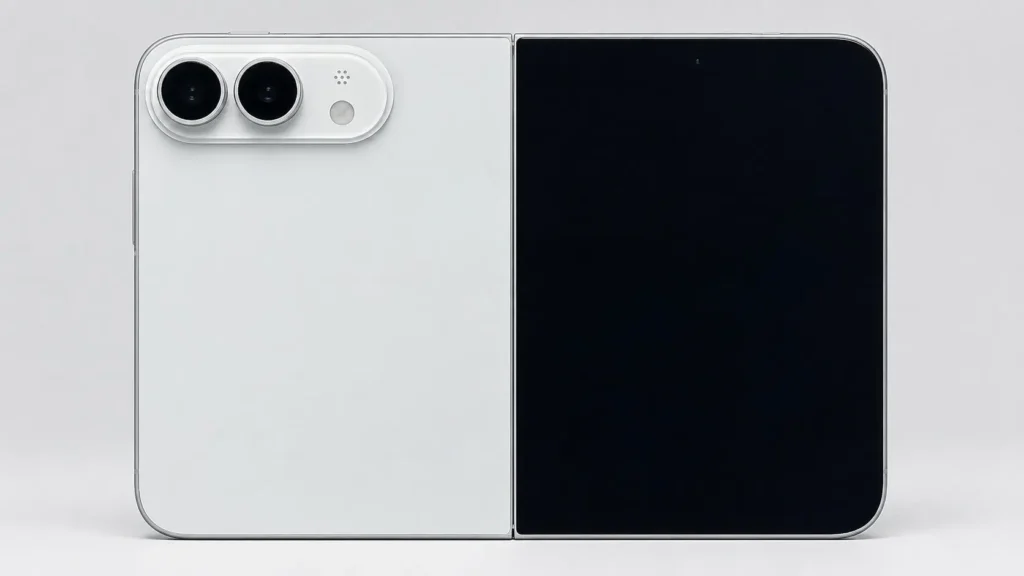
iPhone Ultra pliable : remplacer son écran pourrait coûter plus de 1 100 dollars
Apple’s first foldable iPhone isn’t even officially announced yet, and ownership costs are already raising concerns. Beyond an anticipated launch price exceeding $2,000, replacing its large flexible screen might exceed $1,100 according to a repair specialist’s estimate.
This pricing is not official, and Apple has yet to provide any repair pricing structure or a dedicated AppleCare plan. However, it highlights one of the biggest challenges for the upcoming “iPhone Ultra”: Apple needs to convince customers that its foldable is worth the price, while also reassuring them about the potential costs if the most fragile part fails.
Over $1,100 for Internal Screen Replacement?
The estimate comes from Ricky Panesar, founder of the UK repair company iCorrect. According to him, the replacement of the large foldable screen could cost around £850, approximately $1,150 based on the exchange rate used.
This is certainly not a price set by Apple.
Since the smartphone has yet to be presented, independent repairers obviously do not have access to final parts or official documentation to establish an accurate price. Therefore, this estimate should be viewed as a projection based on the anticipated complexity of the product.
This Could Be One of the Most Expensive Repairs Ever Seen on an iPhone
If this prediction is close to the final price, replacing the internal display would cost as much as a high-end iPhone. This would significantly alter the economic equation of the product.
On a traditional smartphone, a cracked screen is certainly frustrating but typically costs much less than the total value of the device. However, on a foldable priced over $2,000, the main part can represent a substantial portion of the retail price.
Additionally, unlike a battery or USB port, the flexible screen is one of the components most mechanically stressed.
Foldable Screens Are Already Extremely Expensive to Repair
Apple would not be alone in this situation. Samsung’s Galaxy Z Fold also presents high replacement costs for their inner display. Depending on the models and markets, the repair costs are already in the hundreds of dollars. The components involved are much more complex than a traditional OLED.
Repairing involves managing the flexible display itself, its various protective layers, the folding mechanism, and a structure capable of withstanding thousands of opening cycles. Thus, a foldable screen is not just a simple spare part but a complex mechanical subsystem.
Apple Might Even Pay More Than Samsung
Panesar offers another reason for his estimate. Samsung manufactures its own foldable screens via Samsung Display, while Apple would also use panels sourced from Samsung Display, but without the same level of industrial integration, which could raise part costs.
The upcoming iPhone is expected to feature specific solutions developed by Apple regarding the hinge and screen structure. The more proprietary these components are, the more complex their replacements could be in the initial years.
The Hinge Could Make All the Difference
The future foldable iPhone is anticipated to have a particularly sophisticated hinge system. Apple has been working for years to minimize the visibility of the fold in the center of the display. To achieve this, the company has developed a structure that better distributes pressure across the panel when closed. Several unusual materials have been mentioned in various leaks surrounding the project.
However, Apple has yet to confirm any specifics.
One thing seems likely: if the company has indeed taken its time before entering the foldable market, it should offer mechanics that are quite different from the first-generation competitors.
Sophisticated Mechanics Also Mean Harder Repairs
However, innovation comes with complications. When an device uses entirely new parts, technicians have less experience in disassembling and replacing them.
The necessary tools must be adapted, repair procedures developed, and suppliers must produce enough spare parts. For the first few years, independent repairs could therefore be much more challenging.
Additionally, Apple may opt to replace multiple components at once instead of just fixing the display, which would inevitably increase the cost.
The First Foldable iPhone Remains a First-Generation Product
This uncertainty makes the potential costs concerning. Apple obviously has vast experience in smartphone manufacturing. However, a foldable iPhone represents a new mechanical category for the brand. A hinge must continue to operate after tens or hundreds of thousands of openings; the display must endure repeated foldings; the different layers of the panel must not delaminate, and dust must stay away from moving parts.
Even Samsung, which has been selling Fold devices since 2019, continues to improve these elements with each generation.
Waiting Long Doesn’t Eliminate All First-Generation Risks
Apple is often known for entering markets later to avoid rookie mistakes. This strategy works in some areas. However, it does not entirely eliminate the problems associated with a new product. Laboratory tests never perfectly replicate millions of users opening their phones in different ways, in varying climates, and over several years.
Thus, the upcoming foldable iPhone will have to undergo a much tougher test after its launch: real-world use.
The Starting Price May Exceed $2,000
Current estimates place Apple’s upcoming foldable device at around $2,000 or more. Some projections even suggest significantly higher prices depending on storage capacity. Again, no pricing has been announced by Apple yet. However, such positioning would align with the current market. An Apple foldable combines several premium components, a large flexible display, and likely limited availability during the early months.
The manufacturer will therefore have little incentive to seek an aggressive initial price.
The Total Cost Could Become Staggering Without Insurance
At more than $2,000 for purchase and potentially over $1,000 for a damaged screen, the question of AppleCare becomes nearly essential. Ricky Panesar also estimates that the AppleCare coverage appropriate for such a device could itself cost more than traditional iPhones. He also mentions potentially higher deductibles for certain repairs.
Again, these are merely hypotheses. Apple could decide to subsidize certain repairs more to reassure early buyers. However, the intrinsic cost of the screen will leave them with less flexibility compared to a conventional smartphone.
AppleCare Could Become a Key Product Feature
With a MacBook or iPhone Pro, AppleCare is often seen as an option. However, for a foldable device costing over $2,000, it might be considered part of the total purchase budget. The reasoning is straightforward: a buyer willing to invest such a substantial amount will likely want to avoid the risk of paying half the price of the phone after a drop.
Thus, Apple might leverage its insurance as a significant selling point during the launch. The exact terms will be nearly as important as the technical specifications.
All Eyes on September 9
Apple has officially scheduled its fall event for September 9, 2026, under the slogan “Surprise and Shine.” Its first foldable iPhone is largely expected among the announcements, but Apple has yet to confirm its presence. Even if the phone is unveiled at this event, some reports suggest a later release, potentially in October.
It will be necessary to wait for the announcement to learn its official name, pricing, and availability. “iPhone Ultra” remains an unofficial designation for now.
Repair Costs Will Be Nearly as Important as the Phone’s Price
Apple typically only shares complete repair information around the launch of a new product. Therefore, it is at this point that the $1,150 estimate can be measured against reality.
The actual price could be lower. However, it could equally be just as spectacular. The AppleCare pricing structure will also provide insight into how Apple envisions the economic sustainability of its first foldable.
For a product in this category, the purchase price is no longer sufficient to judge its market position.
Apple Must Prove That Its Delay Was Worthwhile
The company arrives several years after Samsung, Huawei, Honor, OPPO, or Google. This delay inevitably raises expectations. The first foldable iPhone must not only function properly.
It must create the impression that Apple has utilized these years to address some of the historical weaknesses of the format. The fold, the hinge, the thickness, but above all, durability. Because a foldable smartphone priced over $2,000 with a screen that could cost over $1,000 to replace must not only be impressive when opened.
It must also be reliable enough that its owner never has to find out if that estimate was accurate.



