

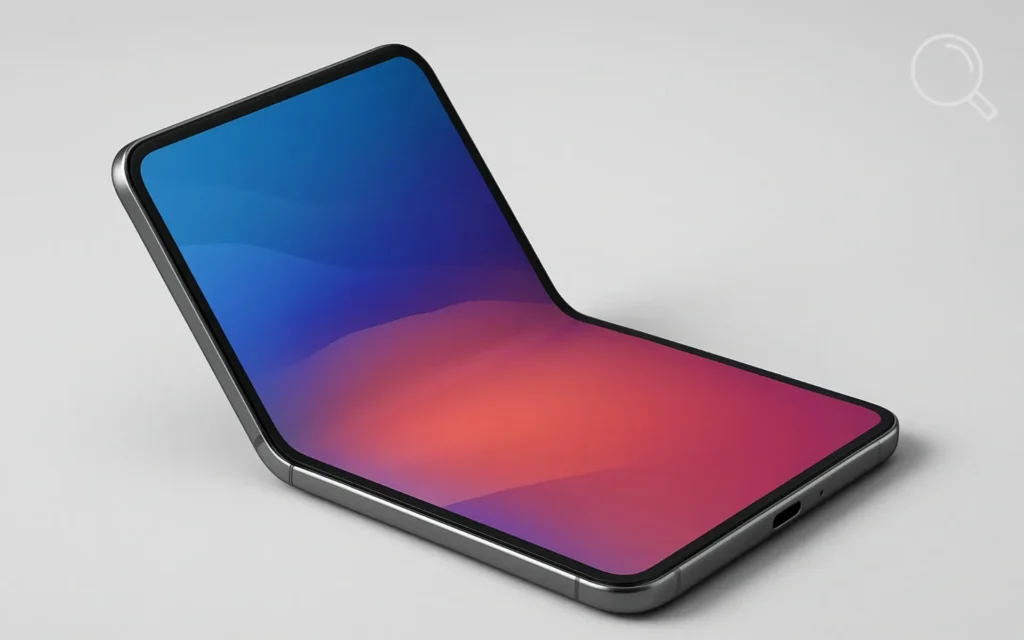
iPhone Fold: Why Apple is preparing a launch ‘like the iPhone X’ in 2026
The foldable iPhone seems to be moving from a mere fantasy to a concrete reality. According to recent comments from Mark Gurman, Apple is indeed set to launch its first iPhone Fold after the arrival of the iPhone 18 Pro and iPhone 18 Pro Max, expected in September 2026.
This delayed launch is no longer just a matter of speculation; it fits within a more plausible scenario, already supported by various recent reports concerning Apple’s new release strategy.
iPhone Fold: A launch after September, as a distinct product
According to MacRumors, which relayed Gurman’s Q&A session, there is “no doubt” that the iPhone Fold will be shipped after the iPhone 18 Pro and Pro Max, but a specific timeline has not yet been confirmed. In 2026, Apple is set to prioritize its premium models, with a second-half launch focused on two Pro iPhones and the debut of the first foldable iPhone, while more affordable models will be introduced later.
This timeline makes sense. A foldable device is not just another iPhone to add to the lineup; it is a more complex and riskier industrial product that is trickier to manufacture at scale. Thus, any delays would be indicative not just of isolated issues but of the very nature of the product.
The comparison to the iPhone X comes naturally
The analogy with the iPhone X is almost unavoidable. In 2017, Apple introduced the iPhone 8, the iPhone 8 Plus, and the iPhone X simultaneously, but the iPhone X was only launched in November, following the release of the other models, due to the complexities involved in its production.
While not mirroring the exact scenario, Apple appears to be returning to a similar logic: unveiling a new product alongside the main iPhone but allowing it its own distinct timeline.
The real challenge remains the foldable interior screen
The most frequently cited reason for the delay is the production of the inner panel. Bloomberg had already reported in mid-March that Apple is working on a foldable device featuring a large internal screen similar to the size of an iPad mini when opened. This type of display, particularly if Apple intends to minimize visible folding, requires a significantly higher level of precision than a standard smartphone.
Recent reports also point to a screen that is “practically crease-free” or nearly without visible folds, which inherently complicates the industrial launch.
An iPhone Fold priced over $2,000 seems plausible
The price is also expected to reflect this ambition. The most credible estimates place the first foldable iPhone in the price range exceeding $2,000, with some projections reaching as high as $2,500. The iPhone Fold would, by far, be the most expensive iPhone ever launched.
This price hike isn’t surprising: Apple doesn’t seem to be preparing an “accessible” foldable but rather a premium demonstration product that could enhance both the brand image and the company’s profit margins.
Touch ID instead of Face ID, at least initially
Another important detail: the first iPhone Fold is likely to forgo Face ID in favor of Touch ID integrated into the side button. The TrueDepth module would likely be too thick to fit neatly into such a slim foldable chassis. The phone is expected to use a Touch ID button similar to that found on certain iPads.
This means that Apple is willing to make a calculated trade-off: maintaining the slimness and structure of the foldable today while delaying the integration of Face ID. Again, this is very much in line with Apple’s philosophy: it’s better to postpone a signature technology than to incorporate it imperfectly into a new product category.
The WWDC on June 8 will be another significant Apple event
Alongside the iPhone Fold developments, Apple has confirmed that WWDC 2026 will take place from June 8 to 12, with a keynote on June 8. Expectations are high regarding AI, particularly around a new, more conversational Siri that is more open to third-party services. Apple is considering opening Siri to other AI like Gemini or Claude via iOS 27, featuring a “Extensions” system and a deeper redesign of the assistant.
In other words, Apple could be leveraging two very different yet complementary fronts in 2026: a significant software push related to Siri and Apple Intelligence in June, followed by a hardware focus in the fall with its Pro iPhones and the later release of the first foldable.
Apple seems to be treating the iPhone Fold like an iPhone X on steroids
What’s most intriguing about this development is not just that Apple is finally preparing a foldable device, but the manner in which it plans to launch it: not as a mere addition to the lineup but as a distinct, more complex, delayed, and symbolic object. In this sense, the iPhone Fold may play a role similar to that of the iPhone X in 2017 — not necessarily the best-selling model from the start, but one that redefines the direction of the product.
In summary, if Gurman is correct, Apple’s first foldable will not arrive alongside the iPhone 18 Pro but shortly thereafter. This slight delay may speak volumes: Apple aims not just to launch a foldable iPhone but to launch its foldable iPhone when it deems the product is ready.



