

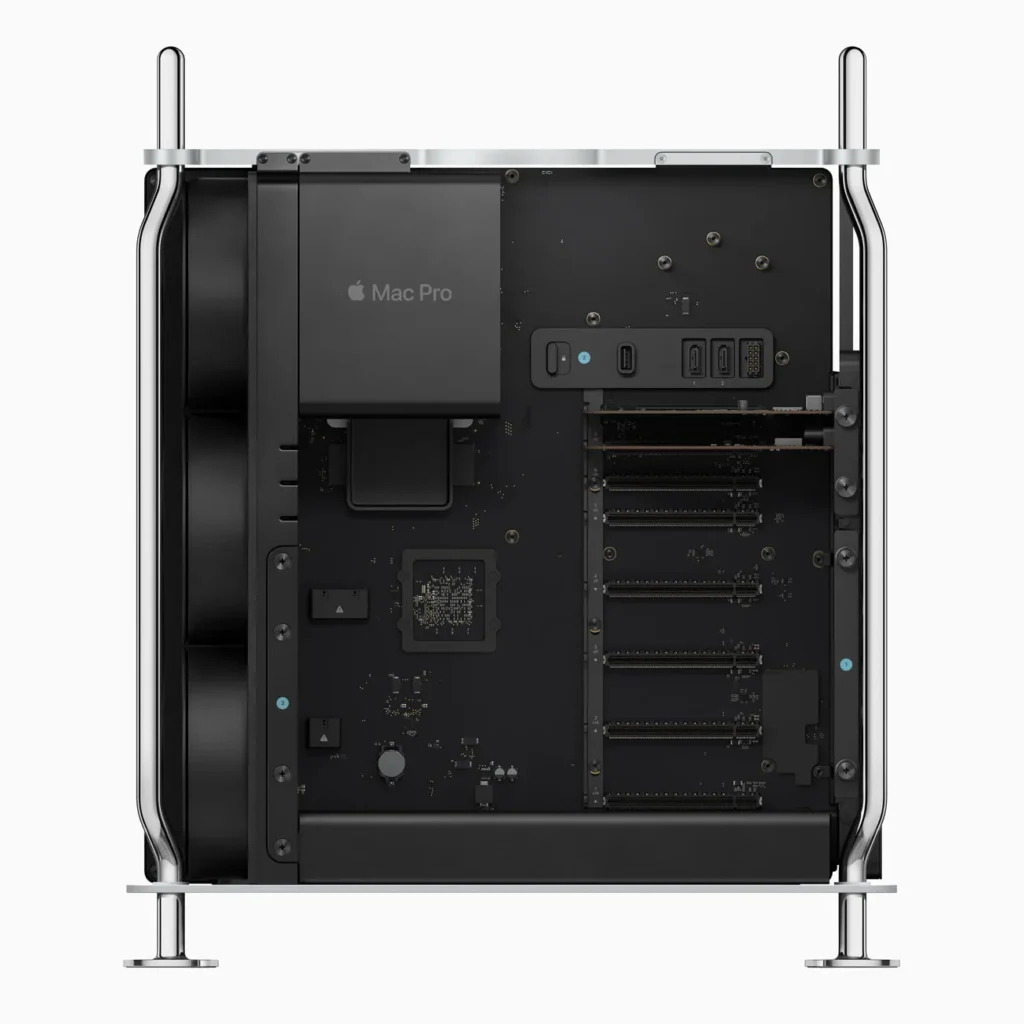
An entire chapter in the history of the Mac closes. Apple has officially discontinued the Mac Pro, its most iconic workstation, with no plans for a successor. The model has been removed from Apple’s website, and according to confirmations reported by 9to5Mac, no new Mac Pro is in development.
Mac Pro: An End Less Dramatic Than It Seems
The disappearance of the Mac Pro may seem sudden, but it was almost inevitable. Since the introduction of Apple Silicon chips, the product’s logic had weakened. The 2023 Mac Pro equipped with the M2 Ultra promised to extend the lineage while maintaining the “tower” DNA and PCIe slots, but it came with a difficult-to-ignore issue: it offered performance very similar to the Mac Studio at a significantly higher cost. The Mac Studio delivered comparable power for thousands of euros less.
It’s also worth noting that the transition of the Mac Pro to Apple Silicon wasn’t a lengthy process. It was limited to a single generation, that of the M2 Ultra launched in 2023. The 2019 Intel Mac Pro, with its famous “cheese grater” design, still had a clear justification in the old Apple world: modularity, ample memory, dedicated GPUs, and expansion cards.
However, in the Apple Silicon universe, the product lost part of its raison d’être, especially since it did not support external GPUs and was much less extensible than a true traditional workstation.
The True Successor Is Not a Successor: It’s the Mac Studio
While Apple has not officially designated a direct replacement, everything points to the Mac Studio as the new benchmark for desktop power in the lineup. The latest models of the Mac Studio, equipped with M3 Ultra, already occupy the space that the Mac Pro was meant to defend: extreme performance, a more compact format, and a much more rational price. The combination of Mac Studio and Thunderbolt 5 makes the old argument for the Mac Pro much less compelling today.
This doesn’t mean that the Mac Studio perfectly “replaces” the Mac Pro in the historical sense. It primarily replaces its commercial role in Apple’s current lineup: that of the most powerful Mac that most professionals can buy without confronting a pricing logic that has become increasingly difficult to defend.
A Symbolic End for the Most Legendary Mac
However, the Mac Pro remains a name rich in history. Even before the 2019 tower, Apple had made a radical shift with the 2013 Mac Pro, the infamous “trash can,” which both fascinated and divided opinions. Then the return to the perforated aluminum chassis in 2019 symbolized a form of reconciliation with professionals.
By discontinuing this line, Apple is not just removing a product from its catalog; it is abandoning the idea that an ultra-modular desktop Mac should still exist as the visible pinnacle of its range.
Apple Chooses Range Efficiency Over the Prestige of a Totem
The case of the Mac Pro tells a broader story about Apple in 2026. The company seems increasingly uninterested in totem products maintained for their symbolic value. If a device no longer clearly justifies its place in terms of performance, price, and technical architecture, Apple prefers to cut it. The Mac Pro will have survived several major transitions but will not survive the one that has made the rest of the lineup powerful enough to render it redundant.
In summary, the Mac Pro is not disappearing because Apple has abandoned the “pro.” It is vanishing because, in the current logic of Apple Silicon, “pro” no longer resembles a large empty tower waiting to be filled — it resembles a dense, quiet, and far more profitable Mac Studio.



