

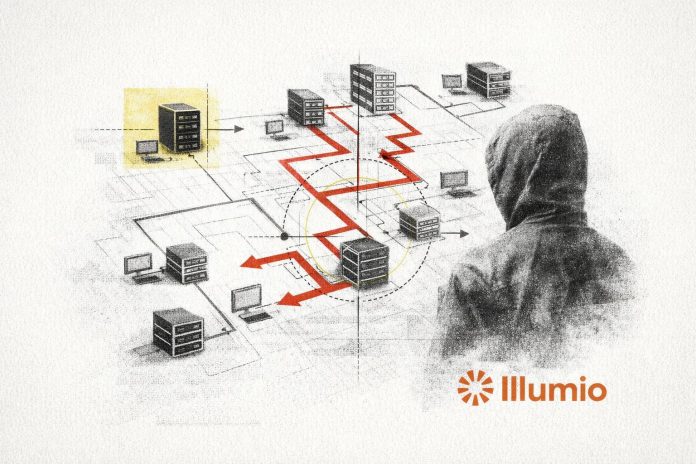
Autonomous agents that traverse enterprise infrastructures at machine speed are significantly enhancing attackers’ ability to move laterally, map interconnected systems, and trigger cascading effects even before human alerts can be processed. In response to this evolution, Illumio is expanding its Illumio Insights platform: where breach containment once focused on isolated workloads, it is now broadening to encompass a dynamic, real-time view of lateral movement risk across the entire system.
Agent-based AI is redefining the terms of engagement in cybersecurity. The principle of micro-segmentation is straightforward: limit an attacker’s ability to spread once they have infiltrated the system. Historically, this approach has been applied asset by asset, defining segmentation policies around individual workloads. However, this model encounters structural limitations when faced with AI-driven attacks that exploit relationships between assets rather than individual entities. John Kindervag, Chief Evangelist at Illumio, underscores this shift: “Attackers exploit relationships, not individual assets. If you cannot see how traffic flows within your environment, you cannot detect the attack or contain the breach.”
Illumio Insights is enhancing its capabilities with the introduction of a new feature called Network Posture. This feature continuously analyzes real network traffic, existing security policies, and their alignment with application mechanisms, while also comparing them against industry benchmarks. The goal is to identify areas at risk for lateral movement, including exposures that are not being actively exploited at the time of analysis. By correlating this data with application and business context, teams can prioritize their containment decisions based on actual risk across the system, rather than relying on an isolated asset-by-asset assessment.
Network Posture Continuously Measures Security Posture
Beyond merely detecting attack paths, Network Posture provides continuous measurement of security posture across hybrid environments. This assessment is articulated in terms relevant to security teams and auditors: NIST CSF, PCI DSS, SOC 2, and DORA. Aligning actual network behavior with these frameworks enables maturity reporting based on operational observations, eliminating the need for declarative or one-time assessments.
This aspect of continuous reporting is particularly pertinent for organizations subject to NIS2 and DORA requirements. These regulations mandate that essential entities and financial actors demonstrate the effectiveness of their security measures with documented traceability. The ability to generate a network posture assessment aligned with DORA, based on actual traffic behavior rather than formal compliance declarations, serves as a concrete operational lever for security leaders tasked with justifying their maturity level to governance bodies and regulators.
IT/OT Convergence as a Priority Focus
In parallel, Illumio is extending its security graph to operational technology (OT) environments through a deep partnership with Armis. This integration brings OT system inventory, context, and traffic flows into attack path analysis, allowing teams to visualize their exposure across interconnected IT and OT environments. Agentless visibility in on-premises data centers complements this by revealing lateral movement risks across both on-site and cloud environments, with direct links to application mechanisms through integrations with Fortinet, Check Point, and other firewalls.
The IT/OT convergence is one of the most concerning exposure vectors for the energy, industrial manufacturing, and critical services sectors. Historically isolated OT networks, now linked to IT infrastructure for operational efficiency, open attack paths that traditional security tools struggle to map continuously. Illumio Insights’ ability to correlate OT and IT flows within a unified security graph addresses this structural gap, especially for vital operators subject to NIS2 obligations concerning the security of critical industrial systems.
Towards Attack Path-Focused SOC Investigations
The third point of this update focuses on the operations of security operations centers (SOCs). Analysts today operate in environments where the volume of alerts structurally exceeds their processing capacity. Illumio Insights transforms the investigation model by correlating identities, vulnerabilities, and traffic relationships throughout the environment to provide visibility into the propagation of suspicious activity within the system. Analysts can then take action on paths presenting the highest risk, directly from their existing SIEM workflows and ticket management systems.
This assessment framework, centered on outcomes rather than tools, aligns precisely with the practices of the most mature security teams and is increasingly mandated by NIS2 and DORA for organizations within their scope.



