

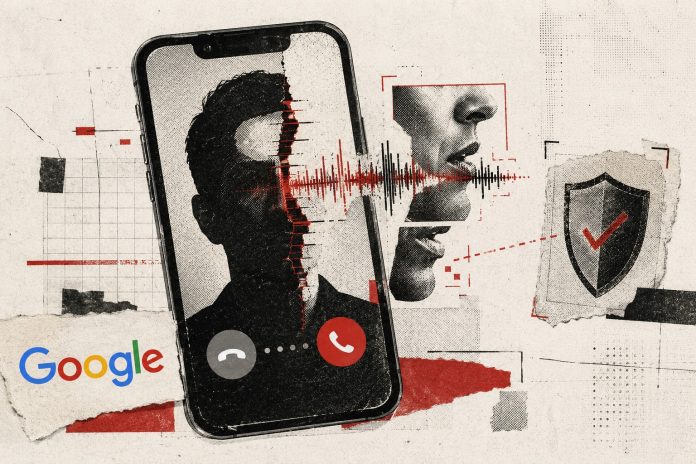
Fraudsters are now ringing phones by displaying the number of a known contact, like a family member or company executive, and using AI tools to mimic their voice to demand funds or access credentials. To combat these calls, Android has introduced a new feature that verifies with the displayed contact’s phone to ensure the call is legitimate, alerting the recipient on-screen when it isn’t. This feature, which is enabled by default in the Phone by Google app, is rolling out globally this month for devices running Android 12 and later, starting with Pixel phones.
For years, caller ID provided a sense of security, allowing users to engage confidently with familiar voices at the other end. However, advancements in voice-cloning technology have disrupted this balance, producing audio hyper-realism that makes it difficult for most people to distinguish between a synthesized voice and a real one. Coupled with caller ID spoofing—where calls are routed through VoIP services to display the names of trusted contacts or financial institutions—this combination has fueled identity theft schemes. A report from INTERPOL’s global financial threat assessment published in March 2026 identifies this method as a major contributor to over $400 billion in global losses.
This alarming trend is precisely what Google’s newly announced fake call detection feature aims to address. The functionality identifies calls that appear to originate from a contact in the user’s address book but are not actually coming from that person’s device, prompting a warning to hang up immediately. This feature builds on Google’s recently introduced financial call verification to warn users when a scammer impersonates their bank, and it complements AI scam detection already available in Google Messages and the Phone app on Pixel and Samsung devices.
A Secure Digital Handshake Between Devices
The mechanism operates like a digital handshake between devices. When a contact calls while both parties are using the Phone by Google app, the caller’s device sends a silent real-time confirmation signal to the recipient’s device, verifying that the call is indeed from that contact’s phone. This signal is transmitted via the Rich Communication Services (RCS) protocol, featuring end-to-end encryption to maintain the privacy of the exchange.
If impersonation occurs, the confirmation signal will be missing. The recipient’s device will then query the actual device of the contact, and if no active call is confirmed, a warning appears on the screen during the conversation. This detection works directly on the call session itself, avoiding an analysis of the conversation’s content or voice, unlike methods that attempt to identify artifacts of synthetic voices. This feature requires both parties to be using Phone by Google, Contacts, and Google Messages with RCS capabilities, and it can be disabled within the app settings.
An Open Standard Proposed for the Entire Industry
Google has developed this feature based on RCS, an open standard supported by the GSMA, encouraging other applications and manufacturers to adopt it. The practical effectiveness of this measure relies heavily on widespread adoption, as the protection only activates between two users of Phone by Google—the default messaging app for most Android devices, yet absent on the iPhone and certain manufacturer custom skins. The integration of this mechanism across the mobile ecosystem will largely depend on buy-in from companies like Apple, Samsung, and telecom operators, similar to the STIR/SHAKEN call authentication protocol, which Google has supported across networks in various countries to verify the network origin of calls without confirming the sending device.
The rollout begins with Pixel devices this month before expanding globally to Android 12 and later devices. Users with devices utilizing different phone applications can download Phone by Google from the Play Store and set it as their default. In 2024 alone, the U.S. FTC reported losses of nearly $2.95 billion due to identity theft scams, a figure that continues to grow amidst rising cases of fraudsters exploiting caller ID spoofing to counteract users’ hesitance to answer unknown numbers, effectively playing on their instincts of caution.
Voice Impersonation Fraud Enters the Corporate Arena
For organizations, this development addresses a scenario familiar to financial departments as “president fraud,” particularly in its escalated form enabled by AI. An incoming call displaying the executive’s number, coupled with a cloned voice, can demand the urgent transfer of funds or sensitive credentials. Even a few seconds of publicly accessible recording—extracted from an online event or voicemail—can suffice to create an effective clone. Traditional checks, such as following up on known numbers and verifying through secondary channels, necessitate vigilance that hyper-realistic impersonation aims to bypass. Automatic verification of the calling device, carried out by the organization’s internal system, adds a layer of protection that doesn’t rely solely on the target’s discernment.
The system authenticates the device making the call, rather than the speaker themselves. Therefore, an incoming call from a legitimate device—whether compromised or operated by an AI agent—passes the verification, while a cloned voice from an unknown number falls outside the verification scope, triggering a separate Scam Detection function that relies on conversation analysis. Additionally, this protection is contingent on uniformity within the organization’s fleet, as both parties must use Phone by Google with RCS enabled—a configuration that IT departments can enforce across managed Android devices but cannot extend to the personal phones of executives or iPhone fleets. Awareness of voice hyper-realism remains critical in training programs, as the coverage of this solution is still partial.



