

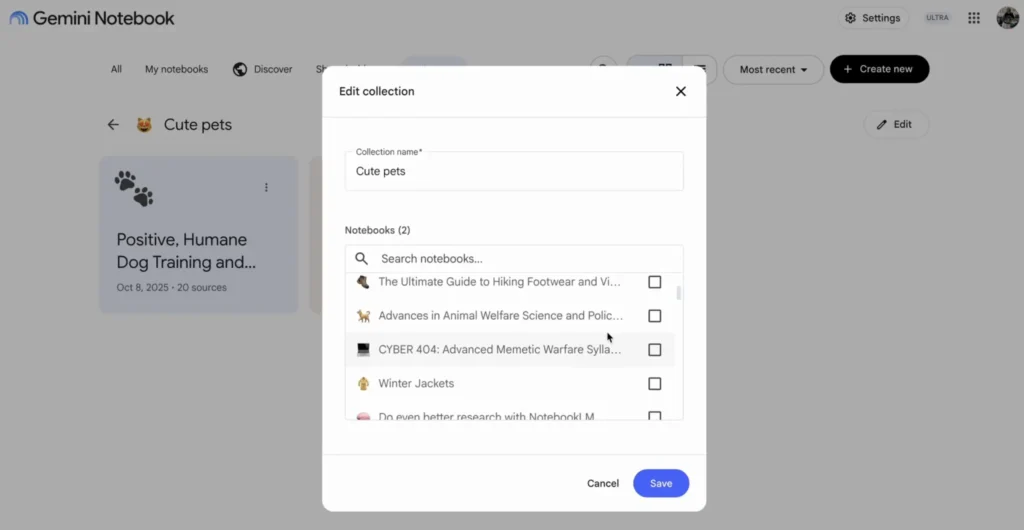
Gemini Notebook: Google adds collections to better organize your research
Google continues to evolve its artificial intelligence ecosystem. After gradually integrating NotebookLM into the Gemini universe and beginning its rebranding, the company is rolling out a new feature designed to simplify research project management: Collections.
This new feature addresses a growing problem as users accumulate dozens, if not hundreds, of notebooks within Gemini Notebook.
A More Flexible Organization Than Traditional Folders
Unlike a classic folder system, Collections function more like tags or playlists. A single notebook can thus be associated with multiple Collections simultaneously.
For instance, a project focused on artificial intelligence could be categorized into a work Collection, a technology Collection, and even a Collection grouping research projects.
This approach avoids duplicating notebooks while allowing users to organize their content based on various criteria. Documents that don’t require specific classification remain accessible in the My Notebooks section.
We heard you loud and clear: you want a way to organize your notebooks. So…
Meet Collections!
A brand new tab, Collections operate like photo albums or playlists: zero rigid folder structures with maximum flexibility. Add notebooks to as many collections as you want, or skip… pic.twitter.com/8wcsVSyEgm
— Gemini Notebook (@Gemini_Notebook) July 20, 2026
A Response to An Increasingly Complex Library
The introduction of Collections comes as Gemini Notebook plays a more significant role in Google’s AI strategy. Notebooks can now be used directly within the Gemini app, alongside conversations with the assistant, imported documents, and personalized instructions.
All modifications are synchronized between Gemini Notebook and other compatible services.
Google is also preparing for deeper integration with Google Search, where certain assisted search features could leverage notebooks created by users. As usage expands, organizing this content becomes crucial.
A Deliberately Simple Feature
However, Google has opted for a minimalist approach. Collections only allow users to group notebooks. At this stage, they do not offer sub-Collections, complex hierarchies, automatic sorting through artificial intelligence, or a true document management system.
The aim is primarily to make the dashboard more readable without imposing a heavy or time-consuming organization.
An Additional Step in the Gemini Strategy
This development illustrates Google’s intention to gradually transform NotebookLM into a central component of the Gemini ecosystem. What began as a tool for AI-assisted note-taking is now evolving into an integrated work platform connected to Gemini, Google Search, and eventually other company services.
In this context, Collections appear less as a mere organization feature and more as a foundational layer of organization designed to support the increasing complexity of user needs.
While more advanced users may lament the lack of a true folder system or automated classification, this new feature should nonetheless ease the day-to-day for those already using Gemini Notebook to manage multiple research projects. It also reinforces Google’s commitment to making Gemini a comprehensive work environment where artificial intelligence not only answers questions but also assists in organizing and managing information.



