

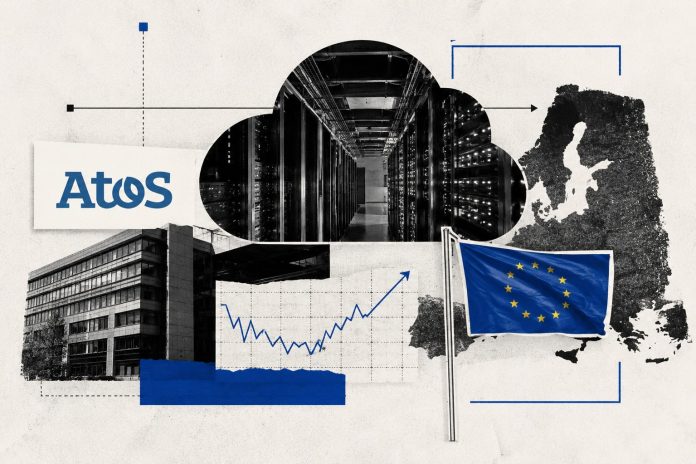
Atos Sovereign Cloud is a hosted application modernization platform based in the European Union, designed for government bodies, defense agencies, healthcare providers, and critical infrastructures. This announcement comes as the group emerges from a financial restructuring that has long limited its investment capacities. The key concern now revolves around the budget allocated and tangible indicators of success.
According to Gartner, referenced in the press release, more than half of multinational corporations are expected to have established a digital sovereignty strategy by 2029, up from less than 10% today. The consulting firm places Atos in line with a trend that has already gained traction in the infrastructure sector: Airbus has partnered with Scaleway for some of its business applications, while Outscale and Numspot are expanding their sovereign offerings. ITS Integra is also pursuing its SecNumCloud qualification. Atos Sovereign Cloud aligns with this movement rather than initiating it.
However, this announcement comes at a pivotal moment for the group, marking a return to investment capabilities that have been absent for several years due to financial constraints. It remains to be seen whether this launch represents a genuine budgetary catch-up or merely an alignment with a well-documented market trend.
What Atos Sovereign Cloud Promises
The platform targets organizations subject to strict regulatory requirements, including public administrations, defense organizations, healthcare institutions, and operators of critical infrastructures. Atos presents it as being fully hosted, operated, and contracted within the European Union, featuring an open architecture designed to enhance application portability and establish dedicated cybersecurity mechanisms for critical systems. A marketplace will bring together Atos services, qualified partner solutions, and client-specific repositories. Availability is slated for sometime in 2026, though no specific date or client has been confirmed at this stage.
IT Social applies a four-tier assessment to sovereign cloud announcements (European hosting, operation by a European entity, legal control, and technical mastery) that is more reliable than the marketing rhetoric of service providers. Atos Sovereign Cloud unequivocally meets the first two criteria, with hosting and operations both announced to take place within the European Union. Legal control will depend on the actual contractual clauses, which have not yet been published. Technical mastery remains to be demonstrated, with the touted open architecture still seen more as a principle than a verifiable detail.
“Digital sovereignty is now a global operational priority,” says Michael Kollar, group head of digital sovereignty at Atos. Punit Sehgal, CEO of Atos BNN, describes the platform as a means to modernize critical applications without compromising control, compliance, or operational resilience. The scope includes defense: regarding classified EU data, the European Union Restricted (R-UE/EU-R) certification will apply, which differs from SecNumCloud, and is jointly issued by the European Commission and ANSSI. This certification is already utilized by Thales for its defense-oriented cloud offerings. Atos Sovereign Cloud will need to clarify the specific sectors it aims to serve.
The Real Test: Budget and Indicators over a Press Release
The Commercial Court of Nanterre approved Atos’ accelerated safeguard plan in December 2024. During this time, the group announced a reduction of €2.1 billion in its gross debt, achieved by converting €2.9 billion of receivables into equity and injecting an additional €145 million in equity. Financial creditors now hold approximately 74% of the company’s capital, and Atos has no repayment deadlines before 2029. Fitch and S&P have upgraded its rating to B— with a stable outlook.
This newfound financial flexibility alters the interpretation of Atos Sovereign Cloud. During the years of restructuring, the group inevitably prioritized debt reduction over product investments. Today’s launch can be viewed as a calculated catch-up, an opportunity to reinstate previously delayed investment plans. Alternatively, it may simply be a communication exercise anticipating an investment capacity that the press release does not quantify. The publicized budget for the platform, the number of staff allocated, and the identification of an initial client would provide crucial signals to differentiate between these two perspectives. Currently, none of this information has been disclosed.
Other service companies undergoing similar transitions have opted to quantify their commitments. For instance, SCC, the second largest French IT Services Company according to the Grand Angle 2025 ranking, announced in July that it will invest between £50 million and £100 million over five years for its own AI repositioning, alongside dedicated technology centers and plans for around a hundred new hires. No such specific figures or timelines have accompanied Atos’ announcement so far.
An IT Services Company in a Bind Seeks New Ground
The French IT services market contracted by 1.8% in 2025 to €34.3 billion, though a rebound to 1.4% growth is anticipated in 2026, according to the Numeum/PAC observatory. In contrast, the French software publishing sector grew by 8.2% and then 8.4%, with AI-driven productivity among publishers increasing from 12.5% to 17%. This widening imbalance occurs as Atos, a historic IT services company, aims to establish itself as an infrastructure publisher.
Pressure is coming from two fronts. On the software side, Microsoft, OpenAI, Anthropic, and AWS have invested over $9 billion in just two months into deployment entities that directly implement AI at client sites, directly competing with consulting firms and IT services companies. On the workforce side, the Malt Tech Trends 2026 study reports that demand for AI specialists has surged by 60 times, with freelancers charging between €120,000 and €300,000 annually for in-depth AI expertise, and between €400 and €800 per day for general AI consulting. The low entry barriers for these freelancers are attracting both former developers and infrastructure engineers as well as new, agile firms.
The billing structure itself is under threat. Gartner projects that global software spending exposed to agentic arbitration could reach $234 billion by 2030, as the traditional per-user license model transitions to usage-based or outcome-driven models. An IT services company that historically sells consulting and integration time is thus facing dual compression on its pricing and service scope. Positioning itself as a provider of sovereign infrastructure rather than a mere service vendor aligns well with this trajectory.
A Political Criterion Still Uncertain
A parliamentary report on digital dependencies, submitted on July 16 by the National Assembly’s inquiry committee, proposes making SecNumCloud qualification a mandatory purchasing criterion for public procurement. Some providers already qualified are supporting this proposal, which would mechanically strengthen their commercial position.
However, its adoption is not guaranteed. An inquiry committee has no binding authority, and the measure is not essential as long as an offer already meets the established four criteria for sovereignty. For a CIO or CISO evaluating Atos Sovereign Cloud today, these four criteria remain the most relevant tests, far ahead of the uncertain outcome of parliamentary discussions.
Ultimately, the evaluation of Atos Sovereign Cloud will hinge on verifiable facts rather than the label “sovereign” used in the press release. A publicly disclosed budget, an initial named client, and a dated roadmap will carry more weight than a qualification that, in any case, cannot yet exist. It remains to be seen whether the group can translate this announcement into a documented commercial offer, or if it will join the ranks of platforms that are presented but never realized.



