

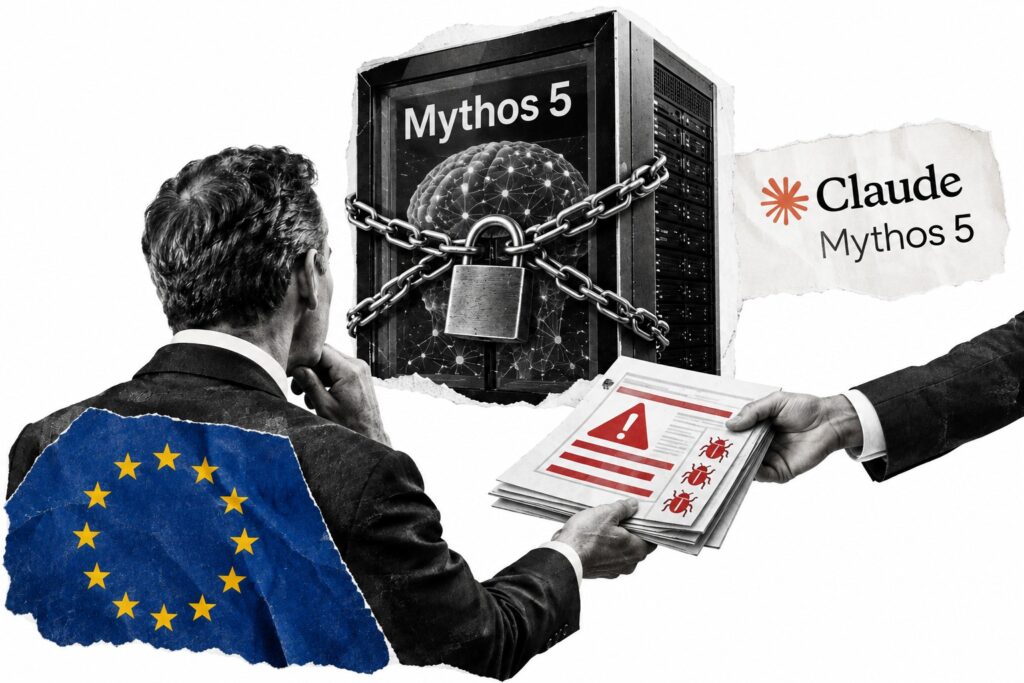
Palo Alto Networks has launched a continuous offensive testing service that leverages Claude Mythos 5 from Anthropic and GPT-5.6-Cyber from OpenAI to probe the information systems of its clients. These models are limited to a select group of authorized partners, including Palo Alto. Consequently, client companies purchase the vulnerabilities identified by these models without ever accessing them directly.
On September 22, Unit 42, the incident response and threat intelligence division of Palo Alto Networks, introduced the Unit 42 Continuous Frontier AI Defense. This service continuously checks for vulnerabilities across applications, identities, cloud environments, and networks for its clients, identifying exploitable vulnerabilities and facilitating their remediation. The service is available worldwide via an annual subscription, with pricing variable depending on the selected models, which Palo Alto has not disclosed. It builds upon the Frontier AI Defense service launched in April, which offered only one-time exposure assessments and a security repository.
In June, Anthropic restricted access to Claude Mythos 5 to partners of Project Glasswing, a critical software security program launched in April with twelve founding members, including Palo Alto Networks, CrowdStrike, Cisco, Google, and Microsoft. OpenAI followed suit on August 10 with Daybreak, which includes the Red tier that provides access to GPT-5.6-Cyber, a model trained for vulnerability discovery and exploit chain construction. Access to this model is contingent on identity verification, legal attestations, and, as of September 1, hardware security keys. Thus, transitioning from a one-time audit to a subscription model relies on privileges held by only a few companies.
Clients receive vulnerabilities without direct model access
Palo Alto Networks is unique in being both a founder of Project Glasswing and a partner named by OpenAI for Daybreak Red, alongside SpecterOps and SentinelOne. Unit 42 added both Claude Mythos 5 and GPT-5.6-Cyber to its tools in August, alongside open-weight models. Thus, the service provides clients with insights they cannot obtain directly — results from two models that are otherwise inaccessible to them.
Unit 42 had already run GPT-5.6 Daybreak for its clients in August, delivering findings and remediation plans without granting access to the model itself, which remains with the authorized partner. Therefore, this framework is not new to the publisher. The subscription model extends this access to two model providers simultaneously, a strategy that OpenAI acknowledges. “Defenders need the potential of frontier AI in the tools, processes, and services they already trust,” stated McCall McIntyre, OpenAI’s global cyber partnerships lead, in Palo Alto’s announcement. Palo Alto justifies this dual access with a statistic: no model detects more than 40% of vulnerabilities in complex environments, and the findings from Claude Mythos 5 and GPT-5.6-Cyber overlap by less than 10%. Palo Alto has not disclosed the number of assessed environments or its counting methodology.
Launch metrics primarily highlight attacker capabilities
According to Sam Rubin, Senior Vice President of Unit 42, an attacker utilized over fifty techniques from the MITRE ATT&CK framework to condense weeks of methodical intrusion into less than ten hours — a staggering 97% faster than a skilled intrusion team. Thus, the standout metric from the launch measures adversary speed, not the service’s efficiency. Unit 42 also observed that automated scanners exploit vulnerabilities within fifteen minutes of their disclosure. “AI has created an asymmetrical advantage for attackers against organizations trying to defend themselves at human speed,” stated Sam Rubin.
Palo Alto quantifies the outcomes of its service without disclosing the methodology behind its findings. The system reportedly identified 3.2 times more high and critical vulnerabilities per product than previous testing methods, and development teams reduced their average remediation time by 51%. In over a hundred Unit 42 missions, exposure analysis found vulnerabilities across all tested clients, with 37% of identified exposures classified as high or critical. Notably, two-thirds of validated exposures in third-party applications did not correspond to any known CVE. Palo Alto has not specified which previous methods it is comparing its results against.
European CISOs depend on non-negotiable access
Claude Mythos 5 and GPT-5.6-Cyber remain under the control of Anthropic and OpenAI, who grant access under strict conditions and can impose restrictions. Thus, for CISOs, the subscription model elevates their dependency further. Anthropic has expressed a desire to broaden access to Claude Mythos 5 “in consultation with the United States government.” The next model, Claude Mythos 5.1, unveiled in early September, is “available only to a set of U.S. organizations,” according to the publisher. Thus, while European firms can purchase Palo Alto’s service, they cannot access the models powering it.
Palo Alto has not clarified where Claude Mythos 5 and GPT-5.6-Cyber are executed or where the analyzed data is hosted. All three companies — Palo Alto Networks, Anthropic, and OpenAI — are American entities subject to the Cloud Act, regardless of data storage location. Before signing any agreements, CISOs should ensure they obtain written clarity on data processing locations, protocols to follow if one of the model providers restricts access mid-contract, and the precise scope of tests permitted on their information systems.
As early as September, twenty security vendors were already employing their products on the models of a single provider, as noted by IT Social. Palo Alto’s offering adds to this growing concentration. Corporate defense now hinges upon an intermediary that holds the keys to the models, as long as their publishers allow them to.



