

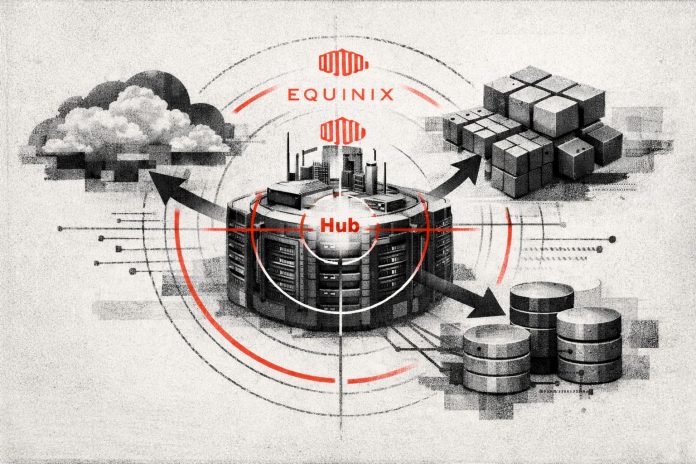
Equinix has launched the Distributed AI Hub, a neutral infrastructure framework designed to connect, secure, and simplify enterprises’ distributed AI ecosystems. Available across Equinix’s 280 high-performance data centers worldwide, the Hub leverages Equinix Fabric Intelligence and introduces Palo Alto Networks’ Prisma AIRS security solution to safeguard real-time interactions between AI agents, models, and external data sources.
The deployment of AI agents in businesses faces a fundamental contradiction: inference workloads and training data are distributed across public clouds, private data centers, edge environments, and specialized GPU cloud providers, each operating under its own performance and sovereignty constraints. As AI systems evolve from being one-off tools into autonomous agents making calls to models, databases, and third-party services, the complexity of governance and interconnectivity increases non-linearly. Mary Johnston Turner, Research Vice President for Digital Infrastructure Strategies at IDC, summarizes the challenge: “Companies are rushing to deploy agent-based AI but find that their existing infrastructure was never designed to handle the complexity of distributed intelligence.” IDC predicts that by 2027, 80% of enterprises will have implemented distributed edge infrastructure to enhance the latency and responsiveness of their AI applications.
Amidst this fragmentation, Equinix aims to position itself as a neutral intermediary among hyperscalers, model providers, and client enterprises. The stated intention is to build one of the market’s most extensive and open AI ecosystems, drawing on its global network of 280 data centers that are already serving as interconnection points for a broad customer base. The Distributed AI Hub serves as an operational realization of this positioning: a unified framework that allows companies to customize their AI architecture from the best available providers, without being dependent on the closed ecosystems of any single supplier.
A Neutral Convergence Point for Clouds, Data, and AI
The Distributed AI Hub is established as a neutral environment regarding providers, unlike the AI platforms of hyperscalers that favor their own services. It enables businesses to connect models, data, computing capacities, and ecosystem partners within a unified framework, without requiring organizations to rebuild their architecture or move their data to different environments. Connectivity is facilitated through low-latency private links within the Equinix Fabric Intelligence network.
Jon Lin, Chief Business Officer at Equinix, articulates the central value proposition: “AI is not centralized, but an optimized infrastructure can make it operate as if it were. Equinix serves as the neutral ground where AI, cloud, and network infrastructures converge. This allows inference to be executed closer to data and users, without the operational complexities imposed by distributed architectures.” For IT leaders, the operational challenge is clear: executing AI workloads where they deliver the best performance, while maintaining consistent governance and control across all environments.
Palo Alto Networks Providing Security for AI Agents
The Hub’s primary integration is with Palo Alto Networks, whose Prisma AIRS solution ensures real-time protection for interactions between AI agents, models, and external tools. This security layer covers an area often neglected by traditional architectures: the flows between autonomous agents, calls to external data sources, and interactions with third-party AI frameworks. Prisma AIRS will also be available on Equinix Network Edge, allowing for centralized security policy management close to users, clouds, and critical applications.
For Chief Information Security Officers (CISOs), this integration addresses an emerging challenge: in an agent-based AI environment, the attack surface extends beyond terminals and APIs — it encompasses the interactions between models, agents, and data, where traceability and access control often remain inadequate in current deployments. Lloyd Taylor, CTO and CISO at Alembic, emphasizes this point: “The challenge extends beyond computing power or data. It’s about controlling where data resides and where computation occurs.”
A Design Focused on Sovereignty and Performance
The availability of the Distributed AI Hub across Equinix’s 280 data centers worldwide directly addresses data residency and latency constraints that hinder large-scale AI deployments. For organizations bound by GDPR or sector-specific data localization requirements, the ability to execute inference as close to the data as possible, without transit to external environments, represents a tangible compliance benefit.
For IT departments grappling with complex multi-cloud architectures, the Hub alleviates integration burdens by centralizing the discovery and connection to AI infrastructure providers, models, GPU clouds, data platforms, network services, and frameworks through a single access point.
Equinix will showcase the Distributed AI Hub ahead of the Nvidia GTC conference.



