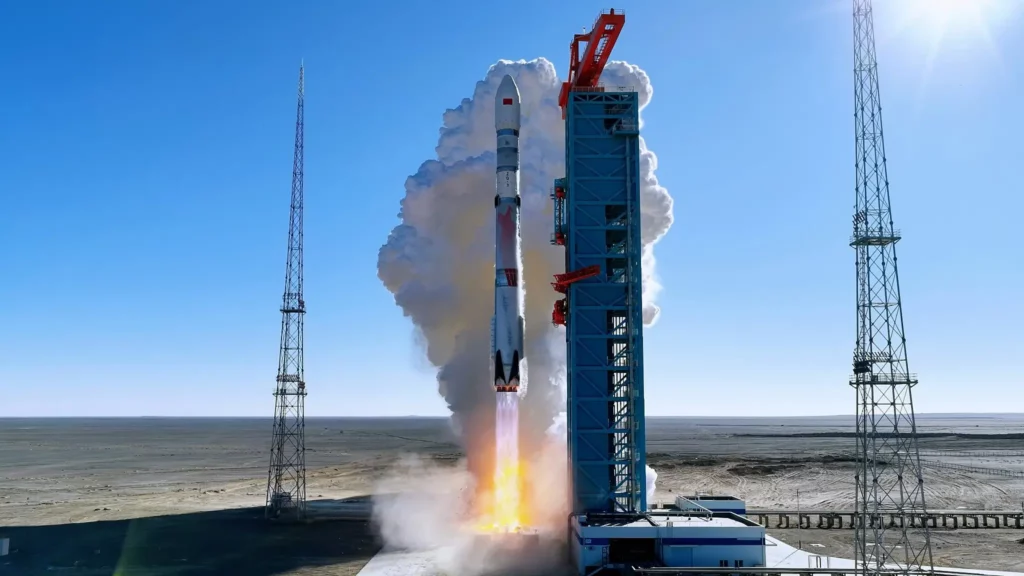
The inaugural flight of the Zhuque-3 rocket ended in a fire during the attempt to recover the first stage. Nevertheless, this launch marks a key milestone in the development of China’s private space industry capabilities.
First Flight Of The Zhuque-3 Launcher: Successful Orbital Deployment And Controlled Return Testing
On December 3, 2025, the Chinese company LandSpace conducted the first launch of its Zhuque-3 rocket. This heavy launcher aimed to place a payload in low orbit and test the controlled return of the first stage after separation. The company sought to achieve a technical standard comparable to that of SpaceX.
LandSpace confirmed the correct orbital placement of the payload. This partial success validated several critical elements, such as the operation of the liquid methane engine, the inertial guidance systems, the programmed flight profile, and the orbital separation sequence. The flight provided actionable data for future program phases.
The attempt to recover the first stage ended in failure, as the stage was destroyed by a fire during landing. LandSpace reported no casualties. The company confirmed that data had been recorded for later analysis, although it did not disclose the specific causes of the failure.
Data Collection And Technical Insights Despite Landing Failure
The failed landing aligns with the scenarios anticipated during the early phases of developing a reusable system. Such tests are designed to analyze terminal phase behavior, measure thrust vector control performance, and evaluate dynamic stability of the module.
Engineers will utilize the data collected during the flight and the return attempt to identify failures and adjust the system. This iterative progression approach is common in similar technology testing campaigns.
Accelerated Design: Two Years From Project Presentation To Launch
LandSpace publicly unveiled the Zhuque-3 at the end of 2023. Less than two years later, the company conducted its launch. This pace demonstrates the applied rapid engineering capability and reflects the momentum characteristic of China’s private space sector players.
The rocket utilizes liquid methane and liquid oxygen propulsion. This technical choice aligns with emerging industry standards, suited for reusability and improved environmental compatibility. The development involved multidisciplinary skills in space engineering.
LandSpace aims to accelerate the operational deployment of its launcher. The company plans to launch commercial missions and experiment with other recovery solutions as part of a strategy for enhanced orbital autonomy.
Controlled Image Release Of The Flight And Strategic Positioning Of The Company
LandSpace released several images and videos of the launch, including drone and onboard camera footage. These materials showcase the initial propulsion phases, including ascent and stage separation. The company did not publish any footage regarding the landing.
This communication aims to highlight the technical achievements obtained while managing the public image of the program. This approach aligns with established practices among private aerospace operators.