

Android 17 could finally integrate a native app lock — a long-awaited feature
Everyone stores sensitive data on their smartphones, and sometimes this data resides in apps that we would prefer to protect with an additional layer of security. Despite the existence of Private Space, Android still does not provide a straightforward solution for individually locking apps.
However, this may finally change with Android 17.
A Native App Lock is Coming to Android 17
According to Android Authority, the latest version of Android Canary contains traces of a new API called App Lock. This feature would be integrated directly into the system, meaning:
- no need to use a solution provided by a manufacturer,
- no need to install a third-party app,
- compatible with all default launchers, potentially available on all Android smartphones, not just Pixels.
In short: Google would finally add a real app lock accessible to everyone.
Why is This Important?
Because Google is… arriving late to the party. There is often confusion, as many users believe that Android already has an app lock. And it’s true… but only on certain manufacturers, like OnePlus, Xiaomi, OPPO, and Vivo.
These brands had already integrated their own solutions long ago.
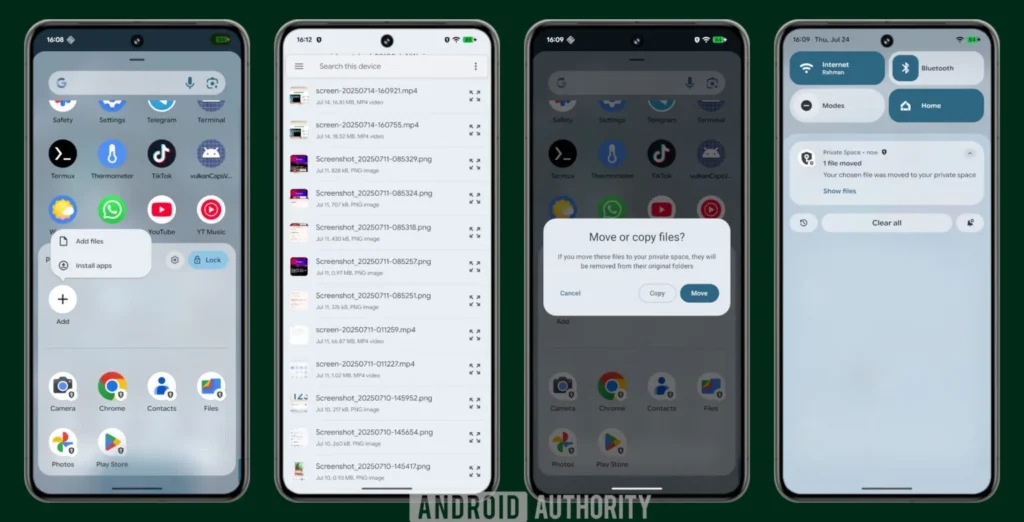
On Google’s side, the only alternative was Private Space, a kind of secure area completely isolated from the rest of the system, based on a separate user profile. It’s powerful, but too complex for a simple lock, impractical for everyday use, and apps cannot appear normally on the home screen.
In short: it’s not at all equivalent to a simple App Lock.
The App Lock: Simple, Effective, and Finally Universal
A native app lock would work as follows:
- any app can be locked
- the user must authenticate via: fingerprint, facial recognition, code, or pattern,
- apps remain visible in the launcher, notifications remain possible (depending on settings),
- nothing is isolated from the system like in Private Space.
This is exactly the functionality already offered by:
- Apple, with iOS 18 (one of the first major players to integrate it),
- some Android OEMs,
- Google Photos, which already has a locked folder.
An Obvious Gap That Should Have Been Filled Sooner
Many observers believe this, and I agree: app locking is a surprisingly absent feature from “stock” Android. It offers the perfect balance between security (protecting a few sensitive apps), simplicity (no dual spaces, no app duplication), and usability (quick access, smooth authentication).
With the arrival of iOS 18, Secure Folder on Samsung, Hider on Motorola, and App Lock on several Chinese competitors, Google has become… one of the last not to offer this fundamental function.
Do you use an app lock?
Most surveys show that users want one, but they dislike third-party apps (often intrusive or unreliable), find Private Space too cumbersome, and just want to lock Messages, Photos, Banking, Notes, etc.
Android 17 could finally fill this gap.



