

Cloudera Eliminates Data Transfer “Tax” to Connect Hybrid Lakehouses with ServiceNow Workflows
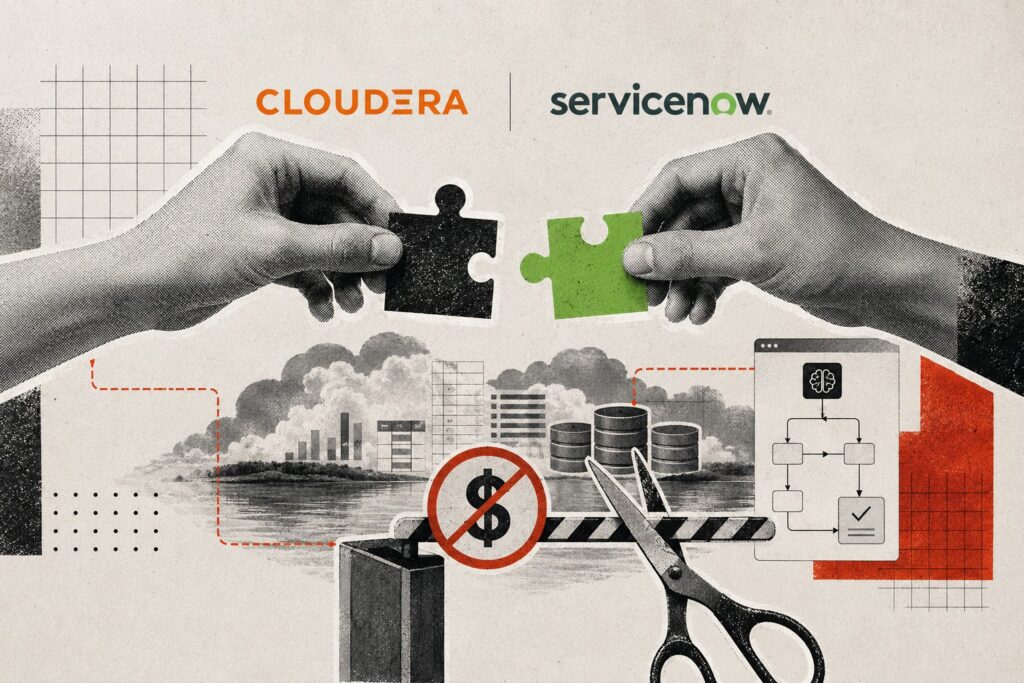
Cloudera has unveiled a groundbreaking addition to its suite of tools: the Workflow Data Fabric Zero Copy connector for ServiceNow. This integration connects Cloudera’s hybrid lakehouses to ServiceNow’s intelligent AI workflows, enabling organizations to execute AI-driven actions on enterprise data without the need for duplication.
This announcement comes hot on the heels of ServiceNow Knowledge 2026, where a flurry of partnerships highlighted the orchestration of enterprise AI agents, notably the collaboration between Tanium and ServiceNow, which automates incident remediation without human intervention. It follows a series of strategic moves in the AI data layer, including SAP’s acquisition of Dremio earlier in May and ongoing developments in lakehouse architectures at Snowflake and Databricks.
Eliminating the Data Transfer “Tax”
Cloudera’s strategy is founded on a widely recognized challenge within IT departments: nearly 80% of organizations report being hindered in their AI initiatives due to incomplete access to data. Fragmented environments, complex governance issues, and the costs associated with data replication pipelines create a persistent bottleneck between AI ambitions and the data resources needed to support them.
The Workflow Data Fabric Zero Copy connector works by flipping the conventional data migration model. Rather than duplicating information, ServiceNow workflows access data directly from Cloudera’s hybrid lakehouse where it resides. This innovative approach bypasses traditional transfer pipelines, eliminates redundant storage, and maintains the access controls tied to the original data. Sensitive information, including Personally Identifiable Information (PII), Protected Health Information (PHI), and Payment Card Information (PCI), remains securely governed within the hybrid environments they originate from, ensuring compliance with applicable regulations.
From a technical and financial perspective, Cloudera’s argument is compelling. Duplicating data between an analytical platform and a workflow platform incurs double costs in terms of storage, replication, and data consistency. By removing this duplication, organizations can achieve immediate cost savings, while also reducing the risk of discrepancies between the source data and its duplicate.
Ensuring Traceability for Production AI Agents
Another critical point raised by Cloudera is the necessity of justifying decisions made by AI agents. The provider specifically targets Chief Information Security Officers, Chief Data Officers, and Chief AI Officers—roles responsible for risk, security, and compliance as AI transitions from pilot stages to full-scale operational deployment.
Leo Brunnick, Chief Product Officer at Cloudera, stated, “Organizations cannot deploy autonomous AI at scale without the ability to justify the decisions made.” He emphasized that without traceability, organizations cannot safely deploy AI agents or meet regulatory requirements.
The regulatory justification is supported by three key pieces of legislation mentioned by the company: the European AI Act, the DORA regulation for financial institutions, and the HIPAA law for healthcare data. The rationale is straightforward: an AI agent that makes a decision without traceability to the source data fails to produce the required audit trail mandated by these regulations. By keeping the data at its source and tracing each query, the Zero Copy architecture provides essential controls to help organizations remain compliant.
ServiceNow Solidifies Its Role as an Agent Orchestration Hub
For ServiceNow, the partnership with Cloudera enriches its growing AI ecosystem, which has been developing since the fall of 2025 when Cloudera joined the fold. This broader strategy positions ServiceNow AI as an orchestration layer capable of mobilizing data and actions from third-party partners without imposing a proprietary storage format.
“Cloudera plays a crucial role in breaking down silos by centralizing and governing enterprise data where it is already structured, processed, and deemed reliable,” explained Pramod Mahadevan, VP of Data & Analytics Product Ecosystem at ServiceNow. “High-quality insights enable us to orchestrate intelligent automations and workflows for closed-loop remediation.”
This strategic alignment aligns with other announcements from Knowledge 2026. A few days prior, Tanium launched the ITOM AI Prime solution in collaboration with ServiceNow, based on the same principle of enhancing workflows with real-time data from endpoints rather than relying on rapidly outdated CMDBs. ServiceNow is moving away from its role as a primary data store, assuming the vital position of conductor that aggregates sources of truth maintained elsewhere.
Competition in Data Architectures for Autonomous AI
Cloudera’s announcement comes amid a flurry of competing moves that are reshaping the data publisher landscape. On May 4, 2026, SAP announced its acquisition of Dremio, an open lakehouse platform based on Apache Iceberg, aimed at making SAP Business Data Cloud inherently Iceberg-compatible and merging both SAP and non-SAP data without the need for ETL pipelines. Snowflake and Databricks are also continuing to consolidate around open table formats. Cloudera, which has championed a hybrid lakehouse architecture focused on on-premises and multi-cloud deployments, is banking on Zero Copy federation to maintain its position in this evolving landscape.
The division amongst these players is now marked by their capacity to manage data access for autonomous agents operating in production, rather than merely their storage capabilities. Zero-copy federation, a principle shared by both Dremio and Cloudera’s connector, becomes a strategic technical selling point against approaches still reliant on prior ingestion. For IT departments, the pressing challenge is not just the choice of orchestration platform, but also ensuring that governance contracts are coherent between the agent layer and the data layer.
Cloudera’s claims will need to be validated across three key areas in initial deployments: the latency of federated queries in environments where agents require rapid response times, the actual granularity of access controls when a ServiceNow workflow replaces a human user, and end-to-end traceability when an agent makes multiple calls to distinct sources. Feedback from early European clients, anticipated in the coming quarters, will reveal whether the zero-copy approach fulfills its promise beyond the architectural pitch.



