

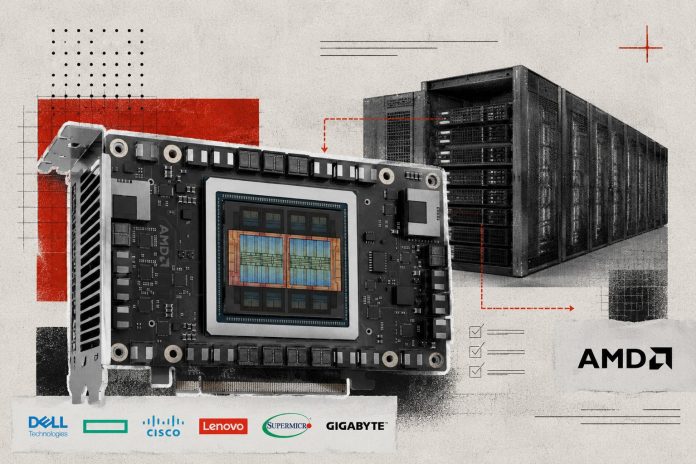
AMD has launched the MI350P PCIe, a standard-sized GPU accelerator designed to integrate seamlessly into existing servers. The company boasts impressive specs: 144 GB of HBM3E memory with a bandwidth of 4 TB/s, estimated performance of 2,299 TFLOPS, and peak capabilities reaching up to 4,600 TFLOPS in MXFP4 precision, all within an air-cooled, dual-slot format. Major manufacturers including Dell, HPE, Cisco, Lenovo, Supermicro, and Gigabyte are now offering the new card within their server lineups.
The landscape for deploying AI computing in enterprise data centers is shifting. Until now, businesses had primarily two options for GPU acceleration aimed at inference: migrating workloads to the cloud or setting up a dedicated liquid-cooled platform capable of housing eight OAM/UBB format accelerators, which often involves significant electrical and thermal redesign challenges. AMD offers a third solution with its standard PCIe card, compatible with already deployed server chassis.
This announcement pertains to the PCIe variant of the MI350 series, with high-end versions like the MI355X and MI350X already powering UBB platforms with eight GPUs for training large-scale models and high-performance computing since 2025. The MI350P utilizes the same CDNA 4th generation architecture found in these premium variants, delivering it in a form factor accessible to conventional server fleets.
144 GB of HBM3E and Native MXFP4 Precision
The MI350P features an impressive 144 GB of HBM3E memory with a bandwidth of 4 TB/s, according to preliminary estimates shared by AMD in April 2026. The card is reported to deliver an estimated 2,299 TFLOPS and can peak at up to 4,600 TFLOPS in MXFP4 precision, which AMD claims is the highest available on an enterprise PCIe card. Native support for MXFP6 and MXFP4 precision formats provides a crucial technical advantage, allowing for a performance-to-power ratio compatible with air cooling and standard chassis power distribution.
Higher precision formats like INT8 and BF16 also benefit from hardware support for sparsity. The card is designed for inference workloads, scaling from small to large model sizes, as well as pipelines enhanced by retrieval. The dual-slot configuration allows deployment of up to eight cards within a single air-cooled server. Training large foundation models, however, remains the domain of UBB platform solutions utilizing eight GPUs and does not fall within the scope of this card.
Support from Six Server Manufacturers
Six server manufacturers have announced support for the MI350P PCIe across their platforms. Dell integrates the accelerator into its PowerEdge line, while HPE enhances its ProLiant servers with additional options. Cisco positions the card as part of a broader integration between AI computing, intelligent networking, and security. Lenovo, Supermicro, and Gigabyte also announce compatibility for the MI350P within their AI server portfolios.
“With the MI350P, we are expanding the options available for our HPE ProLiant servers, bringing enterprise-level AI performance, efficiency, and reliability to our customers,” stated Krista Satterthwaite, Senior Vice President and General Manager of Compute at HPE. Scott Patti, Vice President of the Infrastructure Solutions Group at Lenovo, noted that the collaboration aims to “help customers transition AI from experimentation to production.”
Open Software Stack with No Licensing Costs
The MI350P leverages the ROCm software ecosystem along with the AMD Enterprise AI Suite. This stack includes a Kubernetes operator for GPU lifecycle management, cloud-native inference microservices, and native support for PyTorch. AMD offers this reference stack as open-source, free of charge for its partners.
The associated software partner ecosystem outlines a comprehensive enterprise inference chain. Red Hat is integrating the card into its hybrid AI platforms, while Broadcom expands support to VMware Cloud Foundation, facilitating the use of the accelerators in existing virtualized environments without requiring a data center overhaul. Nutanix announces integration into its AI platform, covering infrastructure, Kubernetes, and hybrid operations. Akamai, Kamiwaza, Seekr, and Uniphore round out the ecosystem with distribution, orchestration, and business applications capabilities.
Relocalized Inference and No Token-Based Billing
The central selling point focuses on controlling operational costs. AMD highlights the ability to deploy inference workloads without token-based billing or licensing fees on the software stack. The card’s compatibility with existing infrastructure eliminates the need for investment in a complete redesign of cooling and electrical distribution systems within the data center.
The performance figures currently presented are preliminary estimates based on engineering projections or early measurements taken by AMD in April 2026. The transition to air-cooled PCIe inference reduces both the hardware and software entry barriers, without necessitating a rewrite of existing workloads.



