

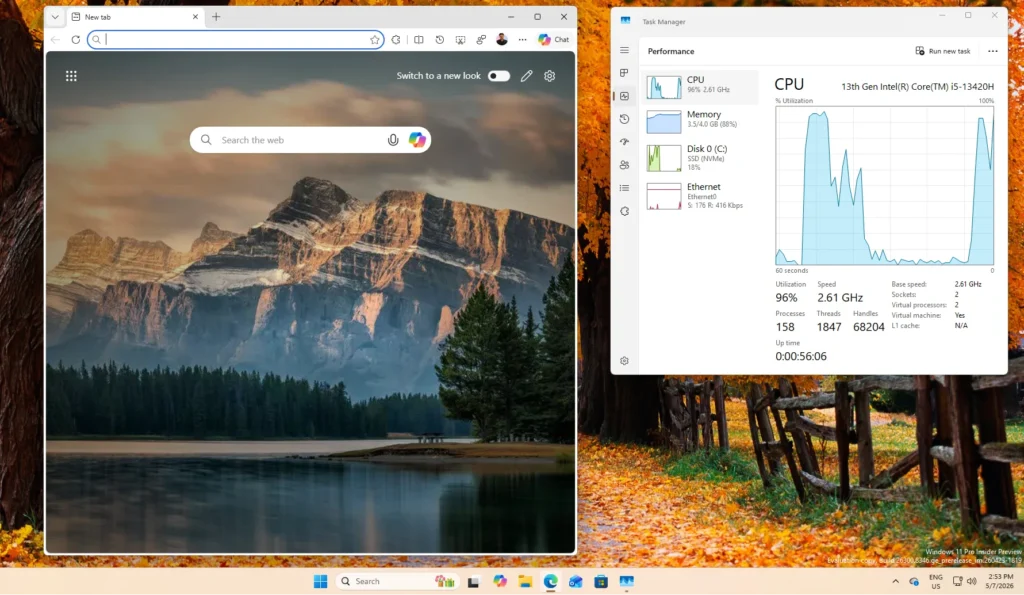
Windows 11: Microsoft is preparing a Low Latency Profile mode to make the system more responsive
Windows 11 can run on very powerful machines yet sometimes feels sluggish. A Start menu that opens with a slight delay, a right-click not as instantaneous as expected, and a File Explorer lacking responsiveness: these micro-latencies can significantly affect the overall experience.
Microsoft appears to be aware of this. Following several recent optimizations, the company is now testing a feature called Low Latency Profile, designed to make Windows 11 run smoother on a daily basis.
A brief CPU boost for important actions
The idea is straightforward: when Windows detects a priority action, the system would briefly push the processor to its maximum frequency.
This could apply to actions like opening an application, launching the Start menu, displaying a system panel, opening quick settings, or using the context menu. The boost would last just one to three seconds but would be enough to reduce the perception of delay.
According to tests reported by Windows Central, certain built-in applications like Microsoft Edge and Outlook could launch up to 40% faster. Interactions with the Start menu and context menus could improve by as much as 70%.
TESTED: Windows 11’s upcoming “Low Latency Profile” mode brings genuine performance improvements to the OS, speeding up flyout and app launches significantly.
We’ve benchmarked opening some apps on video with the Low Latency Profile enabled and disabled, and you can see… pic.twitter.com/BCNtsXmx31
— Windows Central (@WindowsCentral) May 8, 2026
Battery and overheating: points to monitor
The main concern is, of course, the energy impact. Raising the CPU to its maximum frequency might seem risky for a laptop, especially in terms of battery life and heat. However, the effect should remain limited, as the acceleration would only activate in very short bursts.
Microsoft is still working on adjusting the duration of the boost and the situations in which it activates.
It remains unclear whether users will be able to manually enable or disable this mode once it becomes available.
A subtle but crucial update
The Low Latency Profile will likely not be a show-stopping feature presented at a keynote, but it’s precisely the type of enhancement that Windows 11 needs. After all, perceived performance depends not only on benchmarks but also on the simplest actions: opening a window, launching a search, displaying a menu.
If Microsoft can make these actions more immediate without sacrificing battery life, Windows 11 could finally gain the smoothness it currently lacks compared to macOS.



