

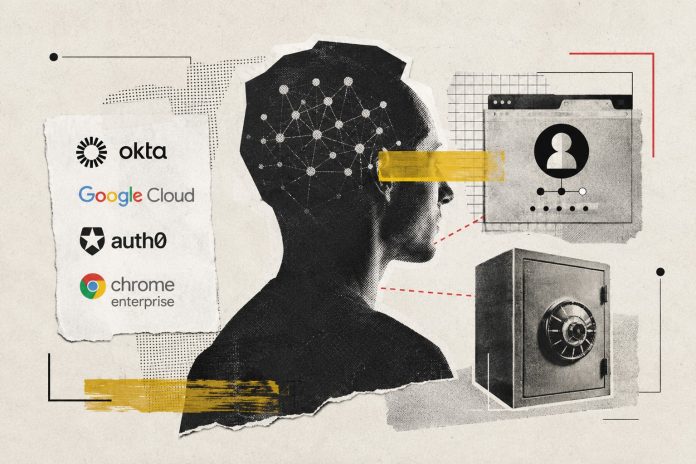
Okta and Google Cloud are extending their identity security and governance mechanisms to AI agents, previously reserved for human users. The integrations encompass the Gemini Enterprise Agent Platform, Chrome Enterprise, and Auth0’s token vault, with some features available immediately and others slated for release in the coming months.
Okta and Google Cloud have introduced a range of integrations connecting AI agents to the enterprise identity layer. By linking Google’s productivity suite and agent platforms to Okta’s access controls, every agent deployed in production can be authenticated, authorized, and tracked just like a human user. This partnership addresses a gap that organizations are facing as they scale these technologies. IT departments are challenged with governing tens of thousands of autonomous agents with the same rigor applied to employee accounts, particularly as workplace security increasingly shifts to browser-based environments.
According to a study released by Okta, 92% of surveyed executives report that AI agents are currently utilized to a moderate or extensive degree within their organizations; however, only 34% apply the same security and governance requirements to AI agents as they do to human users. This disparity sets the stage for their partnership. The governance of AI agents is now crucial for transitioning from pilot projects to full-scale deployment, and this is where the new integrations aim to provide support.
Verified Identity for Every Agent
The first component focuses on the identity of agents built on Google Cloud’s Gemini Enterprise Agent Platform. Auth0 for AI Agents, available now, provides a no-code identity layer that developers can easily implement. Authentication ensures that only an identified user can invoke an agent, while the token vault securely stores and renews OAuth tokens, allowing the agent to connect to third-party services on behalf of the user. Two safeguards govern its actions: granular authorization limits the agent to explicit permissions, and human validation points impose a pause on sensitive actions. This validation distinguishes a supervised autonomous agent from an unsupervised one, a boundary that legal departments are closely monitoring as it shifts responsibility from the user to the agent operator.
A second measure, scheduled for release in the coming months, aims for overarching visibility. When a company deploys thousands of agents, the absence of an inventory creates blind spots regarding identities, while scattered policies can lead to governance vulnerabilities. Okta for AI Agents and the Gemini Enterprise Agent Platform will integrate to ensure that every agent is created with a verified identity, linked to a human owner, and subjected to centralized policies. Registration in a central directory establishes traceability, while the Google Agent Gateway acts as an enforcement point, delegating real-time authentication to Okta. This setup aims to address three key questions that security leaders struggle with: where are the agents located, which resources can they access, and what actions are they permitted to perform? This architecture remains to be confirmed upon delivery, as it is not yet available.
The Browser: A New Front for Security
The third focus shifts attention to the browser, which has become the primary environment for SaaS applications and AI-integrated tools, making it a significant target for attacks. Session hijacking is among the rising techniques, with attackers exploiting session tokens that browsers retain after authentication. Okta and Chrome Enterprise aim to transform the browser into a controlled environment governed by security policies, applicable to both managed and unmanaged devices. Universal enrollment through Chrome Enterprise, accessible via the Okta Integration Network, enforces policies through managed Chrome profiles on any terminal without needing to synchronize identities with Google.
Additional features connect terminal state to access. Okta combines its security posture assessment with Chrome’s trust connector to evaluate the state of the browser and endpoint before granting application access, blocking connections if the antivirus is disabled or outdated. The Device Bound Session Credentials mechanism, an open standard co-developed by Okta and Google, cryptographically binds a session to a terminal. While multi-factor authentication secures the initial connection, this mechanism prevents the use of stolen session cookies on different devices, directly addressing the issue of session hijacking.
Evaluating Dependence for French Decision-Makers
For French CIOs and CISOs, the value of these integrations lies in the centralization of access policies on a unified layer that reduces fragmentation and restores visibility over agent fleets. Identity and access management now absorbs a new entity, the autonomous agent, without necessitating the proliferation of consoles. The benefits are tangible for organizations already engaged in deploying agents.
However, this advancement introduces a dependence that must be carefully weighed. Both Okta and Google Cloud are U.S.-based providers, thus subject to the Cloud Act, which permits U.S. authorities to request data held by these entities regardless of storage location, including within a European region. A centralized identity layer that manages authentication for all agents and access points inherently concentrates sensitive control points within these two companies. The partnership offers a coherent response to the governance challenges posed by agents, provided that organizations factor this legal exposure into their decision-making alongside the risks of vendor lock-in associated with any unified identity architecture.



